
Another Step Toward Clean Air: Uzbekistan Phases Out AI-80 Gasoline
2025-09-12 15:00:00 / News
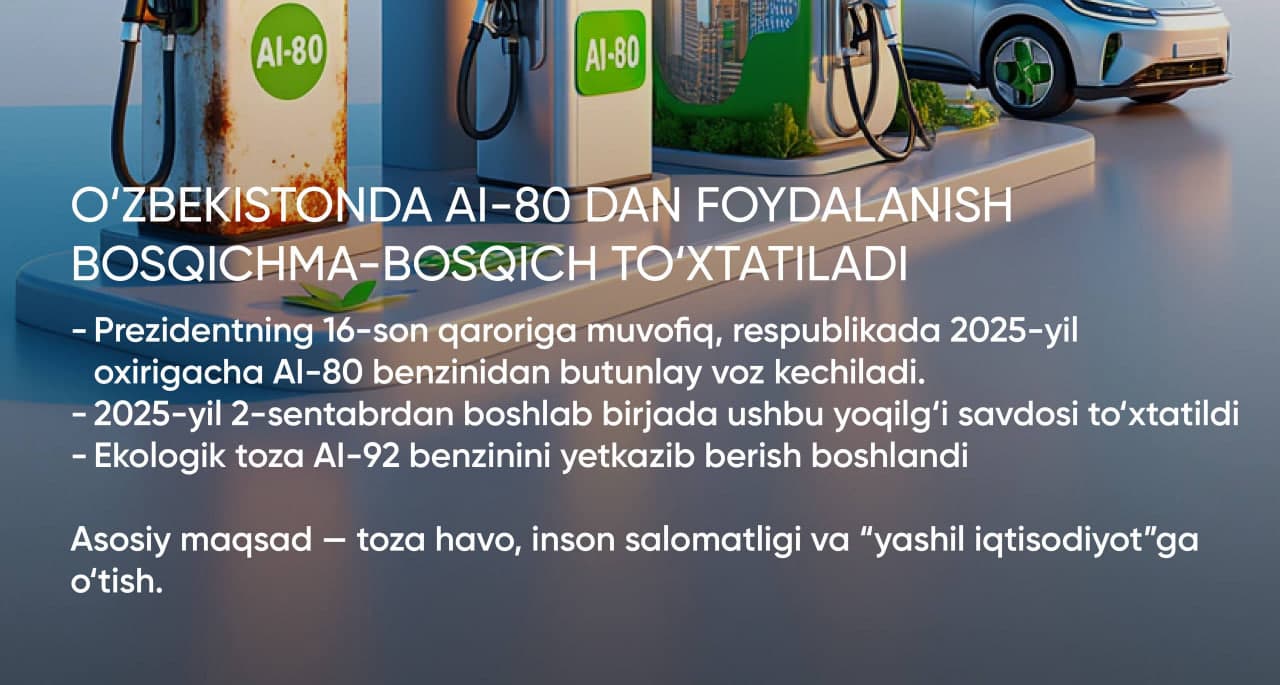


Global statistics show that 60% of harmful emissions into the atmosphere come from motor vehicles. In Uzbekistan, this is reflected in a growing number of citizen complaints about air pollution, as well as elevated concentrations of dust, harmful gases and smoke in urban areas.
According to international data, the sources of air pollution are distributed as follows:
– motor vehicles — 59%,
– industrial enterprises — 21%,
– power generation — 20%.
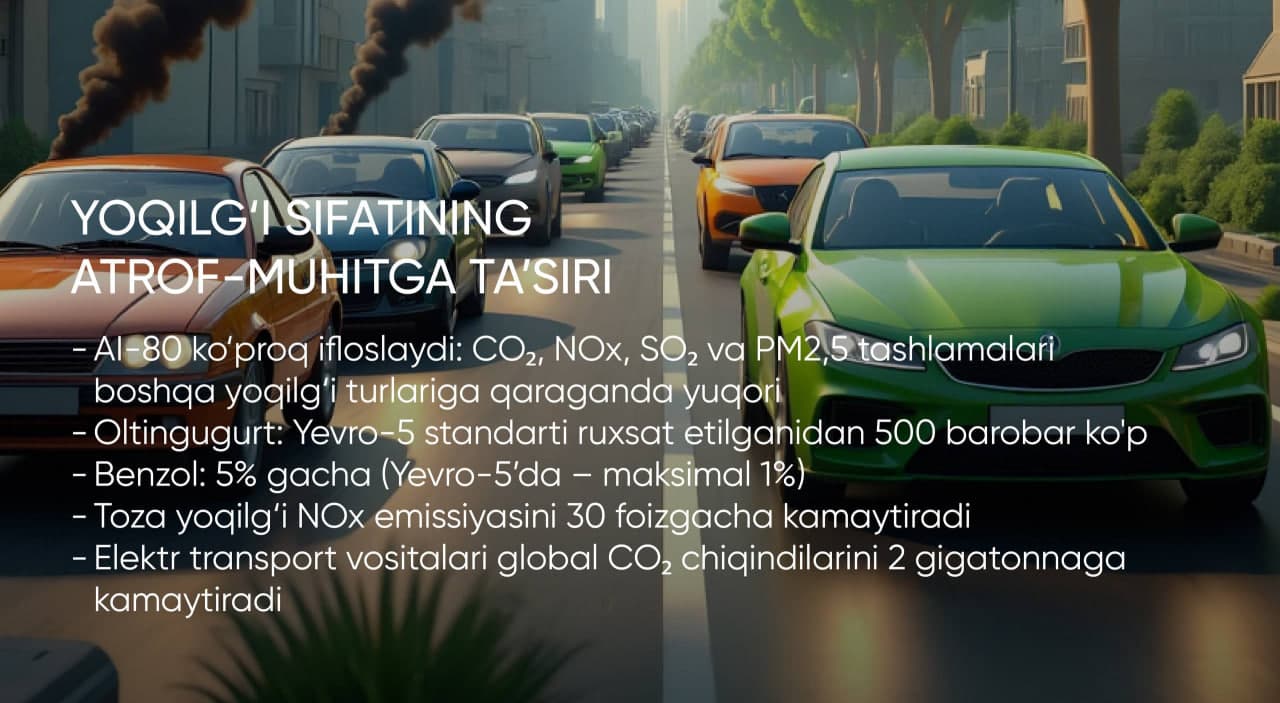
Particular concern is raised by vehicles running on low-octane AI-80 gasoline. Its use results in significantly higher emissions of carbon dioxide, nitrogen oxides, sulfur dioxide, hydrocarbons, and PM2.5 particles compared to higher-quality fuels.
The international community is taking active measures to reduce harmful emissions from transport.
– The European Union strictly regulates automotive fuel quality through “Euro” standards. Introduced in 2005, the Euro-4 standard restricted the use of low-grade fuels, including AI-80 gasoline.
– In January 2024, Ethiopia became the first country to completely ban the import of gasoline- and diesel-powered cars. This decision reduced fuel import costs and improved environmental conditions.
– Chile and the United States have announced plans to end sales of gasoline-powered cars by 2035.
– In CIS countries, the use of AI-80 has also been prohibited, with tax incentives introduced for the import of electric vehicles. The only exception remains Afghanistan, where this type of fuel is still widely used.
Research shows that reducing sulfur content in fuel can cut nitrogen oxide emissions by up to 30%. Transitioning to electric vehicles could reduce global CO₂ emissions by 2 gigatons.
A comparison of standards highlights significant differences in environmental requirements:
– AI-80 allows sulfur content up to 0.5%, whereas Euro-5 permits only 0.001% — 500 times less;
– benzene content in AI-80 may reach 5%, while Euro-5 limits it to 1%;
– Euro-5 also restricts aromatic compounds during combustion, which AI-80 does not regulate at all.
In light of increasing environmental risks, Uzbekistan is steadily moving toward phasing out low-octane fuel.
According to Presidential Decree No. 16 "State Program for the Implementation of the Strategy "Uzbekistan – 2030" in the Year of Environmental Protection and "Green" Economy", the use and sale of AI-80 gasoline will be restricted by the end of 2025. At the same time, special attention is being paid to ensuring that the population has access to high-quality, environmentally friendly and affordable fuel.
On September 2 of this year, JSC "Uzbekneftegaz" ceased offering AI-80 on commodity exchanges, while increasing the supply of AI-92 gasoline.
Thus, Uzbekistan is gradually aligning with global trends aimed at reducing harmful emissions from transport. The phase-out of AI-80 is a step toward cleaner air, safeguarding public health and building a green economy.