
Air quality in Tashkent improved in October compared to the same period last year
2026-11-05 17:25:00 / News
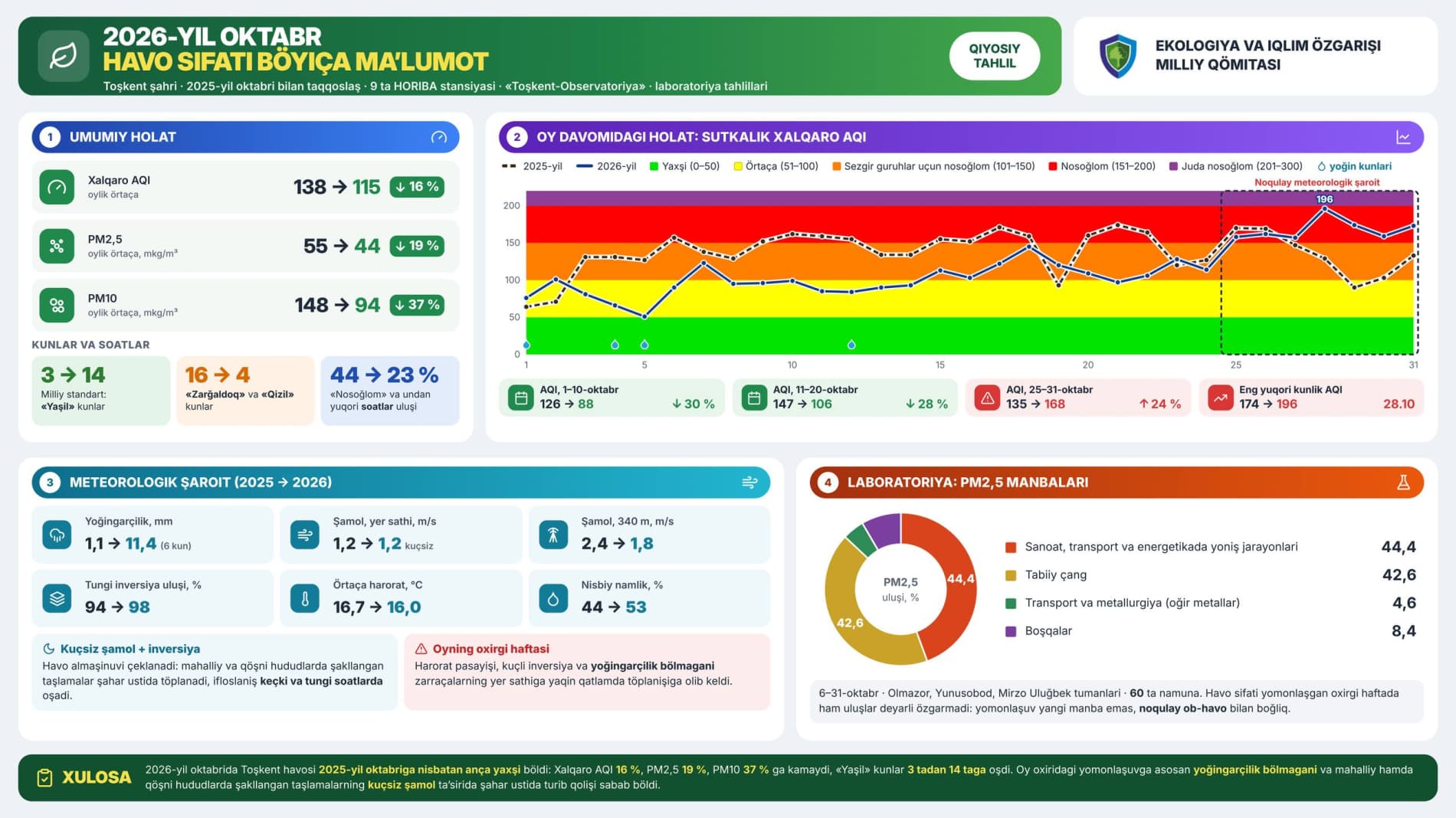
According to monitoring results, air quality in Tashkent improved in October compared to the same period last year. The monthly average Air Quality Index (AQI) decreased from 138 to 115. PM2.5 concentrations fell by 19%, while PM10 concentrations declined by 37%. At the same time, the number of days classified as having “good” air quality under national standards increased from 3 to 14, while the number of days with “orange” and “red” air quality levels decreased from 16 to 4.
However, air quality fluctuated throughout the month. While readings during the first twenty days of October were considerably better than those recorded during the corresponding period last year, air quality deteriorated between 25 and 31 October. This was largely due to falling temperatures, light winds, frequent temperature inversions and insufficient rainfall, all of which limited the dispersion of air pollutants.
Light winds and temperature inversions contributed to the accumulation of emissions from both local and neighbouring areas over Tashkent and its surrounding areas. As a result, the dispersion of particulate matter slowed, allowing these particles to remain in the near-surface layer of the atmosphere for extended periods.
Laboratory analysis of 60 samples collected throughout October to determine the composition of PM2.5 showed that, on average, 44.4% consisted of components associated with industrial activity, transport and fuel combustion in the energy sector, while 42.6% was made up of naturally occurring dust. Even on days when air quality deteriorated towards the end of the month, no significant changes in the proportions of these components were observed.
Overall, air quality in Tashkent improved by 16% in October 2026 compared to the same period last year, according to the Air Quality Index (AQI).
The short-term deterioration in air quality towards the end of the month was primarily attributable to the accumulation of emissions from the city and neighbouring areas over Tashkent, driven by light winds and unfavourable meteorological conditions.