
How Is the “3-30-300” Principle Being Implemented?
2026-10-06 10:45:00 / News
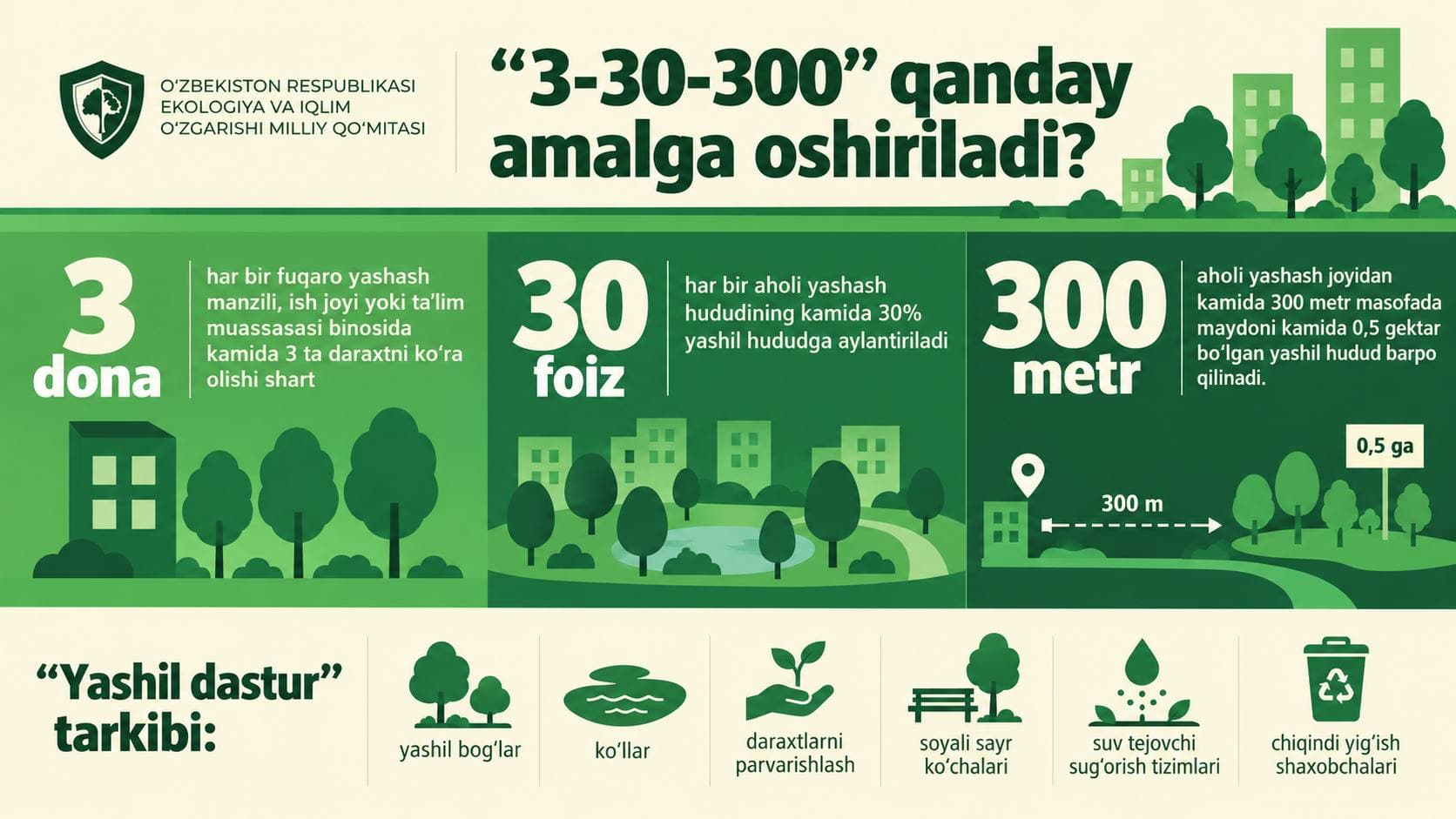
Under this approach, the number of tree seedlings planted will be increased so that every citizen can see at least 3 trees from their home, workplace, or educational institution.
In addition, at least 30 percent of the areas where people live should be transformed into green spaces. A green area of at least 0.5 hectares will also be established within 300 metres of residential areas.
As part of the green programmes, green parks, water bodies, and tree-lined pedestrian streets will also be created. Particular attention will be paid to tree maintenance, the introduction of water-efficient irrigation systems, and the establishment of waste collection points.
For reference: urban forests play an important role in climate change adaptation, improving air quality, and supporting public health and well-being. With this in mind, in February 2021, Cecil Konijnendijk, Co-Chair of the Nature Based Solutions Institute (NBSI), proposed the 3+30+300 principle for urban greening. The main objective of this approach is to make green spaces an integral part of the environments where people live, work and study.
Today, the 3+30+300 principle is applied in hundreds of cities and municipalities around the world. The approach is used, in particular, in Antwerp, Athens, Belfast, Hamburg, Munich and Washington. International organisations also recommend it as a tool for urban greening and creating healthy living environments.
The criteria developed on the basis of this principle help expand equitable access to trees and green spaces for urban residents and contribute to the creation of a resilient urban environment.