
“Yashil Makon”: Shaded Walking Streets Being Created in Mahallas
2026-09-21 10:15:00 / News
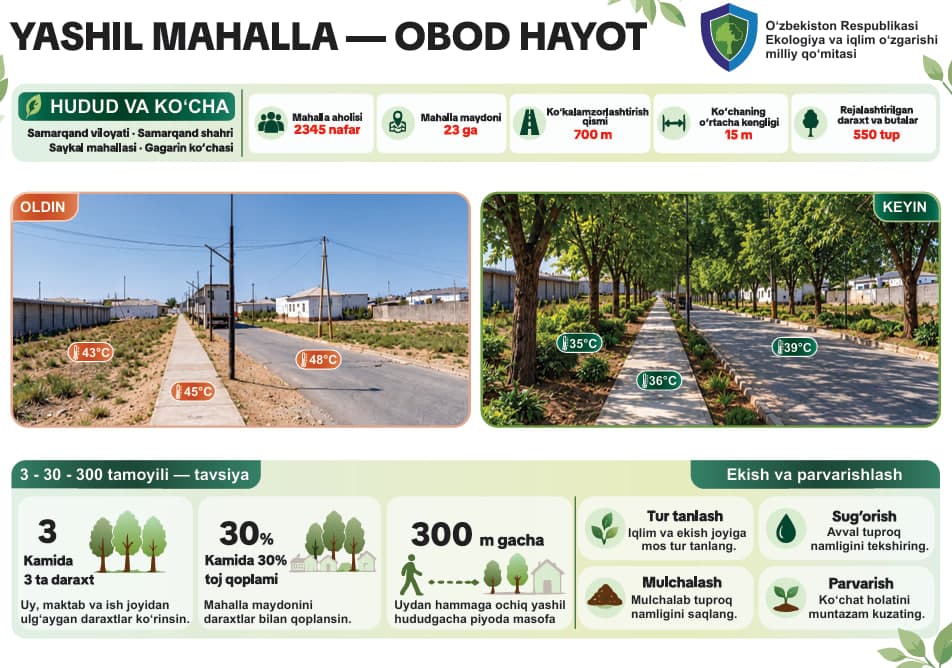
For reference: The nationwide "Yashil Makon" project has been implemented at the initiative of the President of the Republic of Uzbekistan since 2021. Under the project, at least 200 million fruit-bearing and ornamental tree and shrub seedlings have been planted annually during the spring and autumn planting seasons. In addition, pursuant to the Presidential Decree “On the State Programme for the Implementation of the Uzbekistan–2030 Strategy in the Year of Environmental Protection and the Green Economy,” the creation of a network of “Shaded Walking Streets” along the main pedestrian sidewalks across the country has been established as a priority. This initiative is expected to reduce air pollution by 5–10 percent and lower air temperatures along sidewalks by 3–5 degrees. It will also help increase physical activity among the population and create conditions conducive to a healthy lifestyle.
In "Sayqal" Mahalla, 550 tree and shrub seedlings will be planted, and a 700-metre stretch will be landscaped. As a result, cooler conditions will be provided during hot weather: ground surface temperatures are expected to decrease from +43°C to +35°C, while asphalt surface temperatures will fall from +48°C to +39°C.
It is worth noting that the 3–30–300 principle is being applied to increase green coverage across local communities. Under this principle, every person should be able to see at least three mature trees from the window of their home. This has a positive impact on psychological well-being, helping to reduce stress and improve concentration. In addition, at least 30 percent of the area of each mahalla (or district) should be covered by trees. This represents the minimum level of tree coverage considered necessary to mitigate the urban heat island effect, improve air quality and provide shade.
Furthermore, every household should be located no more than 300 metres from the nearest park, public garden or green space. This is equivalent to approximately a five-minute walk. Such proximity encourages people to engage in physical activity, spend time outdoors and interact socially. Today, the 3–30–300 principle is widely applied in the planning of many forward-looking cities around the world and in the development of environmental strategies.
The initiatives being implemented under the nationwide "Yashil Makon" project will contribute to achieving the country’s goals of increasing green coverage and mitigating the impacts of climate change more rapidly.