
Environmental Education to Be Strengthened at Green University and “Green” Technical Colleges
2026-04-02 15:30:00 / News
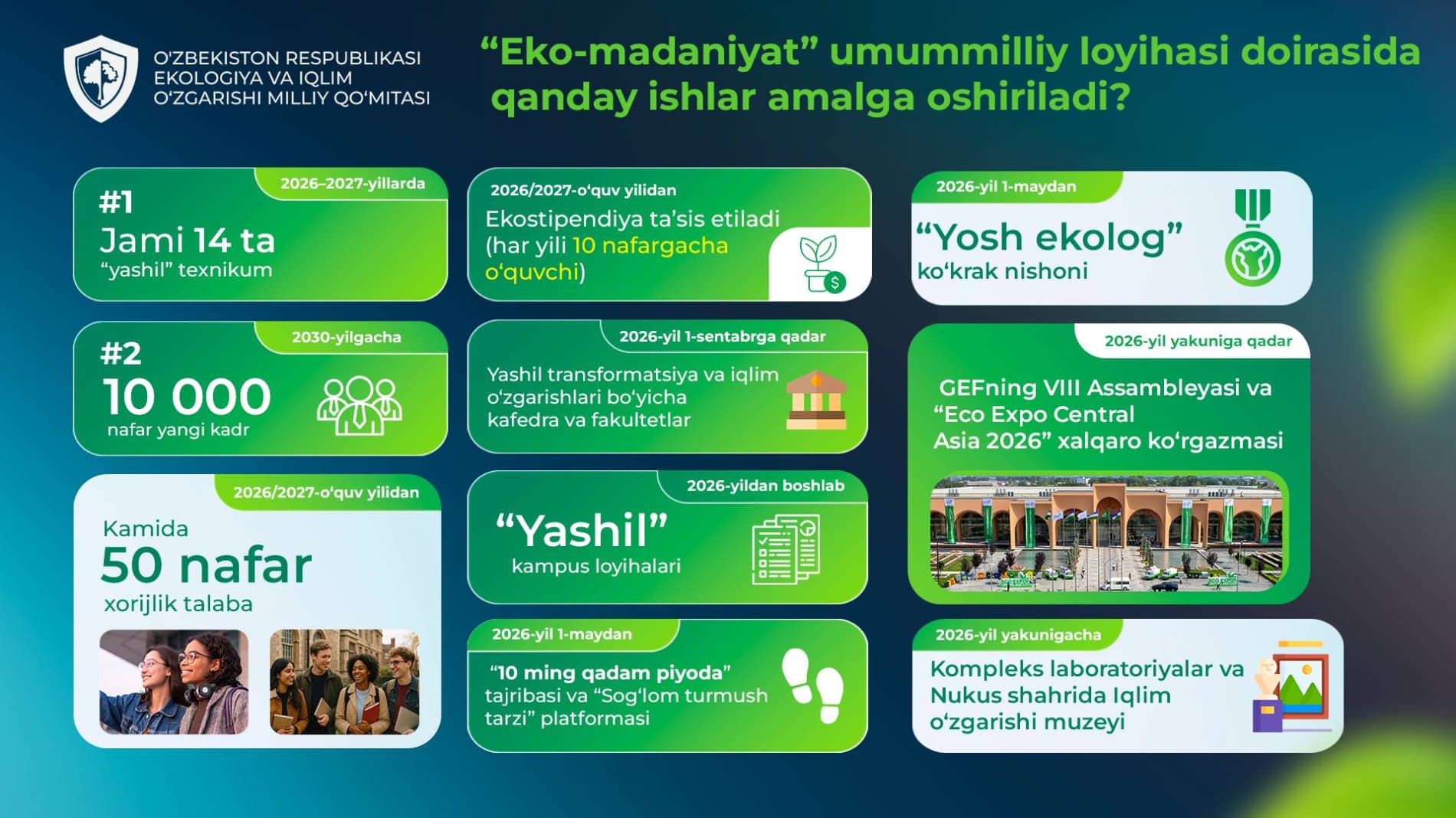
According to the document, in 2026–2027 the operation of 14 “green” technical colleges will be established across the regions of the country to train mid-level specialists. It is planned that 5,000 specialists will be trained in the 2026/2027 academic year, 7,000 in 2027/2028 and 10,000 in 2028/2029. In addition, starting from the 2026/2027 academic year, the Central Asian University of Environmental and Climate Change Studies (Green University) will enroll at least 50 students from Central Asian countries and other foreign states, with this number expected to at least double in the 2027/2028 academic year. Furthermore, between 2026 and 2028, the number of specialists obtaining academic degrees in ecology, environmental protection and climate change will be increased to 150.
In accordance with the Resolution, beginning from the 2026/2027 academic year, one technical college in each region (14 in total) will be reorganized into “green” technical colleges. These institutions will introduce training programmes for mid-level specialists tailored to the environmental, social, and economic characteristics of each region. From the same period, an “Eco-Scholarship” will be introduced in these colleges and awarded annually to up to 10 outstanding students. Practical training bases will also be established for students of Green University and the “green” technical colleges at forestry facilities, hydrometeorological stations, protected natural areas, waste management sites, botanical and dendrological gardens, zoos, as well as institutes of botany and zoology.
The Resolution also предусматривает the annual organization of competitions for innovative, applied and fundamental projects in the fields of ecology, environmental protection, and climate change. By September 1, 2026, departments and faculties on green transformation and climate change will be established at higher education institutions based on the Science Oasis principle and from 2026, the development of “green campus” projects will commence.
In addition, from 2026, five universities included in the international UI GreenMetric ranking will receive partial compensation of their expenses based on annual performance results. Starting from May 1, 2026, the “10,000 Steps” initiative will be reinstated, and the “Healthy Lifestyle” platform will be launched.
According to the Resolution, effective from March 1, 2026, the “Young Ecologist” badge will be introduced to recognize young people demonstrating initiative in environmental protection, as well as outstanding school students. The badge will be awarded in the following categories:
– Grade III — for school students;
– Grade II — for vocational and higher education students;
– Grade I — for young individuals achieving high results at national and international levels.
Furthermore, the document provides for the high-level organization in Samarkand of the Eighth Assembly of the Global Environment Facility (GEF) and the 71st Meeting of the GEF Council, as well as the international exhibition Eco Expo Central Asia 2026 aimed at promoting nature-based solutions.
In addition, by the end of 2026, the establishment of comprehensive laboratories at Green University is предусмотрено, enabling the analysis of water and soil quality, as well as the launch of a Climate Change Museum in Nukus. The museum will feature permanent exhibitions dedicated to innovative, cultural, and environmental education technologies, as well as to climate change research, ecosystems and innovative solutions for their restoration.
Furthermore, a Central Asian Climate Forum will be held annually in August. The Resolution is aimed at fostering environmental culture among the population, modernizing all levels of the education system in line with international standards and environmental requirements and ensuring the training, retraining, and professional development of specialists with relevant knowledge and skills within the framework of the nationwide "Eco-Culture" project, based on a dual education system.