
National Geographic presents Uzbekistan as a promising destination on the new Silk Road
2026-08-18 11:50:00 / News
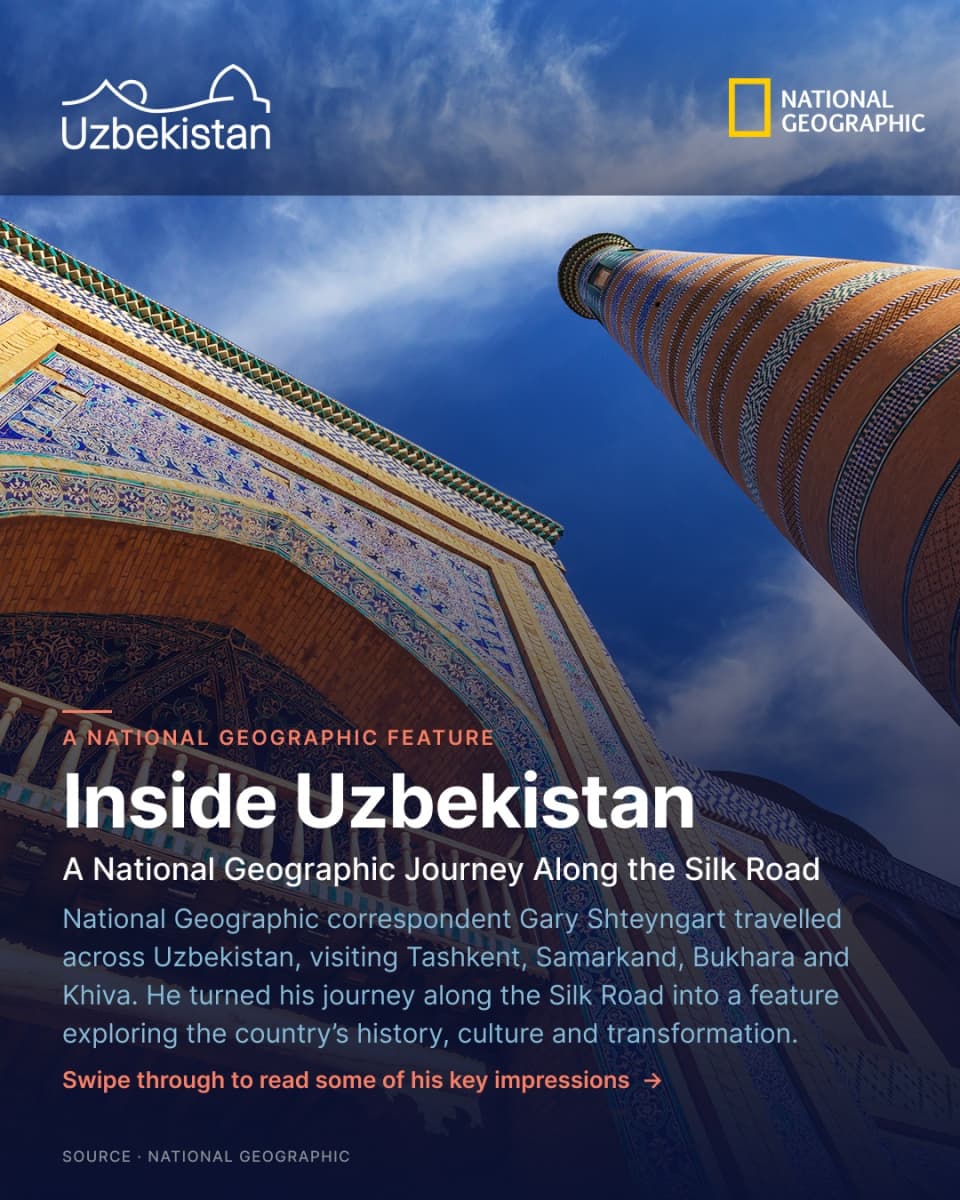
The article focuses not only on the world-famous heritage of the Silk Road, but also on how modern Uzbekistan is transforming this legacy into the foundation of a new tourism offering.
The author begins his journey in Tashkent, which serves as his introduction to modern Uzbekistan. One of the first places he visits is the famous Chorsu Bazaar, with its distinctive blue dome and numerous rows of shops.
“I chose Tashkent’s Chorsu Bazaar as my first stop, figuring that there could hardly be a place that better conveyed, and perhaps also dispelled some of the myths surrounding, the spirit of the Silk Road. Its Soviet-era pavilion stands on a site where a market has existed for some 2,000 years, and it still embodies what the Silk Road has always been about — trade.”
A significant part of the publication is devoted to Samarkand, one of Uzbekistan’s most important historical centres.
“If you have ever seen photographs of Uzbekistan, you have probably seen the magnificent blue-turquoise-and-yellow portals of the three madrasas surrounding the famous Registan Square. Their incredibly ornate gateways lead into former centres of learning that once earned Samarkand the nickname ‘the Oxford of the East,’” the author notes.
The second major historical destination on the journey is Bukhara. The author draws attention to the compactness and remarkable integrity of the city’s historic centre, noting that modern development has had less impact on the traditional urban environment.
Among the most impressive landmarks, he highlights the Ark Fortress, the historic centre of Bukhara, and Kalyan Mosque with its iconic brick minaret.
An important feature of the publication is that the author goes beyond the traditional image of Uzbekistan as a country of ancient monuments and Silk Road cities.
The article also highlights modern tourism infrastructure, hotels, transportation, gastronomy, markets, and emerging tourism formats.
The feature introduces Uzbekistan to an international audience through the personal experience of a traveller, presenting the country as a destination where rich historical heritage, ancient architecture, culture, gastronomy, and a rapidly developing tourism infrastructure come together.
At the same time, the publication goes beyond the well-known monuments of the Silk Road and highlights the transformation currently taking place in Uzbekistan’s tourism industry.
According to the author, Uzbekistan’s tourism sector is experiencing rapid growth. He cites a figure of approximately 12 million international travellers in the previous year, compared with around two million a decade earlier. The author also notes the country’s ambitious target of reaching 20 million tourists by 2030.
The National Geographic feature is particularly valuable from the perspective of Uzbekistan’s international tourism promotion, as it presents the country not merely through individual attractions, but as a comprehensive travel experience.
The author portrays Uzbekistan as a distinctive Central Asian country that has chosen a clear and recognizable brand for promoting its tourism potential.
“Every country has its own myths and images that it sells to tourists: cowboys for the United States, bullfighting for Spain, sausages for Germany. So it is only natural that a developing country such as Uzbekistan would seek to leverage its historical heritage, emblazoning ‘Silk Road’ and camel-caravan imagery on everything from passenger trains to shopping centres in an effort to attract affluent tourists.”
Publications of this kind in leading international media contribute to strengthening Uzbekistan’s international image as one of the most promising and attractive tourism destinations in Central Asia, while further increasing awareness of the country among potential travellers worldwide.