
Draft presidential decree prepared to advance adventure tourism in Uzbekistan
2026-08-04 15:25:00 / News
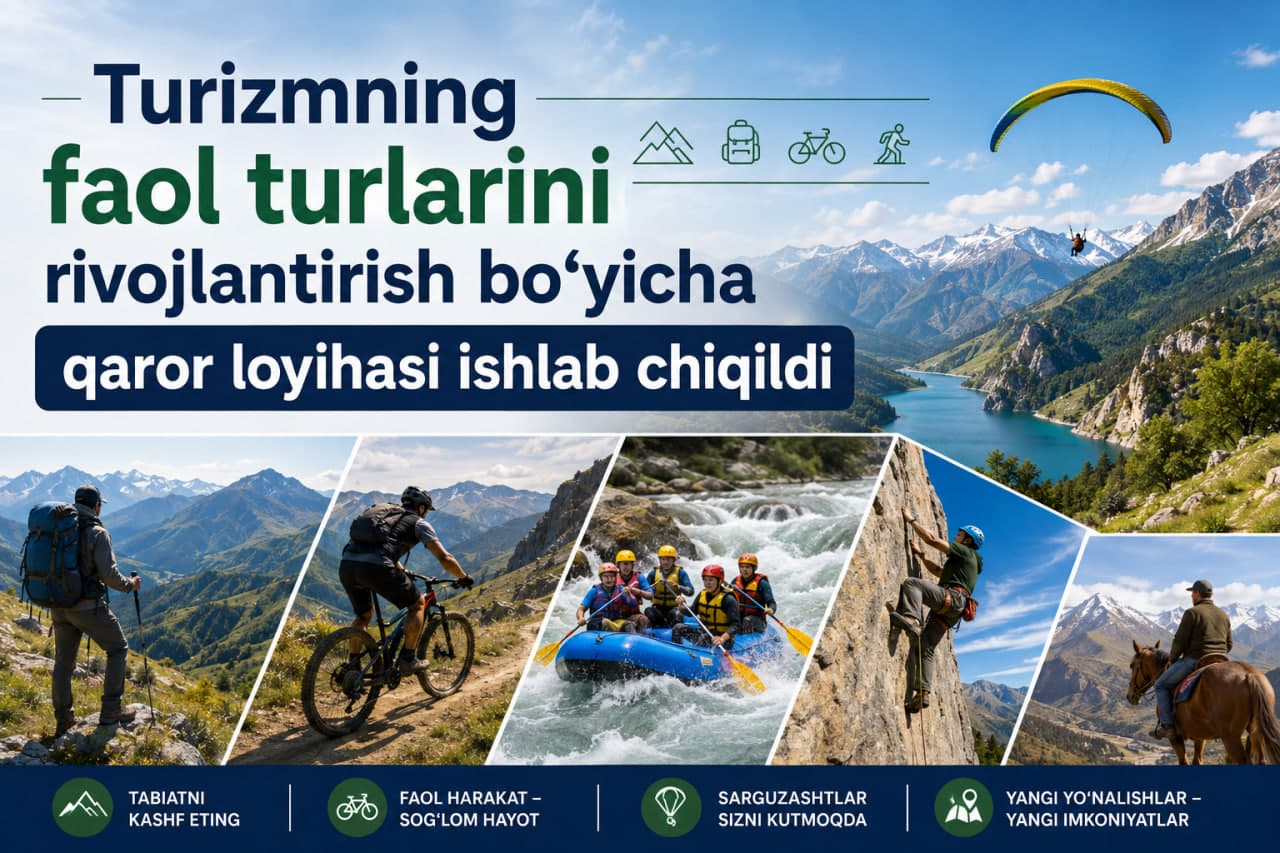
During the drafting process, the working group studied the experience of leading mountain tourism destinations, including Switzerland, Austria, France, Georgia, Kazakhstan, and Kyrgyzstan. Consultations were also held with representatives of the tourism industry, non-governmental non-profit organizations, and volunteer mountain rescue services engaged in adventure tourism.
The draft identifies six strategic priorities for the development of the sector. These include ensuring the safety and well-being of tourists; diversifying tourism products through the effective use of the country's natural and geographical assets; introducing national and international safety standards; gradually digitalising and simplifying permitting procedures; improving the training and certification of professional guides and instructors; and supporting entrepreneurs and non-profit organizations operating in the field.
As part of the initiative, an inventory of 162 natural sites with strong potential for adventure tourism has been compiled. These are located across five regions of Uzbekistan: Tashkent Region (77 sites), Surkhandarya Region (30), Samarkand Region (22), Kashkadarya Region (20), and Jizzakh Region (13). The list includes 88 mountains and mountain ranges, 21 lakes, 20 waterfalls, 18 caves and grottoes, and 15 mountain peaks, with each site classified according to its type, location, and geographical characteristics.
The draft also provides for the approval of a comprehensive “Roadmap” aimed at developing tourism infrastructure, expanding adventure tourism products, and promoting Uzbekistan as a destination for active outdoor recreation.
A unified framework for adventure tourism
Following the adoption of the decree, the Tourism Committee will prepare, within one month, a regulation establishing a unified legal framework governing the organisation and operation of adventure tourism activities in Uzbekistan.
The draft also introduces a dedicated regulatory framework for the creation and operation of extreme tourism facilities. A state registration, commissioning, and monitoring system will be introduced for such facilities. Existing regulations will also be expanded to formally include attractions such as zip lines, alpine coasters (rodelbahn), bungee jumping, rope parks, and suspension bridges.
International standards for guides and mountain instructors
The Ministry of Emergency Situations, together with the Tourism Committee and industry experts, will develop a national training programme for mountain guides and trekking instructors.
A professional certification and continuing education system will be introduced, with curricula aligned to the standards of the International Climbing and Mountaineering Federation (UIAA), the Union of International Mountain Leader Associations (UIMLA), and the International Federation of Mountain Guides Associations (IFMGA).
Specialised training centres are planned for the Republic of Karakalpakstan, as well as the Jizzakh, Kashkadarya, Namangan, Samarkand, Syrdarya, Surkhandarya, and Tashkent regions.
The draft also proposes significant simplification of access to mountainous and border areas. Within two months, the Border Troops of the State Security Service will introduce an electronic system enabling both Uzbek citizens and foreign visitors to obtain special permits through the Unified Portal of Interactive Public Services. Permits will be issued electronically within 10 days, while the Ministry of Digital Technologies will integrate this service into the Unified National Tourism Platform.
General aviation to become a new driver of adventure tourism
The draft places particular emphasis on the development of general aviation as a promising segment of adventure tourism.
The Civil Aviation Agency under the Ministry of Transport is proposed as the national regulatory authority for this sector and will be granted six additional functions, including aircraft registration and certification, technical oversight, specialist training, and flight safety supervision.
The Agency will develop aviation regulations governing aircraft with a maximum take-off weight of up to 5,700 kilograms (or 2,250 kilograms for helicopters) certified in accordance with the standards of the International Civil Aviation Organization (ICAO).
In addition, the Ministry of Transport will prepare, within three months, simplified and transparent procedures for the registration, certification, and technical inspection of general aviation aircraft. Within six months, a draft law introducing mandatory third-party liability insurance based on the principles of the ICAO Rome Convention is also expected to be developed.
The Roadmap further provides for amendments to national airspace regulations through the introduction of U-space, G-space, and W-space airspace categories; exemption from mandatory registration for aircraft weighing up to 115 kilograms, in line with international ICAO practice; the creation of a new "Recreational Aviation" category for light aircraft; the establishment of a unified digital "General Aviation" platform; and the launch of a Cadet Program to train future pilots.
The draft also envisages restoring disused regional airstrips for tourism purposes. Following rehabilitation, these facilities will be leased to private investors and project developers. Buildings and infrastructure will likewise be made available to entrepreneurs and non-profit organisations for the establishment of adventure tourism training centres.
Stronger support for businesses and tourism infrastructure
To encourage private investment, the draft proposes exempting imports of vehicles, equipment, and specialised gear used in adventure tourism from customs duties between 1 January 2027 and 1 January 2030.
The proposed exemption covers approximately 40 categories of equipment, including ATVs, UTVs, SSVs, buggies, off-road vehicles, motorhomes, jet skis, parachutes, paragliders, hang gliders, aeronautical equipment, mountaineering gear, water sports equipment, portable radio systems, and other specialised equipment.
This measure is expected to reduce operating costs for businesses while significantly expanding the range of tourism services available.
Beginning in 2027, projects to develop road infrastructure, engineering networks, and other essential facilities at selected adventure tourism sites will gradually be incorporated into state development programmes. Financing will be provided through the state budget, international grants, private investment, and other sources permitted by law.
To improve visitor safety, special traffic regulations will be introduced for buses and minibuses operating in mountainous areas, including the Charvak, Zaamin, and Kamchik Pass routes. In cooperation with the Insurance Market Development Agency, proposals will also be developed to introduce an insurance system for adventure tourism services based on international best practices.
The measures envisaged by the draft are expected to stimulate the growth of adventure and extreme tourism in Uzbekistan, create new tourism products, unlock the tourism potential of the country's regions, generate new employment opportunities, and significantly improve visitor safety in line with international standards.
The draft document has been published for public consultation. Comments, proposals, and recommendations may be submitted via the link provided.