Press Conference on the Results of the Ministry of Employment and Poverty Reduction for 2025 and Plans for 2026
2026-03-11 14:55:00 / Press-releases
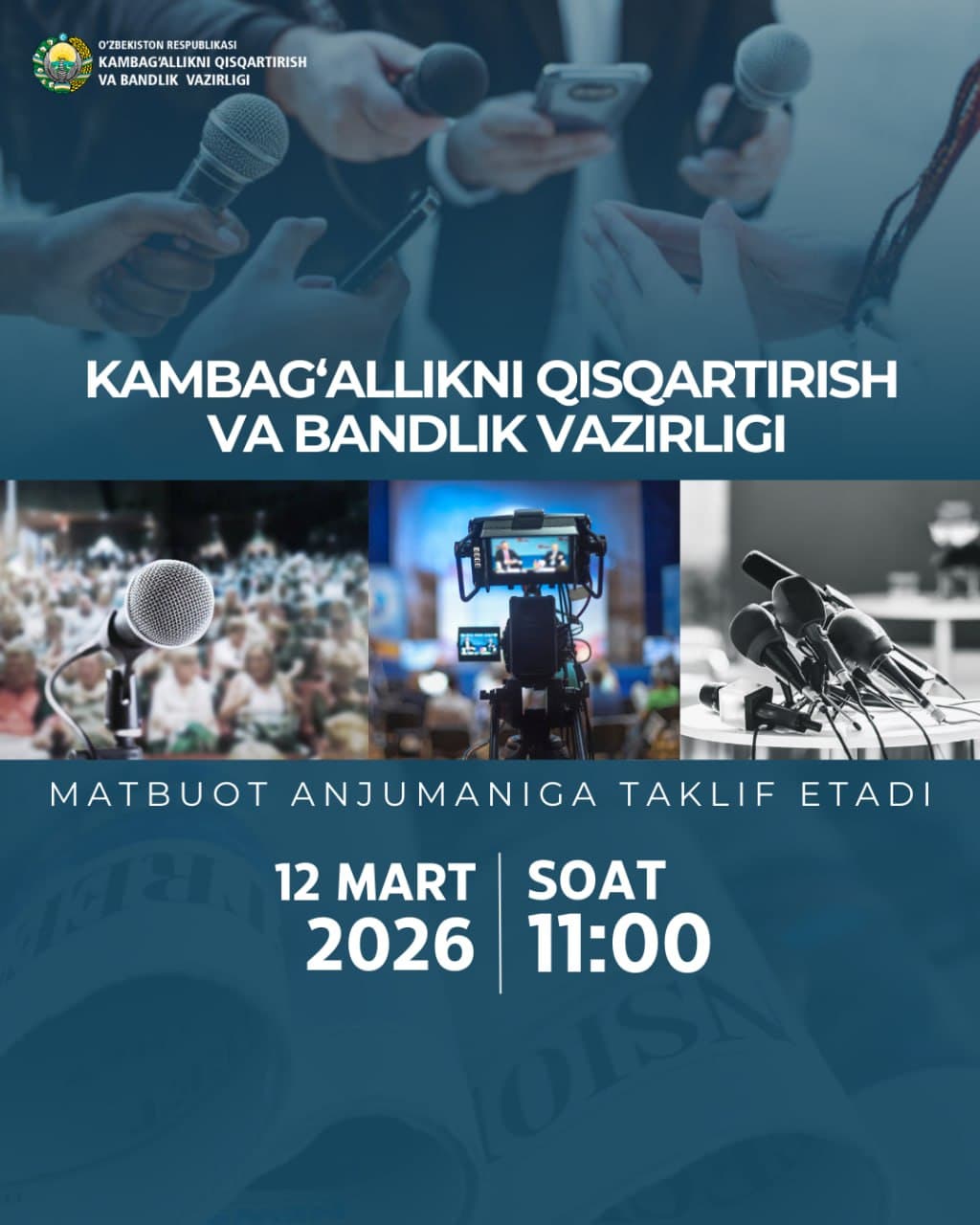
In order to widely promote information on the work being carried out in the country to reduce poverty, ensure employment, and increase the income of the population, a press conference will be held on 12 March 2026 at the Media Content Preparation Center on the topic: “Results of the Ministry of Employment and Poverty Reduction for 2025 and Plans for 2026.”
In 2025, employment was ensured for 5.4 million people in Uzbekistan, and measures were taken to increase the income of 2.3 million low-income families.
Reducing poverty, increasing household incomes, and creating new job opportunities remain key priorities of state policy. In 2025, as a result of comprehensive measures implemented based on Presidential decrees and resolutions, significant progress was achieved in employment, entrepreneurship support, and the economic activation of mahallas.
“From Poverty to Prosperity” Programme
Within the framework of the “From Poverty to Prosperity” programme, implemented in accordance with Presidential Decree No. PP–330 dated 23 September 2024, the capacities and needs of 761,000 families (3.2 million people) were assessed in 2025, and individual development plans were prepared for them.
Based on these plans, 523,000 low-income families (2.3 million people) were covered by income-increasing measures, including:
-
369,000 citizens employed;
-
528,000 involved in entrepreneurship activities;
-
54,000 trained in vocational skills.
To support entrepreneurial initiatives of low-income families, 2.2 trillion UZS in loans and 265 billion UZS in financial assistance were allocated.
In addition, about 410,000 micro-projects were implemented at the initiative of Hokim assistants in mahallas, increasing the income of 840,000 people.
Development of Mahalla Infrastructure
In 2025, irrigation infrastructure was developed in 864 “high-need” mahallas, providing 467,000 households with access to water for the first time.
Within this framework:
-
2,000 km of irrigation networks were concreted;
-
174 km of channels were constructed;
-
14 water facilities were commissioned;
-
448 pumping units were installed;
-
862 wells were drilled;
-
371 km of pressurized pipelines were laid.
In addition, electricity supply was improved in 959 mahallas, with the installation of 1,745 transformers, 129,000 power poles, and 4,533 km of electrical networks.
Pilot Projects
In 2025, pilot projects were implemented in 32 directions, resulting in increased incomes for 200,000 families.
In particular:
-
484 cooperatives were established, involving 16,000 families;
-
21,000 hectares of forest fund land were leased to 8,667 families;
-
service sectors were developed in 52 tourism mahallas;
-
40,000 young people were trained in e-commerce.
Employment
In 2025, 5.4 million people were provided with income-generating employment, including:
-
1.3 million in permanent jobs;
-
2.1 million engaged in entrepreneurship.
Key Objectives for 2026
-
reduce poverty rate from 5.8% to 2.8%;
-
ensure permanent employment for 1 million people;
-
increase the income of 4 million citizens;
-
transform 3,500 mahallas into poverty- and unemployment-free areas;
-
implement new economic projects worth 165 trillion UZS.