
INDUSTRIAL SAFETY ACROSS UTILITY-SCALE WIND POWER PLANTS
2026-09-28 19:00:00 / News
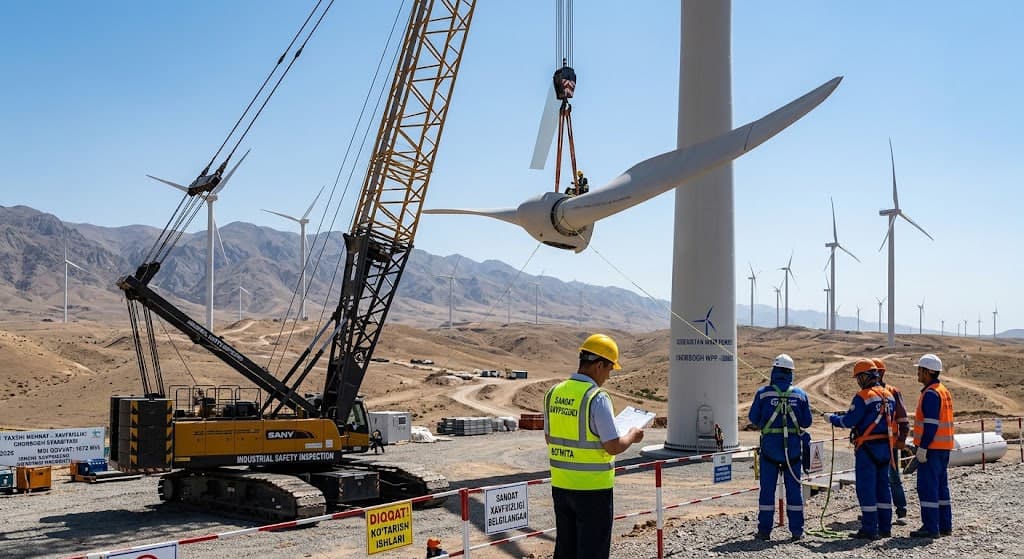
Between January and July 2026, large-scale utility solar photovoltaic and wind generating assets produced a combined 7.5 billion kWh of electric power.
The operational effectiveness of wind generation is demonstrated by the "Chorbog" Wind Power Plant. With a rated capacity of 20 MW, this plant is capable of generating up to 50 million kWh of electricity annually, meeting the power demands of approximately 20,000 households.
Concurrently, ensuring stringent industrial safety throughout the construction, erection, and operational lifecycles of wind farms remains an essential statutory priority.
Within its defined regulatory jurisdiction, the Committee for Industrial, Radiation, and Nuclear Safety enforces compliance across critical domains, specifically: ⭕ Operational safety and technical integrity of heavy hoisting machinery, high-capacity crawler, and mobile cranes utilized during turbine assembly and tower erection;
⭕ Regulatory compliance of pressurized systems and equipment, where incorporated into auxiliary plant systems;
⭕ Enforcement of industrial safety standards across designated hazardous production facilities (HPFs);
⭕ Compliance verification of construction, structural assembly, and commissioning workflows against mandatory industrial safety codes.
A utility-scale wind power facility is therefore far more than an installation of clean green generation—it constitutes a major industrial infrastructure complex requiring dedicated engineering oversight across its heavy lifting, mechanical, and high-consequence operations.
Note: The 1,672 MW figure denotes nominal installed generation capacity rather than aggregate generated energy. Actual gross energy yield fluctuates depending on local anemometric conditions and dispatch schedules. For instance, in June 2026, national wind power assets generated 245.7 million kWh of electricity.