🇩🇪 Germany: A Country Where Industrial Power and Safety Culture Go Hand in Hand
2026-06-17 17:00:00 / News
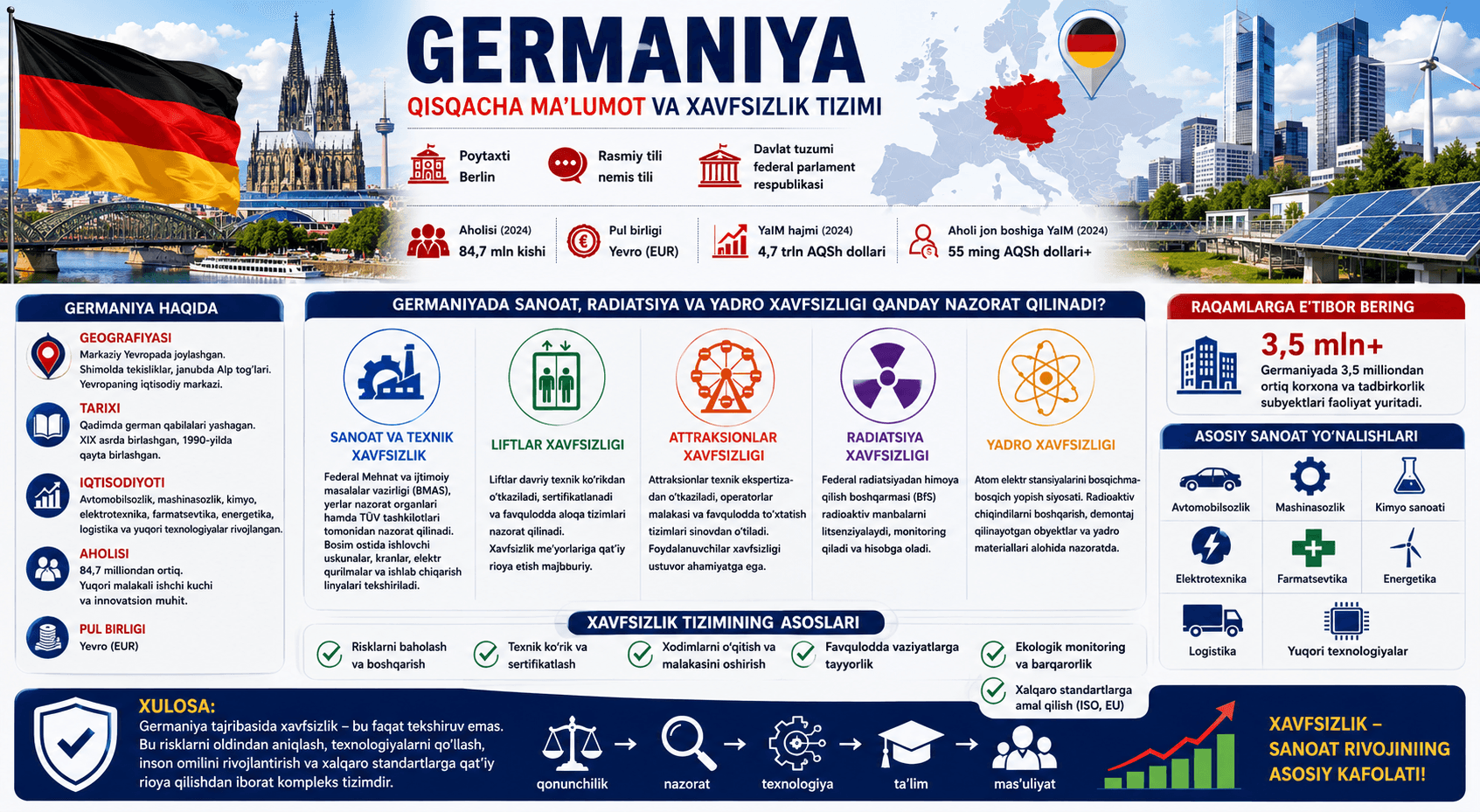
🏛 Capital — Berlin
🗣 Official language — German
🌍 Form of government — federal parliamentary republic
👥 Population — over 83 million people
💶 Currency — euro (EUR)
📊 GDP — approximately 5 trillion US dollars
📈 GDP per capita — over 60 thousand US dollars
Germany is among the global leaders in the automotive industry, mechanical engineering, chemical industry, electrical engineering, pharmaceuticals, energy and logistics. Major companies such as BMW, Mercedes-Benz, Volkswagen, Siemens, Bosch and BASF are clear examples of the country’s industrial potential.
📜 The territory of Germany has been known since ancient times as a region inhabited by Germanic tribes. In the 19th century, the unification of German states led to the formation of the modern German state. After the two World Wars, the country was divided into East and West Germany, and in 1990 it was reunified. Today, Germany is one of the key countries of the European Union in political, economic and technological terms.
💼 A key feature of Germany’s economic model is the harmony between industrial development and safety culture. Manufacturing enterprises, chemical industrial complexes, energy facilities, transport infrastructure and scientific centers operate under a strict system of control.
🇩🇪 In Germany, industrial, radiation and nuclear safety are ensured through a comprehensive mechanism based on federal and regional authorities, independent inspection organizations and international standards.
🏭 In the field of industrial safety, the Federal Ministry of Labour and Social Affairs, supervisory authorities of the federal states and technical inspection organizations play an important role. One of the most well-known institutions of technical supervision is TÜV, which assesses the safety of pressure equipment, lifting mechanisms, energy installations, production lines and other technical facilities.
Safety requirements at enterprises are not limited only to the technical condition of equipment. The qualifications of employees, occupational safety, environmental safety and emergency preparedness are also regularly monitored.
🛗 Elevators, escalators, cranes, pressure vessels and other technical devices in Germany are subject to strict inspection requirements. Emergency communication systems, protective devices and safety mechanisms in elevators are periodically checked.
🎡 Amusement parks and attractions also operate under technical supervision. Each attraction undergoes inspection before being put into operation, while operator qualifications, emergency stop systems and structural reliability are assessed.
☢️ One of the main authorized bodies in the field of radiation safety is the Federal Office for Radiation Protection. This institution is responsible for the registration of radioactive sources, radiation monitoring, radioactive waste management and the protection of the population from radiation.
⚛️ Although Germany has gradually phased out nuclear energy, safety issues related to radioactive materials, nuclear waste management, facilities undergoing dismantling and radiation sources remain an important area of state supervision.
🌍 Germany’s industrial safety system has been developed in line with the European Union’s Seveso III Directive, recommendations of the International Atomic Energy Agency and ISO standards. The main feature of Germany’s experience is that safety control is aimed not only at eliminating the consequences of accidents, but primarily at preventing them.
🌐 Information Service of the Committee for Industrial, Radiation and Nuclear Safety