
🌾 Industrial Safety at Grain Storage and Processing Enterprises — A Key Condition for Sustainable Production
2026-06-12 14:00:00 / News
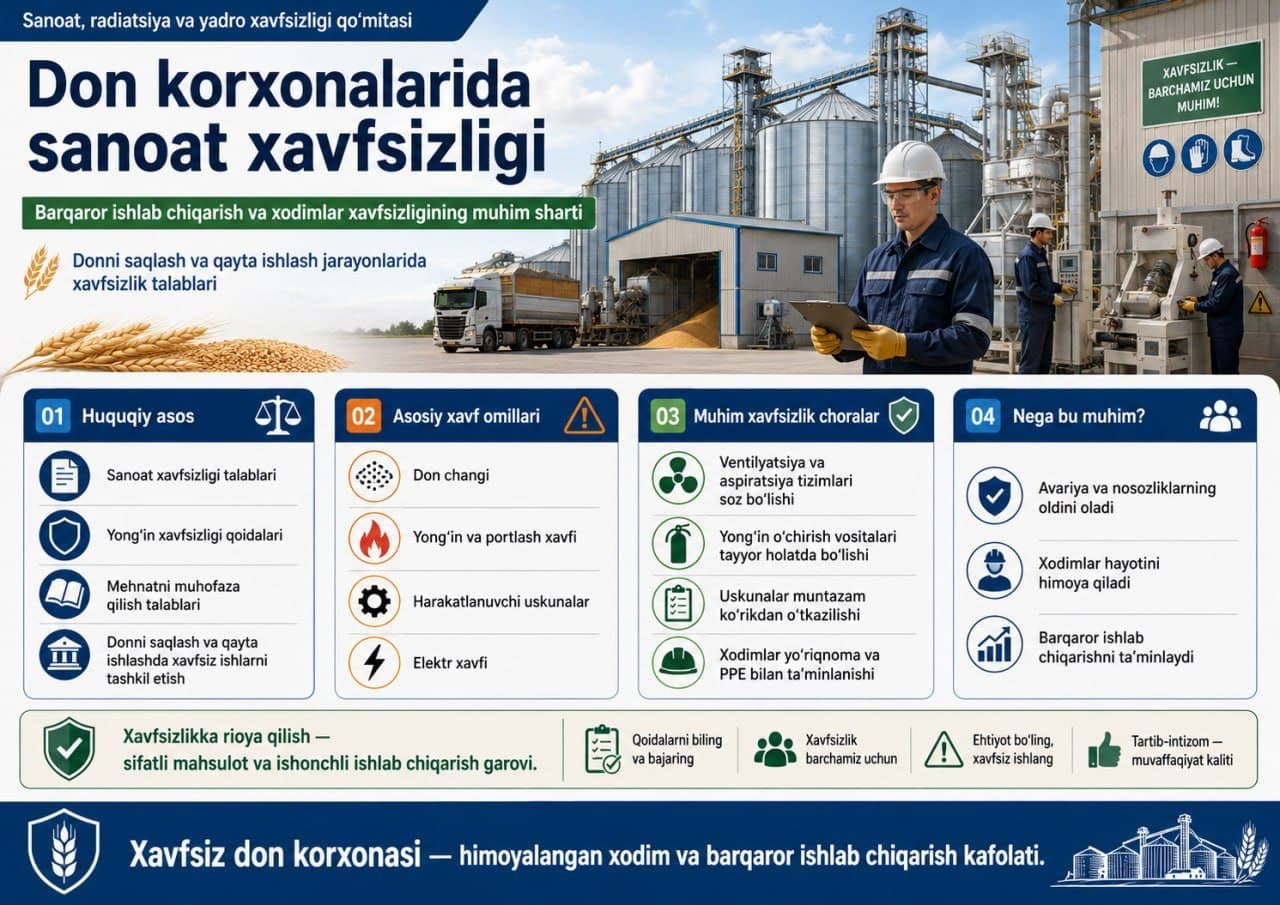
📘 Legal Framework
Compliance with safety requirements at grain storage and processing enterprises is regulated by the following legal and regulatory documents:
🔹 The Law “On Industrial Safety of Hazardous Production Facilities” establishes requirements for preventing accidents at hazardous production facilities, protecting the life and health of employees, and ensuring the safe operation of technical equipment.
🔹 The “Safety Rules for Operations at Grain Storage and Processing Enterprises” define requirements for the safe organization of work at enterprises engaged in grain storage and processing. These rules cover safety measures for grain elevators, mills, warehouses, bunkers, conveyors, and other production facilities.
🔹 The Law “On Fire Safety” and the Fire Safety Regulations of the Republic of Uzbekistan establish general requirements for preventing fires and protecting human life, property, and the environment from fire-related hazards.
⚠️ Main Hazard Factors at Grain Enterprises
🌫 Grain Dust
Dust is generated during grain receiving, cleaning, drying, grinding, transportation, and storage processes. Under certain conditions, grain dust can significantly increase the risk of fire and explosion.
⚙️ Moving Machinery
When operating conveyors, elevators, crushers, fans, and other equipment, protective guards, interlocking devices, and alarm systems must be maintained in proper working condition.
🔥 Fire and Explosion Hazards
Dust accumulation, electrical faults, open flames, sparks, hot work operations, or failure to comply with technological procedures can significantly increase fire risks.
⚡️ Electrical Safety
The technical condition of electrical systems, grounding systems, cables, automatic protection devices, and electrical equipment used in potentially explosive areas must be continuously monitored.
🏗 Condition of Buildings and Structures
The technical condition of warehouses, silos, elevator towers, galleries, and bunkers directly affects production safety.
✅ Key Areas Requiring Attention
🧹 preventing dust accumulation in production areas;
🌬 ensuring the proper operation of aspiration and ventilation systems;
🧯 monitoring the availability and serviceability of primary fire-fighting equipment;
🚨 checking the operational condition of fire alarm systems and automatic protection systems;
⚙️ maintaining protective devices, interlocks, and emergency stop buttons of technological equipment in proper working order;
⚡️ carrying out inspections of electrical equipment and grounding systems in accordance with established procedures;
📋 providing employees with industrial and fire safety training and instructions;
🦺 supplying employees with appropriate personal protective equipment;
📄 maintaining technical documentation, instructions, inspection reports, and maintenance logs.
🌾 Safety requirements at grain enterprises are not merely a part of the production process. They are a critical factor in ensuring enterprise stability, protecting employees' lives, and maintaining the uninterrupted operation of the food supply chain.
🤝 Therefore, strict compliance with industrial safety requirements, regular preventive measures, and strengthened accountability of responsible personnel are of particular importance.
🛡 A safe grain enterprise means sustainable production, protected employees, and high-quality products.
🌐 Information Service of the Committee for Industrial, Radiation and Nuclear Safety