🌍 International Experience: How is Industrial Safety Ensured in the Visegrad Group Countries?
2026-06-02 09:00:00 / News
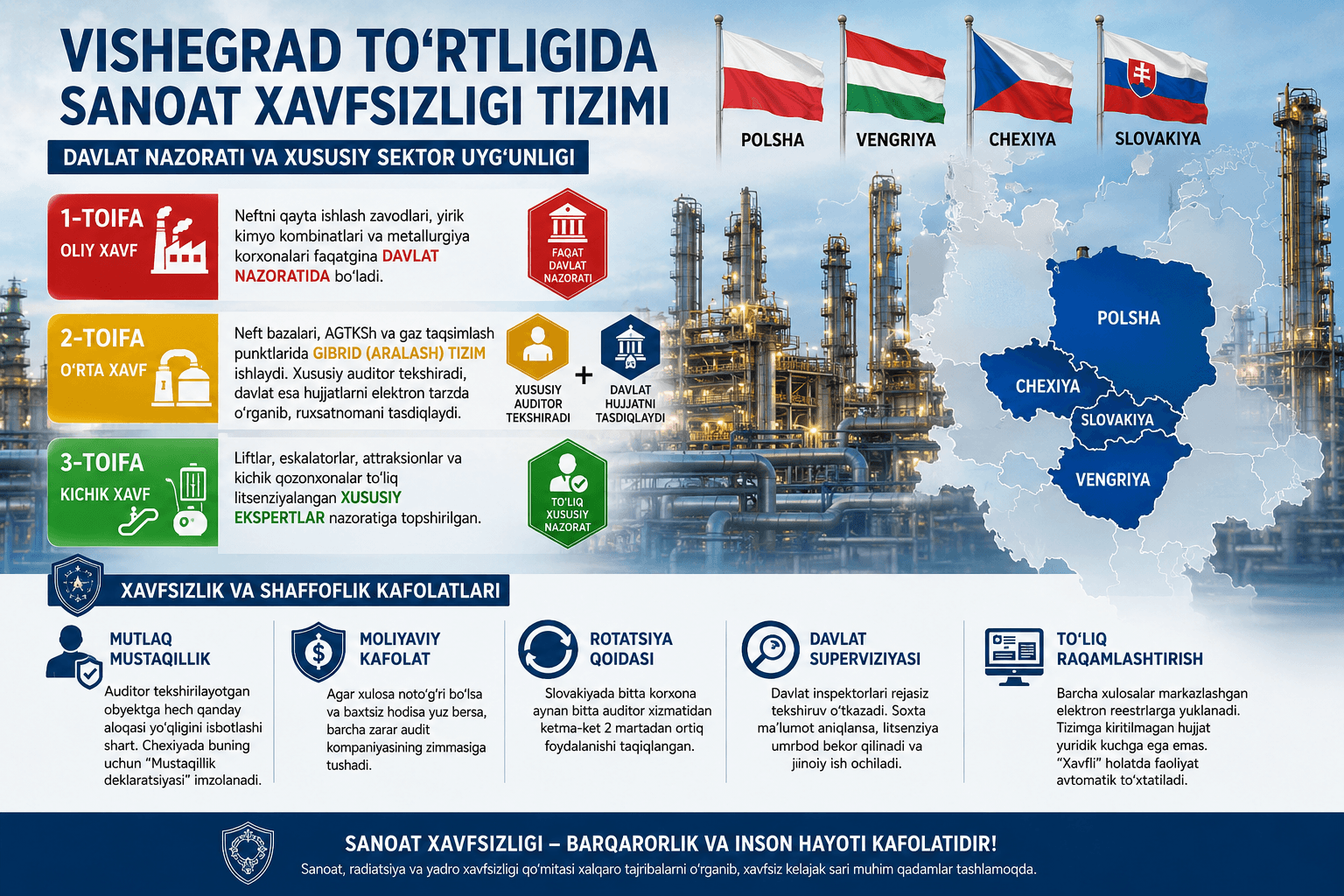
In these countries, state control and private sector participation are strictly coordinated, and inspections are divided into 3 main categories depending on the risk level:
🔴 Category 1: High-Risk Facilities Oil refineries, large chemical plants, and metallurgical enterprises are exclusively under State control. According to the EU's Seveso III directive, private companies do not have the right to inspect or issue final safety reports for such large strategic plants.
🟡 Category 2: Medium-Risk Facilities A hybrid (mixed) system operates at facilities such as oil depots, CNG filling stations, and gas distribution points. Internationally accredited private auditors inspect the facility, while the state inspectorate reviews the documents electronically without physical presence and approves the operation permit.
🟢 Category 3: Low and Technical Risk Facilities Elevators, escalators, amusement rides, and small boiler houses are fully handed over to the control of licensed private experts.
🛡 How are Safety and Transparency Guaranteed? To ensure the proper functioning of the system and prevent the issuance of fake reports, a number of strict rules are established in European countries:
-
Absolute Independence: According to the ISO/IEC 17020 standard, an auditor organization must prove that it has no connection (even through relatives) to the inspected facility. In the Czech Republic, a special "Declaration of Independence" is signed for this purpose.
-
Financial Guarantee: If a private auditor declares a facility "safe", but an accident occurs later, all financial damages fall on that audit company.
-
Rotation Rule: In Slovakia, a single enterprise is prohibited from using the services of the same auditor more than 2 times in a row; a different independent company must be hired each time.
-
State Supervision: State inspectors randomly conduct unannounced control checks at facilities that private auditors found to be safe. If false information is detected, the license is permanently revoked, and a criminal case is initiated.
💻 Complete Digitalization All inspection reports are uploaded to centralized electronic registries, such as eUDT in Poland or TIČR in the Czech Republic. A document not entered into the system has no legal force. If a facility is rated as "Dangerous", the state system automatically generates an order to suspend operations.
Industrial safety is the guarantee of stability and human life! The Committee for Industrial, Radiation and Nuclear Safety continuously studies international experience in its activities and continues to take important steps toward a safe future.