
New Uzbekistan has created a growth model through its youth
2026-04-29 17:00:00 / Statements and speeches of administration
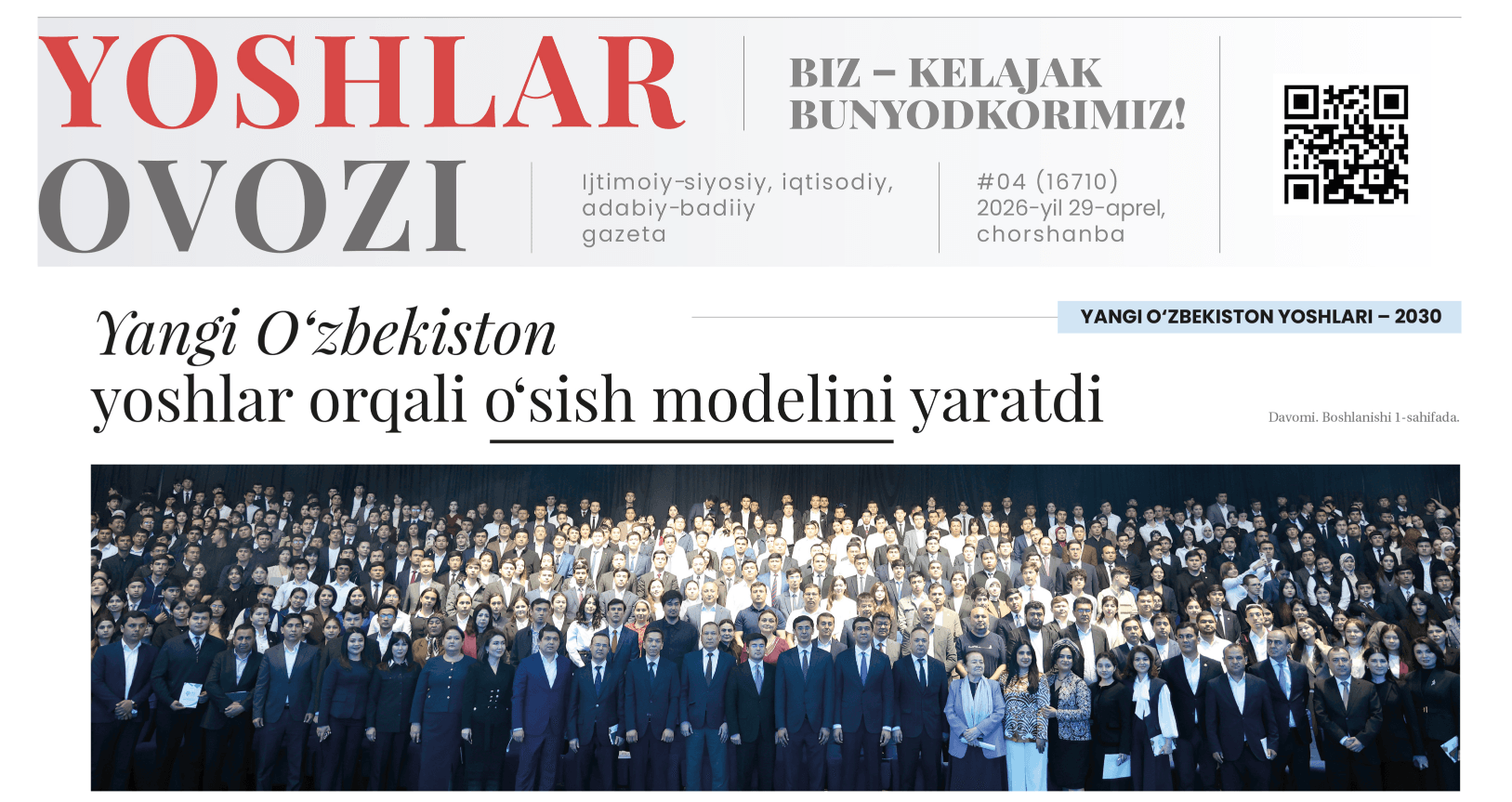
Thanks to the support of the Head of our State, over the last seven to eight years, the system of working with youth in Uzbekistan has transformed from a simple social policy direction into a strategic development model. Today, systematic programs with clear mechanisms are operating in the fields of education, reading, vocational training, sports, culture, employment, and entrepreneurship. The fact that a vertical management system has been created in the field through the neighborhood (mahalla) institution, and government agencies and leaders of all levels are massively involved in the field, is the basis of the achieved results.
At the same time, the participation of the non-governmental sector in the field is expanding. New formats have appeared in education, and vocational training is developing.
Considering that 9.5 million of our 38 million population consists of young men and women aged 14-30, and 270,000 young families are formed every year, the demographic factor requires a long-term and systematic approach to youth policy. For example, this year, more than a million students are graduating from school and entering the labor market. This growth keeps the existing system under constant pressure. If the education system does not adapt to this, and new jobs are not created at a sufficient speed, the pressure will turn into internal problems. That is, a large number of young people in itself brings both opportunity and responsibility. Proper directing of this factor requires systematic decisions.
Based on the real situation, for the first time in the history of our country, a large-scale program aimed at more fully realizing the role and potential of youth in building a New Uzbekistan was developed – the Strategy "Youth of New Uzbekistan – 2030".
This document brought together the priority areas of working with youth, clearly defined their interconnectedness, and systematized the mechanisms leading to the result. In particular, it is specifically noted that there is a discrepancy between the knowledge provided in educational institutions and the real demands in the labor market. Demographic growth directly affects employment policy, quality of education, social stability, and even security issues.
If we may say so, the task of providing employment for hundreds of thousands of young people every year does not only mean creating jobs. This number requires a balance between education, the economy, and regional development. Likewise, the task of bringing 450,000 young people to the B2 level in foreign languages will not be solved only by separate courses, but depends on the quality of the entire educational system. Or else, the strategy plans to cover 900,000 young people in volunteering. This serves to increase social activity. But for the process to be stable, it must be inextricably linked to the basic needs of young people, that is, income, profession, and living conditions.
Now, not initiatives, but the system works
In the Strategy, individual directions are viewed as a single chain. I can safely say that to this day, we have created an environment in youth policy where youth can be proactive and show their capabilities. For this reason, the main focus in the new document is not on the number of new initiatives, but on how existing mechanisms work. It is not how many projects there are, but how they complement each other that is becoming important.
Employment and entrepreneurship are among the most important directions before us. When we conducted a survey among more than 100,000 young people, more than 25 percent of them expressed their desire to start their own business. Creating jobs for young people entering the labor market every year should become the state's number one strategy. It should be understood that this is not the task of a single organization, say, the Youth Affairs Agency. The Head of our State instructed to direct every ministry and agency to this goal and bring it to the agenda.
It is planned to provide employment for 600,000 young people every year. For this, several mechanisms will be launched simultaneously. And entrepreneurship, as always, will take center stage. Through the "Entrepreneurs of the New Generation" program, it is planned to train 20,000 young people in cooperation with institutions such as Harvard, Stanford, MIT, and London Business School. A thousand business projects will be selected, and a loan of up to 500 times the basic calculation amount will be allocated to them for a period of up to three years. For young entrepreneurs, part of the costs of connecting to engineering networks will be covered.
During our recent trip to the United States of America, cooperation was established with Harvard Business School, Yale, Cornell, Wharton, Stanford University, Massachusetts Institute of Technology, and leading centers. Through the "Entrepreneurs of the New Generation" program, it is planned to bring young founders into these ecosystems, prepare them based on global market requirements, and strengthen them with practical skills.
Another noteworthy aspect is that a loan of up to 300 million soums will be allocated for the establishment of training centers in remote areas. For these centers, the social tax and the income tax of teachers will be set at 1 percent.
An employment monitoring system will also be introduced through electronic platforms, creating the ability to determine where young people work and in which direction they are active. As a result, future decisions will be based on real data. Efficiency, hitting the right spot in solving problems happens only and only through correct information and transparency.
The path of global competition: knowledge, language, and experience
In recent years, our esteemed President has been paying great attention to the issue of deeply teaching young people modern professions in demand in the global labor market. In this sense, the process of entering the labor market will also be reviewed. Opportunities for professional certification, training in modern professions, and gaining experience through international programs will be expanded. Incentives given for the level of foreign language proficiency are not without reason. The simplification of issuing foreign passports for young people who have reached the B2 level opens the way for their further actions. And for youth who have a C1 level or come up with initiatives, state service fees will be reduced.
In a situation where population growth continues, diversifying migration is very important for us. We need to think about teaching young people languages, raising them to be modern, capable, and educated, and transferring them to foreign countries as specialists, managers, and business owners. Recently, when we were in Silicon Valley with our delegation, we saw that there are about 5,000 Uzbekistanis there. Uzbekistan has the potential to produce truly leading specialists. And I think we must direct and support this.
The formation of about 270,000 new families every year creates a layer of new needs in society. A new family needs housing, stable income, and a stable environment. If these are not met, the results achieved in other directions will not be solid. Since every family is a pillar of society, it is necessary to strengthen it from the very beginning. For this reason, at least 10,000 young families will be supported through mortgages every year. The financial burden will be reduced by covering the part of the loan that is above the Central Bank rate.
The system encourages activity
Another important direction is volunteers, that is, the volunteer movement. In the Strategy, the issue of social activity is given with specific indicators. If the number of registered volunteers is 100,000 now, we want to increase this number to 900,000. This will be filled not by short-term actions, but through stable participation. It is planned to allocate grants of up to 100 million soums through the volunteering fund.
To form a cultural and educational environment, it is planned to establish "Youth Streets". Books and "book cafes" will be launched in these places. The issue of how young people spend their time will find its solution here. Minimum infrastructure standards will be introduced in certain regions, and "youth districts-cities" will be selected.
Also, a separate system of incentives is being formed in the creative direction. A Presidential Award will be introduced for advanced creators. That is, the activity of youth will not be limited only to social or economic directions; incentives for the cultural layer and initiatives to meet the spiritual needs of our population will also be strengthened.
Events such as projects "Uzbekistan loves youth!", "Hayot fest", "Talaba Fest", "Talaba Expo 2026" will be held nationwide. The activities of the Robotics Association will be supported. The main focus here is not on increasing numbers, but on forming an environment. Of course, for a young person to be active, conditions are needed. Within these conditions, they choose their direction and act.
A healthy generation – a stable future
In the process of the development of the digital world, the technological revolution, and the formation of a new generation in society, the issue of mental and psychological health of youth is very urgent. In recent years, there has been a need to solve accumulated problems in this direction without delay. The strategy sets the task of reducing the proportion of young people in the psychological risk group by 40 percent. At the same time, it is planned to establish a 24/7 psychological contact center. The issue of strengthening psychological services is connected with the educational and social environment. Studies, work, and family conditions directly affect the mental state of young people.
Another important direction is to increase physical activity. It is planned to increase the proportion of young people engaged in sports by 25 percent. This indicator is related to infrastructure, conditions, and interest.
In the strategy, the issue of dialogue with youth is established through specific mechanisms. Such dialogues already existed in our youth policy; our current task is to raise it to a new level.
The Institute for Studying Youth Problems and Training Prospective Cadres will regularly conduct social surveys to determine the needs, expectations, and real problems of youth. Based on this data, the National Youth Index will be formed.
Working with appeals is also identified as a priority direction. Appeals from young people are not just accepted; they are analyzed and linked to the decision-making process. It is determined that meetings with youth will be held every Thursday. Direct contact is maintained through these meetings.
It is also planned to strengthen the dialogue through digital platforms. Information on employment, education, and activity directions will be collected and updated. The important aspect here is that dialogue is formed as a continuous process, allowing decisions to be made based on the real situation.
The strategy sets the task of ensuring the participation of 100,000 young people in global international programs. Cooperation with international organizations will also be expanded.
7 directions and 56 projects designed for 2026-2027 show how specifically the strategy has moved to a clear stage. General goals are divided into individual tasks, reinforced with deadlines and result criteria. Education, employment, entrepreneurship, and the social sector are set in motion at the same time; their harmony determines the quality of the result. Responsible persons have been identified for each direction; evaluation will be carried out in the context of specific tasks.
When announcing the Strategy "Youth of New Uzbekistan – 2030", the Head of our State focused on one important factor: for this document to work in practice, we must continue active dialogue with the youth. I believe that the strategy will be a great step for our youth to conquer new milestones and set great goals for themselves.
Alisher SA'DULLAYEV,
Director of the Youth Affairs Agency of the Republic of Uzbekistan, Senator