“National Reading Movement”: A New Stage in Developing a Reading Culture Among Young People
2026-10-17 12:00:00 / News of ministry
A joint resolution approved by the Youth Affairs Agency of the Republic of Uzbekistan, the Ministry of Education and Science, the Writers’ Union of Uzbekistan, the Republican Center for Spirituality and Enlightenment, and the Alisher Navoi National Library of Uzbekistan has established the organizational and legal framework for implementing this program, the duties of the responsible organizations, the stages of the competition, and the procedures for evaluating participants and awarding winners.
The main goal of the program is to popularize reading widely, strengthen students’ interest in books, and develop their knowledge and intellectual potential through reading.
The “National Reading Movement” program covers students in grades 1–11 of general secondary schools. Participants are divided into three groups according to age and grade:
- students in grades 1–5;
- students in grades 6–8;
- students in grades 9–11.
A separate reading list has been compiled for each age category. It includes works of Uzbek and world literature intended for children and teenagers, works of fiction, and books of historical, spiritual and educational content.
The list of recommended literature for the competition is annexed to the joint resolution, and participants’ reading is organized on the basis of this list.
Under the resolution, the competition within the program is held through an online platform. The platform provides for registering participants, assessing their reading level, conducting the stages of the competition, and compiling its results.
The competition consists of several stages, through which participants’ knowledge and skills are assessed step by step.
At the preliminary selection stage, students are assessed on whether they have read the recommended literature, understand the content of the works, and can answer questions about them. At later stages, the focus shifts to participants’ ability to analyze what they have read independently, justify their opinions, and demonstrate their speaking and creative abilities.
Participants’ results are evaluated according to established criteria. In addition, relevant commissions are set up to organize the evaluation process and review the results.
Alongside reading itself, the program places particular emphasis on assessing students’ ability to understand and analyze the content of literary works, think independently, and express their views freely.
The resolution sets out the procedure for holding tests, creative assignments and oral interviews at the relevant stages of the competition.
In particular, the tests serve to determine participants’ knowledge of the recommended literature. Creative assignments assess students’ understanding of a work’s content, independent thinking, creative skill, and adherence to language rules. The oral interviews focus on their views about books, their ability to analyze literary works, and their standard of speech.
Thus, what matters in the competition is not only the number of books read, but also how well participants have understood and absorbed their content, and their ability to draw their own conclusions and express their own opinions about the works.
The joint resolution also sets out the mechanisms for selecting and awarding the winners of the competition.
Students in grades 1–5 compete up to the district stage. Winners in this category are to be awarded valuable gifts and diplomas.
For students in grades 6–8 and 9–11, the competition is held at the district, regional and national stages. At the national stage, first-, second- and third-place winners are determined in each age category.
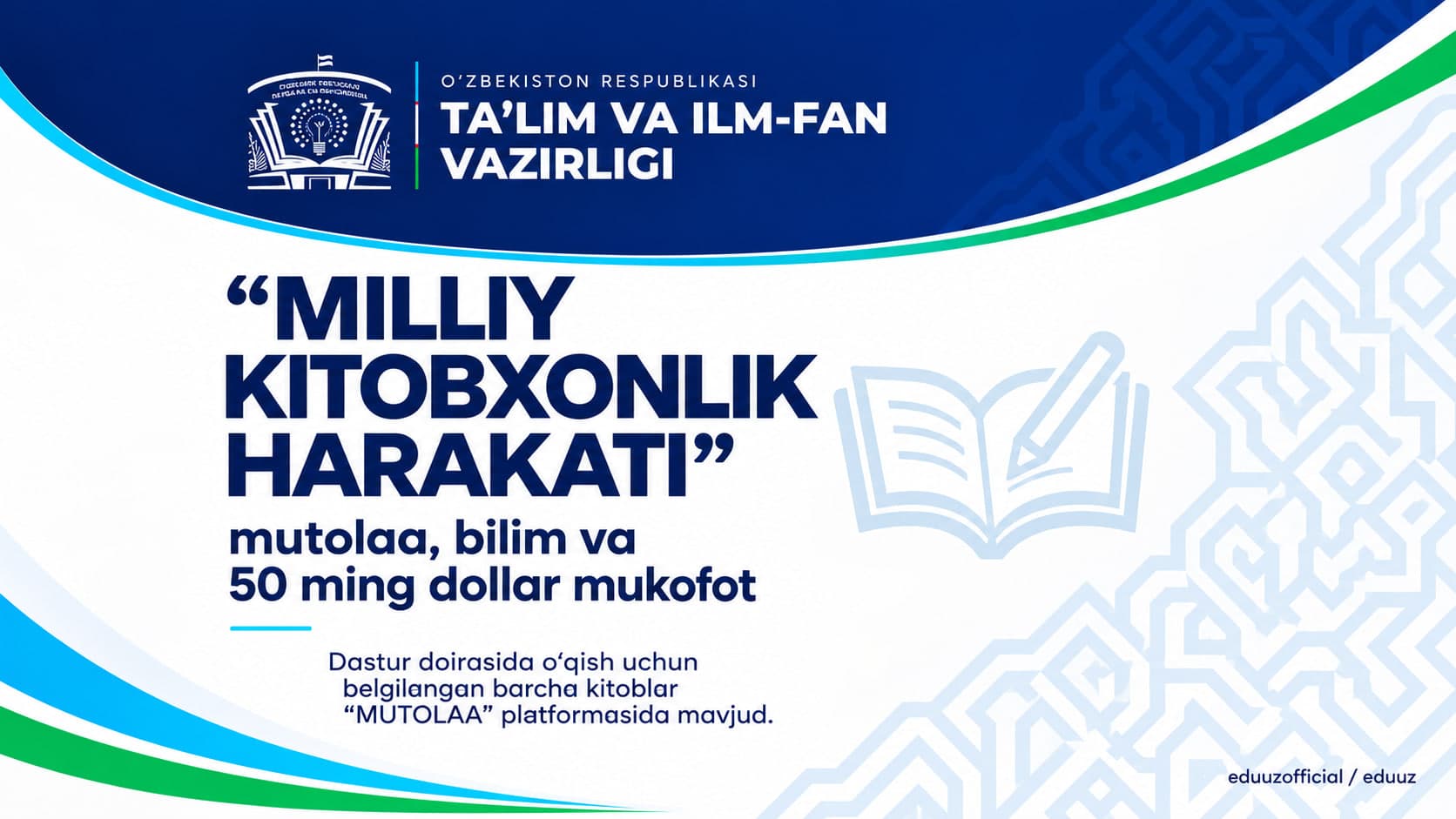
Cash prizes and diplomas are established for winners of the national stage. In each age category, the first-place winner is to receive a one-time cash prize of USD 50,000, the second-place winner USD 30,000, and the third-place winner USD 15,000, together with a diploma.
Winners in additional categories will also be awarded. In particular, the winners of the “Most Active Teacher,” “Best Reading School,” “Best Reading Family,” “Example of Determination” and “Special Recognition” categories will receive a one-time cash prize of USD 10,000 and a diploma.
An appeals commission is also provided for to review objections to the competition results. Under the established procedure, participants may submit an appeal to the commission within 15 days after the results are announced. The commission reviews complaints in accordance with the established procedure.
The “National Reading Movement” program aims to make reading an integral part of young people’s lives, strengthen interest in literature, and raise reading culture to a new level.