
The Appeals Handling System as an Important Tool for Resolving Public Issues
2026-10-14 18:00:00 / News of ministry
Appeals in Numbers
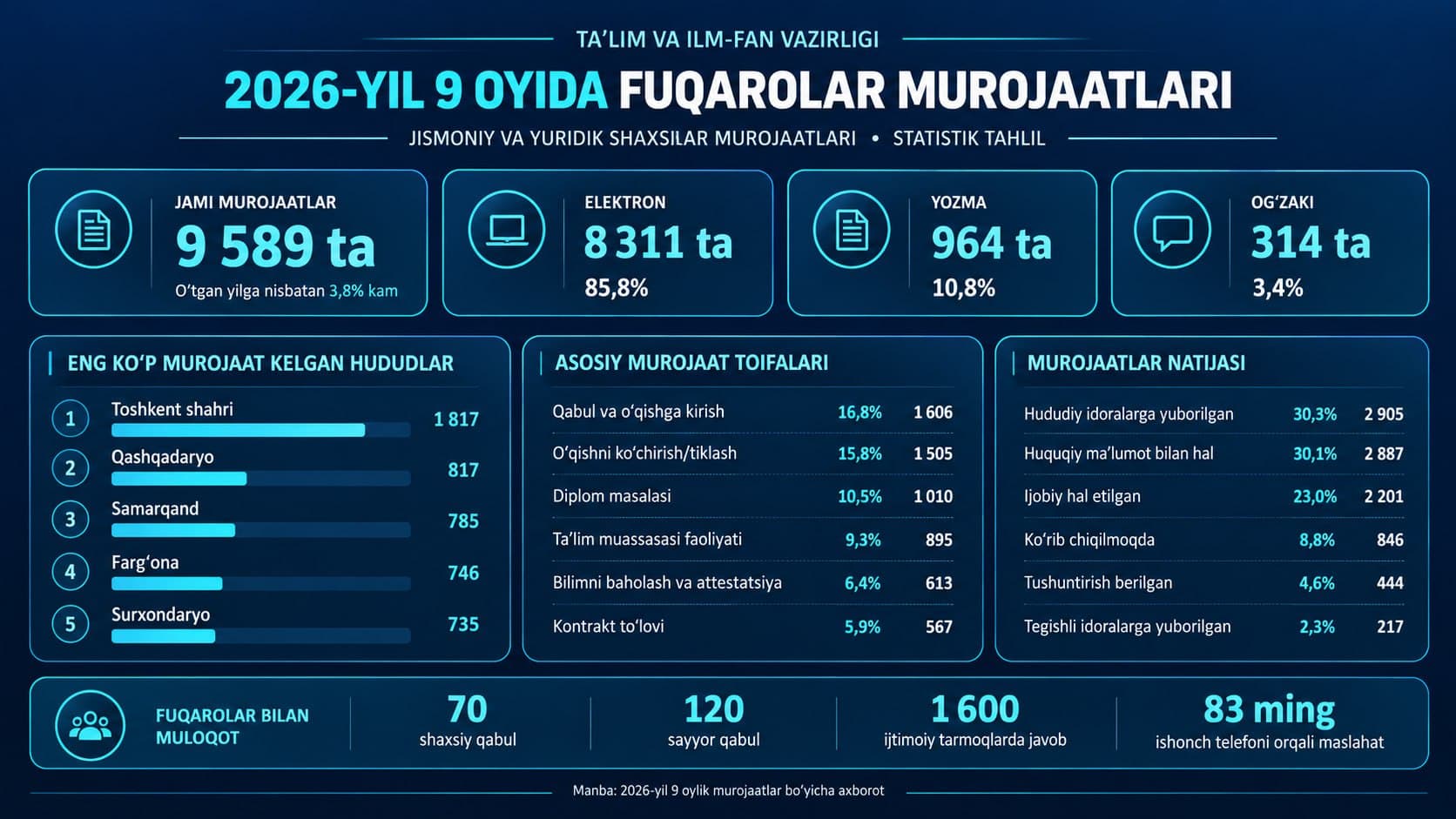
An analysis of appeals received by the Ministry of Education and Science and the organizations within its system indicates growing public interest in this sector. During the reporting period, the ministry received a total of 9,589 appeals. This represents a 3.8% decrease (388 appeals) compared with the same period last year. The decline reflects the timely resolution of issues in the sector and the effectiveness of systematic efforts.
The majority of appeals — 8,311 (85.8%) — were submitted electronically. In addition, 964 (10.8%) written appeals and 314 (3.4%) oral appeals were registered.
Which Regions Submitted the Most Appeals?
The regional analysis shows that appeals were distributed unevenly across the country. In particular:
- Tashkent city — 18.9% (1,817 appeals);
- Kashkadarya Region — 8.5% (817 appeals);
- Samarkand Region — 8.2% (785 appeals);
- Fergana Region — 7.8% (746 appeals);
- Surkhandarya Region — 7.7% (735 appeals);
- Tashkent Region — 7.2% (695 appeals);
- Andijan Region — 6.4% (616 appeals);
- Republic of Karakalpakstan — 5.6% (540 appeals);
- Namangan Region — 5.6% (536 appeals);
- Khorezm Region — 5.4% (522 appeals);
- Bukhara Region — 5.4% (521 appeals);
- Jizzakh Region — 4.8% (456 appeals);
- Navoi Region — 4.7% (454 appeals);
- Syrdarya Region — 3.2% (304 appeals).
Appeals received from abroad accounted for a further 0.5% (45 appeals).
What Issues Do Citizens Raise Most Frequently?
An examination of the content of citizens’ appeals revealed the following main categories:
- Admission procedures and enrolment — 16.8% (1,606 appeals);
- Transfer and reinstatement of studies — 15.8% (1,505 appeals);
- Diploma-related issues — 10.5% (1,010 appeals);
- Issues concerning the activities of educational institutions — 9.3% (895 appeals);
- Student assessment and final state attestation — 6.4% (613 appeals);
- Tuition contract payments — 5.9% (567 appeals);
- Dissatisfaction with the performance of an educational institution employee — 5.0% (479 appeals);
- Employment-related issues — 3.2% (308 appeals);
- Financial matters (salaries, scholarships and financial assistance) — 3.1% (295 appeals);
- Student accommodation — 2.6% (251 appeals);
- The operation of electronic platforms (HEMIS, tuition contracts, transfer systems and others), as well as research activities — approximately 1.8% each.
The remaining share consisted of issues such as recognition of foreign educational qualifications (nostrification), foreign-language proficiency testing, obtaining certificates and other matters.
Outcomes of Appeals
Every appeal received by the ministry is reviewed in accordance with the law, and appropriate measures are taken. Specifically:
- 23.0% (2,201 appeals) were resolved positively;
- in 30.1% (2,887 cases), the issues were resolved by providing legal information;
- the necessary explanations were provided for 4.6% (444 appeals);
- 0.3% (26 appeals) were left unconsidered, while 0.6% (61 appeals) were discontinued;
- 30.3% (2,905 appeals) were forwarded to regional authorities, while another 2.3% (217 appeals) were referred to the relevant agencies;
- 8.8% (846 appeals) are currently under review.
The Effectiveness of Direct Engagement with Citizens
In addition to formal written and electronic appeals, particular attention is paid to direct engagement with citizens. During the reporting period, 70 citizens were received during personal appointments, while 120 citizens were received during off-site public appointments.
Furthermore, prompt responses were provided to 1,600 appeals received through social media. Legal consultations and practical assistance were provided to as many as 83,000 citizens through dedicated helplines.