
Uzbekistan’s Medical Education Takes a Leading Position on the International Stage
2026-06-06 12:55:00 / News of ministry
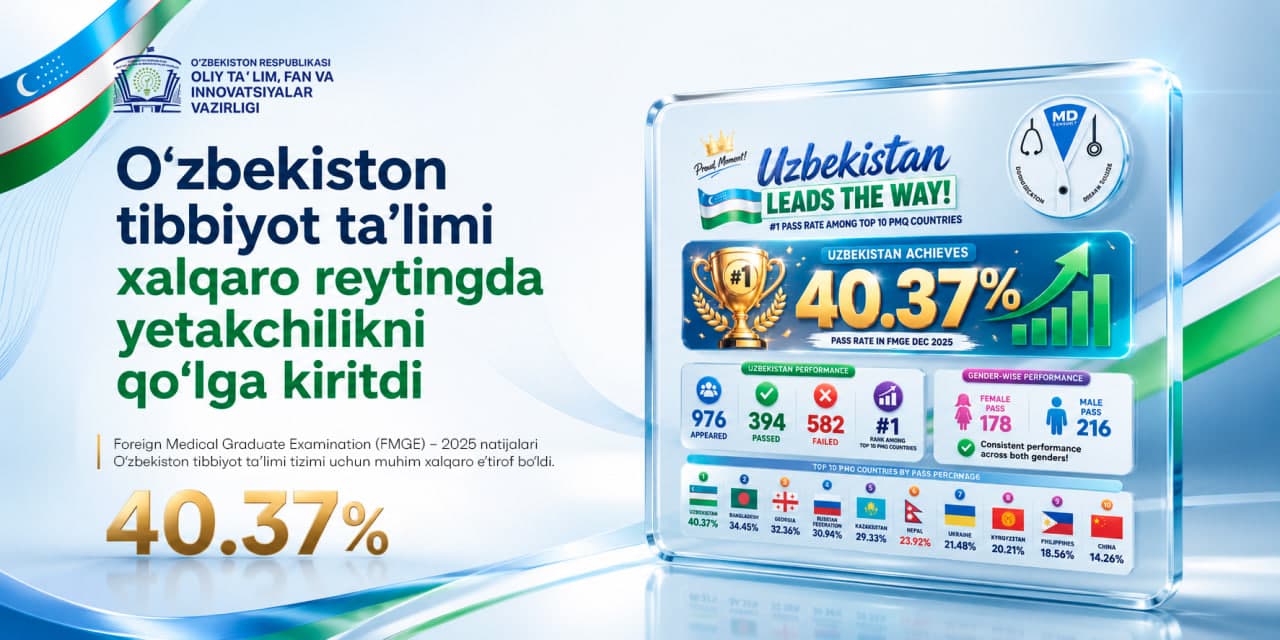
According to the results, Uzbekistan ranked fourth in the world among countries educating international medical students, achieving a success rate of 40.37 percent. It also secured first place among the countries of the Commonwealth of Independent States (CIS) and Southeast Asia. Among foreign countries where Indian citizens obtain medical degrees, Uzbekistan emerged as a leading destination.
Uzbekistan demonstrates strong performance not only in terms of examination pass rates but also in the number of international students enrolled in its medical institutions. These figures serve as an important indicator of the practical impact of the large-scale reforms implemented in the country’s medical education system in recent years.
What is FMGE?
The Foreign Medical Graduate Examination (FMGE) is a national licensing examination that Indian citizens who obtain a medical degree abroad must pass in order to gain the right to practice medicine in India.
For example, if an Indian student studies medicine in Uzbekistan, Russia, Kazakhstan, China, or any other foreign country, they are required to pass this examination upon returning to India after graduation. Graduates who fail the examination are not permitted to practice as physicians.
Therefore, FMGE results provide an important measure of the quality of medical education offered by a particular university or country. The higher the number of graduates who successfully pass the examination, the higher the quality of education is considered to be.
Why is this important?
Today, thousands of Indian students choose foreign countries to pursue medical education, and Uzbekistan is among the preferred destinations.
For this reason, the FMGE results published annually are closely monitored by prospective students, parents, educational agencies, and universities.
Uzbekistan’s strong performance indicates that the country’s medical education system is producing competitive results in the international arena. This achievement may contribute to a further increase in the number of international students choosing Uzbekistan for medical studies.
What factors contributed to this achievement?
In recent years, Uzbekistan has undertaken comprehensive reforms in its medical education system.
First, medical curricula have been aligned with international standards. Modern infrastructure and clinical training facilities have been established at leading healthcare institutions. Innovative teaching methodologies, simulation centers, digital learning technologies, and electronic education platforms have been introduced.
Second, the involvement of international professors and medical experts has expanded significantly. Particular emphasis has been placed on developing students’ practical skills alongside their theoretical knowledge.
Third, universities have broadened their international cooperation through joint educational programs, academic exchange initiatives, and international accreditation processes, all of which have contributed to improving educational quality.
As a result, medical universities in Uzbekistan are increasingly capable of preparing specialists who meet the demands of both national and international labor markets.
Why is the result noteworthy?
According to the FMGE 2025 results, Uzbekistan recorded the highest success rate among medical institutions in the CIS and Southeast Asian regions, achieving a pass rate of 40.37 percent.
This means that nearly one out of every two graduates successfully passed India’s highly demanding medical licensing examination.
This achievement confirms the quality of education provided at Uzbekistan’s medical universities, the high level of clinical training, and the effectiveness of academic programs designed in accordance with international standards. Comprehensive conditions have been created for international students from dozens of countries around the world to receive high-quality education, develop clinical competencies, and successfully prepare for international professional examinations.
The success of graduates in international examinations serves as an important indicator of the effectiveness of ongoing reforms and demonstrates the growing reputation of Uzbekistan’s medical education system on the global stage.
What opportunities does this create for Uzbekistan?
Today, education has become a major sector of the global economy. Countries that attract international students not only expand their export of educational services but also strengthen their international standing and reputation.
The FMGE results provide a solid foundation for enhancing Uzbekistan’s educational brand. First, they increase confidence in the country’s medical universities. Second, they may contribute to a rise in the number of international students choosing Uzbekistan for medical studies. Third, they create additional opportunities for improving the positions of Uzbek universities in international rankings. Fourth, they pave the way for broader international cooperation in the field of medical education.
In Conclusion
The results of the Foreign Medical Graduate Examination (FMGE) 2025 represent an important international recognition of Uzbekistan’s medical education system. Uzbekistan’s first-place ranking among CIS countries and the strong performance of graduates from Tashkent State Medical University clearly demonstrate the practical outcomes of the educational reforms being implemented in the country.
Most importantly, these results confirm that Uzbekistan’s medical universities are successfully competing in the international educational arena, that the quality of national medical education is steadily approaching global standards, and that a strong foundation has been established for the country to become one of the leading centers of medical education in the region in the future.