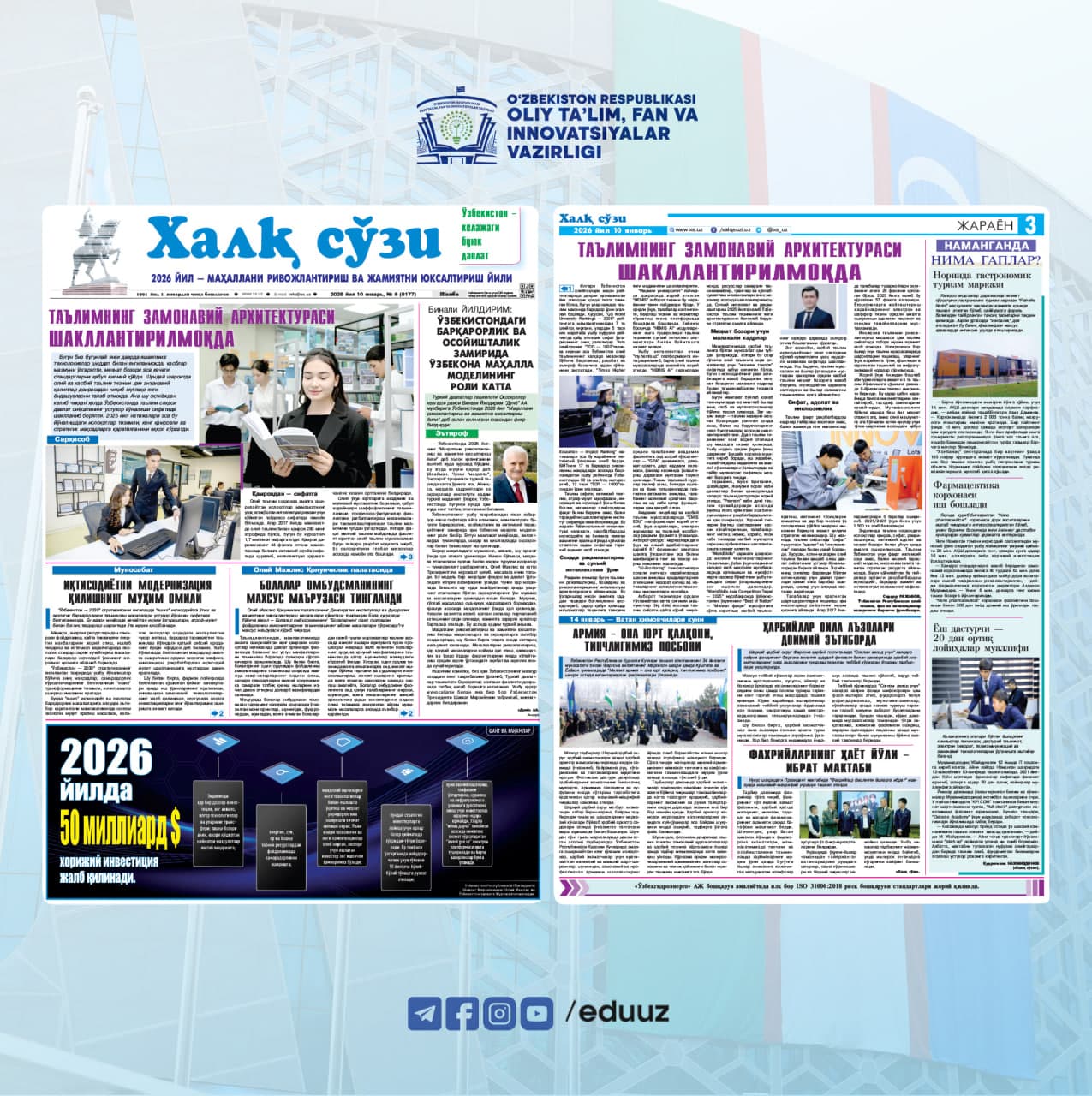
Overview: A Modern Architecture of Education Is Taking Shape
2026-01-10 10:00:00 / News of ministry
Education Based on the Demands of a New Era
We are living in a fundamentally new era marked by rapid technological advancement, changing professional landscapes, and evolving labor market expectations. In such conditions, higher and vocational education systems must move beyond traditional frameworks and adopt entirely new approaches. Education has therefore become a key priority of state policy in Uzbekistan. The results of 2025 clearly demonstrate that reforms are systemic, comprehensive, and strategically oriented.
From Access to Quality
Higher education enrollment has increased from 280,000 in 2017 to 1.7 million today, with coverage reaching 44 percent.
Universities have been granted academic and financial autonomy, admission processes have become transparent, and faculty incentive mechanisms have improved.
In QS World University Rankings – 2026, seven Uzbek universities are listed, five for the first time, with three entering the Top 1000.
In the Times Higher Education Impact Ranking, 59 universities from Uzbekistan participated, and 12 ranked within the Top 1000 based on the UN Sustainable Development Goals.
Digitalization and Artificial Intelligence
Digital transformation has become the backbone of the new educational architecture.
The HEMIS information system unifies academic management, while HEMIS AI modules introduce predictive analytics, GPA tracking, attendance monitoring, personalized learning pathways, and plagiarism detection.
The EMIS EDU platform digitizes academic lyceums and vocational institutions. Approximately 87 percent of educational resources have been digitized.
AI-proctoring ensures exam transparency. Big data analytics now informs policy-making, resource allocation, and grant mechanisms.
Vocational Education
Vocational education has evolved into a strategic mechanism aligned with labor market demands.
Dual education models are expanding. International cooperation includes Germany, the UK, Switzerland, and South Korea.
Participation and achievements in WorldSkills competitions, including the “Best of Nation” award at WorldSkills Asia Competition Taipei – 2025, demonstrate international recognition.
Social Justice — Education for All
Education serves as a mechanism for equal opportunity.
State grants for girls from low-income families have doubled, dormitory coverage has increased from 28% to 57%, and inclusive education measures are expanding.
Applicants may now choose six study programs instead of five. Admission quotas for experienced women without higher education have increased fivefold to 2,500 places.
In conclusion, Uzbekistan’s education reforms integrate access, quality, digital transformation, social equity, and labor market alignment. Education has become not merely a social sector, but a strategic national development model built upon human capital.
Sardor Rajabov
First Deputy Minister of Higher Education, Science and Innovations