
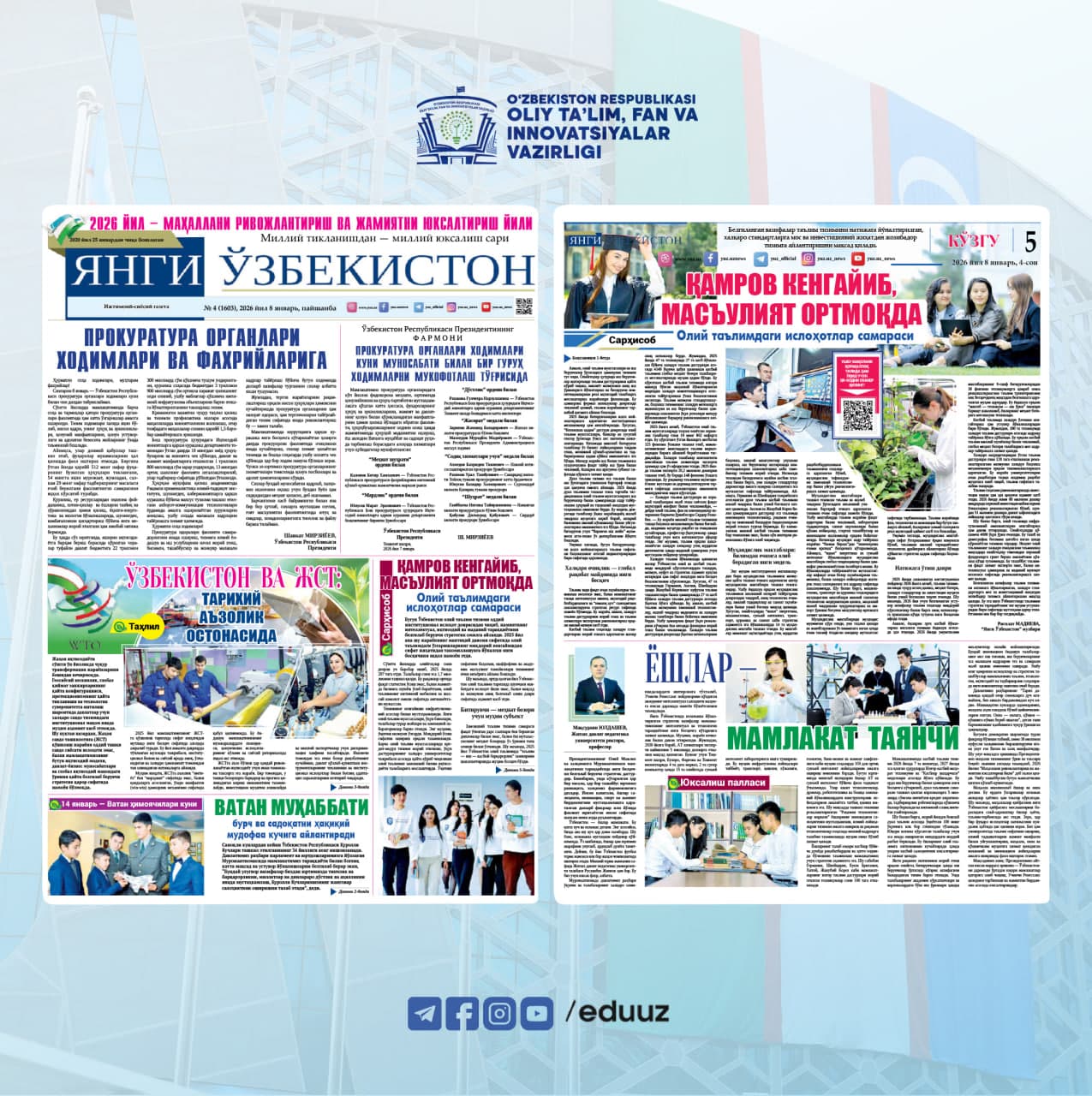
Expanding Access, Increasing Responsibility
2026-01-08 12:40:00 / News of ministry
System expansion has been reinforced by strong infrastructure development. New universities, academic buildings, dormitories, and modern laboratories have been established. Most importantly, the content of education has evolved. Quantitative growth has been accompanied by qualitative improvement. The introduction of the credit-module system across all institutions and the revision of curricula based on international university experience have aligned higher education with the modern knowledge economy. Quality assessment, transparency, and academic accountability are becoming institutional norms.
Thus, the concluding year represents not merely another reform phase but a period of strategic clarification. Higher education has strengthened its role as the core institution for human capital formation and laid a solid intellectual foundation for future development.
Establishing Our Place in Prestigious Rankings
Until recently, Uzbekistan’s universities were barely visible on the global higher education map. Today, the situation has changed. National institutions have entered the global competitive arena, securing positions in the QS World University Rankings and Times Higher Education rankings.
According to First Deputy Minister Sardor Rajabov, participation in global rankings signifies readiness for international standards and external evaluation. The system is transitioning from quantitative expansion to competency development and international competitiveness.
Graduates as Key Labor Market Actors
Educational effectiveness is measured not by diplomas issued but by graduates’ employability. In 2025, systematic cooperation between universities and employers strengthened significantly.
Within the “Kelajakka qadam” initiative, an ecosystem linking universities, banks, and the private sector enabled thousands of graduates to launch business projects. Employment is increasingly viewed not merely as job placement but as entrepreneurship.
The dual education system has bridged the gap between education and industry. Students now gain hands-on industrial experience during their studies, reducing the “first job” challenge.
Graduate employment has become a primary indicator of education quality.
International Openness — A New Stage of Global Competitiveness
Education now serves as a strategic resource shaping the country’s intellectual image, economic competitiveness, and soft power.
In 2025, 4,149 students enrolled in 27 internationally aligned vocational programs across 47 technical colleges. International student enrollment reached 19,862 (125% growth), and education exports totaled $35.2 million (148% growth).
Internationalization enhances competitiveness, openness, and long-term diplomatic and cultural cooperation.
Quality Through Infrastructure
In 2025, 20 dormitories were built under public-private partnership mechanisms, adding 10,884 beds (136% of the annual target), with over 300 billion UZS in private investment.
Dormitories are evolving into integral parts of the educational ecosystem.
Engineering Schools: From Knowledge to Solutions
Fourteen advanced engineering schools were established in strategic fields such as green energy, artificial intelligence, transport, and construction.
Education integrates research, industrial collaboration, and innovation. Engineers are trained to analyze problems and propose responsible solutions.
These schools represent a strategic step toward positioning education as a technological driver of national development.
Transition Toward Results
Key priorities for 2026 include:
-
Enrolling 30% of 9th-grade graduates into technical colleges;
-
Expanding international programs to 100 colleges;
-
Increasing internationally accredited programs to 120;
-
Attracting $80 million in foreign investment;
-
Creating 4,000 additional study places;
-
Introducing grant opportunities for foreign students.
These measures aim to build a results-oriented, globally competitive, and investment-attractive education system.
Education in the New Uzbekistan is firmly establishing itself as a cornerstone of strategic national development.
Risolat MADIYEVA
Correspondent, “Yangi Uzbekistan” Newspaper