What Should You Know About Types of Radiation?
2026-02-26 09:00:00 / News
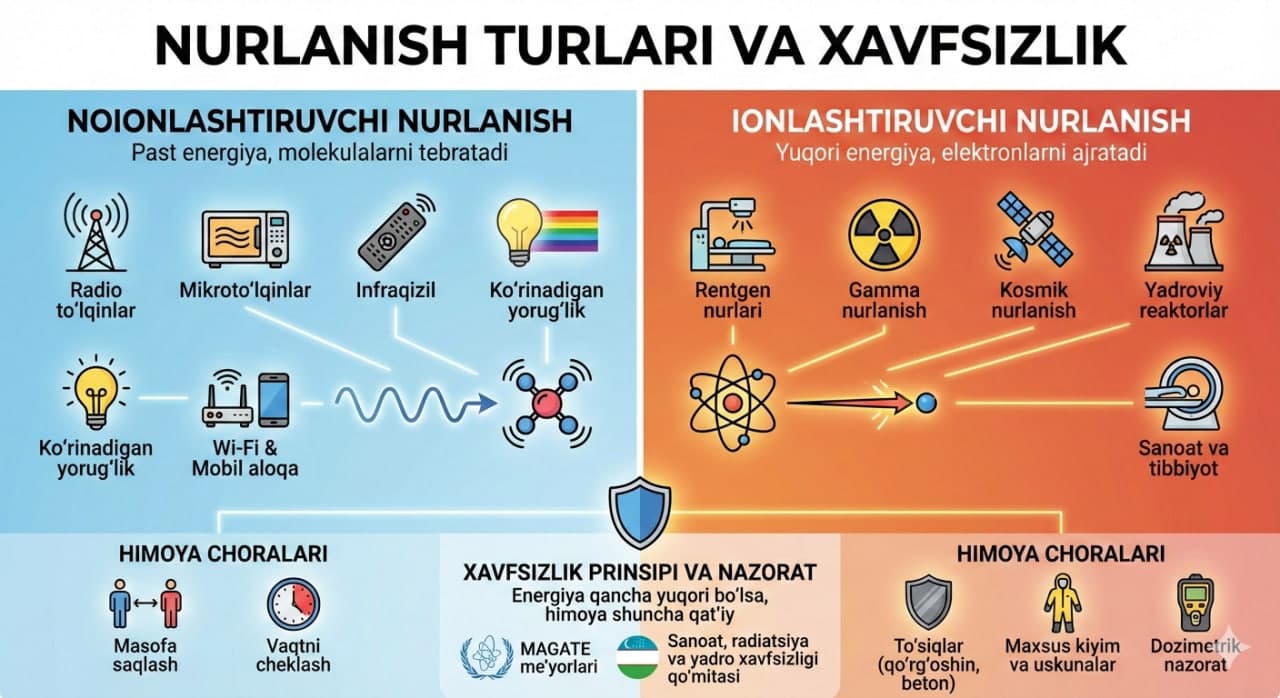
The main difference between them is the energy level and the required protection methods.
1. Non-Ionizing Radiation 📶☀️
This is low-energy radiation that does not have enough power to remove electrons from atoms or molecules (i.e., it does not cause ionization).
Effect: It does not destroy living cells but can cause molecules to vibrate, leading to heat generation.
Examples: Microwave ovens, radio waves, infrared radiation, and visible light.
Protection: Usually, maintaining distance is sufficient.
2. Ionizing Radiation ⚡️🧪
This is very high-energy radiation that, when interacting with matter (including living organisms), can knock electrons out of atoms and create ions.
Characteristic: Can cause changes at the atomic level.
Benefits: When used properly and with safety measures, it provides tremendous benefits in medicine (cancer diagnosis and treatment), industry, scientific research, and energy.
Protection: Requires strict safety procedures and special shielding.
How Is Safety Ensured? 🛡
The principle is simple: the higher the energy, the stronger the protection required.
Work with ionizing radiation sources follows strict international safety standards established by the IAEA (International Atomic Energy Agency). This allows the “power of the atom” to be used effectively without harming human health or the environment.
🚀 The Committee for Industrial, Radiation and Nuclear Safety ensures compliance with these safety standards in our country.