
Climate Change and Water Resources: Uzbekistan's New Approaches
2026-11-10 16:05:00 / News
“The issue of water scarcity is becoming increasingly urgent worldwide. Therefore, from the very first days of our reforms, we have made the rational use of water a priority of state policy.”
Shavkat Mirziyoev,
President of the Republic of Uzbekistan
Water is our most priceless blessing. Wherever it flows, there is life, prosperity, and well-being. Since ancient times, human civilization has taken shape along the water's edge, where cities have risen and agriculture has flourished. Water is not only a daily human necessity, but also a strategic asset that shapes the development of nations and the future of peoples.
However, water, which has been a source of life for centuries, is today becoming a serious challenge for humanity. Climate change, rising global temperatures, shrinking glaciers, and intensifying droughts demand a fundamental reassessment of our approach to water resources.
This issue holds particular significance for Uzbekistan. Nearly 90 percent of the water resources used in our country are allocated to agriculture. Amid a growing population and rising economic demand for water, conserving every cubic meter is a vital necessity.
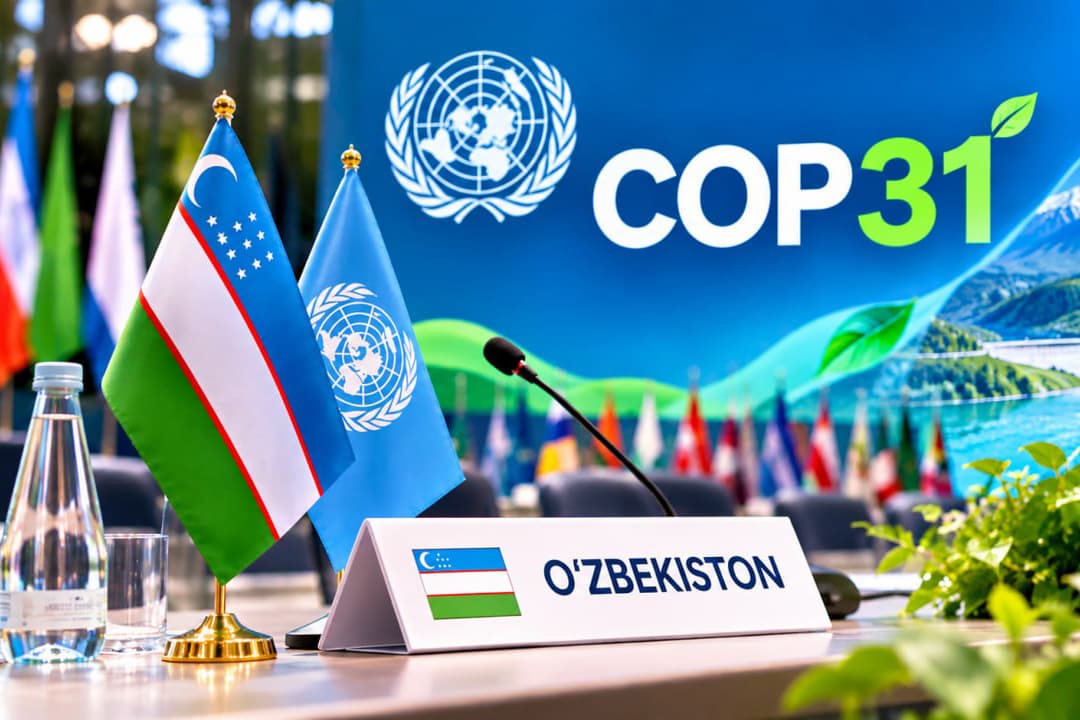
Scheduled to take place in Antalya, Türkiye, from November 9 to 20 this year, the 31st Conference of the Parties to the UN Framework Convention on Climate Change (COP31) will serve as an important platform for discussing these issues on an international scale.
As part of the conference, a summit of heads of state and government is scheduled for November 11–12. For Uzbekistan, this prestigious event will serve as another opportunity to showcase our country's practical experience in climate change adaptation, rational water management, and environmental sustainability to the international community, as well as to discuss new avenues of cooperation.
Water Conservation: A Strategic Goal and Practical Outcome
At the ceremonial event dedicated to the 35th anniversary of our country's independence, President Shavkat Mirziyoyev outlined the priority tasks of the fourth national program, which is aimed at fundamentally changing our attitude toward water and nature. A goal has been set to expand the coverage of croplands with water-saving technologies to 100 percent over the next five years. This means transforming water conservation from an isolated best practice into a universal standard for irrigated agriculture.
Let us analyze the results. For the 2026 growing season, the water withdrawal limit for economic sectors was set at 32.6 billion cubic meters, while 34.2 billion cubic meters of water resources were actually supplied (105 percent of the established limit).
From January to October 2026, 10.69 billion cubic meters of water were saved across the Republic of Karakalpakstan and the regions by implementing the following measures. Specifically:
- 4.935 billion cubic meters through the introduction of water-saving technologies and laser land leveling;
- 3.14 billion cubic meters by repairing, restoring, and lining irrigation networks with concrete;
- 670 million cubic meters through the adoption of digital technologies;
- 1.945 billion cubic meters of water were saved by increasing the share of drought-tolerant crops and implementing additional agrotechnical practices across farmlands.
While water-saving technologies were used on just 28,000 hectares in 2017, their coverage has now reached 2.8 million hectares – nearly 65 percent of all irrigated land.
During the first ten months of this year, water-saving technologies and laser land leveling were implemented across 654,000 hectares.
Specifically, drip irrigation was introduced on 144,000 hectares, and sprinkler irrigation on 28,000 hectares. Surge irrigation and flexible pipe methods were applied on another 110,000 hectares, while plastic mulch irrigation was established on 70,000 hectares. Furthermore, 302,000 hectares of land were leveled using laser equipment.
Modern Irrigation: A Key Factor in Climate Change Adaptation
Even if water-saving technologies are used in the fields, the expected results cannot be fully achieved if water is lost in transit from the source to the consumer. Therefore, priority is being given to lining canals with concrete, reconstructing hydraulic structures, and modernizing networks.
In 2026, 2.2 trillion soums were allocated for irrigation and land reclamation, resulting in the concrete lining of 1,030 kilometers of inter-farm canals and over 15,000 kilometers of on-farm canals. This helps reduce water seepage into the soil, ensure a stable supply to consumers, and increase the efficiency of existing resource use.
Land Reclamation: A Vital Prerequisite for Food Security
The degradation of irrigated land conditions can lead to lower crop yields, excessive water consumption, and a loss of soil fertility. Therefore, alongside water resource management, Uzbekistan is consistently working to improve the condition of its agricultural lands.
As a result of land reclamation measures implemented during the first ten months of 2026, the total area of saline land in the country decreased by 36,000 hectares compared to the previous year. Notably, heavily and moderately saline areas shrank by 17,000 hectares. Additionally, areas with problematic groundwater levels were reduced by 21,000 hectares.
Digital Management: Tracking Every Cubic Meter of Water
The primary prerequisite for effective water resource management is accurate accounting. Without proper measurement, it is impossible to distribute water efficiently or reliably determine the volume of losses.
To this end, a total of 13,310 “Smart Water” devices have been installed at water management facilities, along with online water meters at 1,915 pumping stations, to track and monitor water resources.
Additionally, 108 major water management facilities have been automated, and an online system for monitoring water levels and volumes has been introduced at 43 large reservoirs.
In collaboration with the Ministry of Digital Technologies and Uzinfocom LLC, the “Water Accounting” information system was integrated with the systems of the Cadastre Agency and the Tax Committee. This has enabled the online generation of water usage statements and the automatic calculation of corresponding taxes.
A “Unified Water Management Platform” has been developed, consolidating all existing information systems in the sector into a single platform.
These upgrades are expanding capabilities to track the movement of water resources in real time, minimize human error in accounting, and make prompt management decisions. Most importantly, digitalization is becoming a vital tool for ensuring accuracy and transparency in water distribution.
Water and energy conservation: Interconnected tasks
Energy efficiency also plays a crucial role in the development of the water sector. This is because nearly 60 percent of the irrigation water in our country is delivered via pumping stations – a process that consumes vast amounts of electricity.
Modernizing pumping stations, replacing outdated units with energy-efficient equipment, and utilizing renewable energy sources simultaneously deliver both economic and environmental benefits.
Over the first ten months of this year, 172 pumps and 168 electric motors that had reached the end of their service life were replaced across the ministry's system.
To harness alternative energy sources, solar photovoltaic panels with a total capacity of 15,660 kilowatts and 66 capacitor units were installed.
As a result of the measures taken, electricity consumption has been steadily declining. Specifically, while annual electricity consumption at pumping stations stood at 8.3 billion kWh in 2017, this figure is projected to drop to 6.3 billion kWh by 2026. This represents a reduction of 2 billion kWh per year, or nearly 24 percent, compared to 2017.
Regional Cooperation – A Guarantee of Shared Water Security
Transboundary rivers account for a large share of water resources in Central Asia. Therefore, using them rationally, strengthening mutual trust among states, and improving cooperation mechanisms are vital for the region's sustainable development.
On international platforms, President of Uzbekistan Shavkat Mirziyoyev consistently champions the fair and efficient use of water resources, joint adaptation to the impacts of climate change, and environmental sustainability in the Aral Sea region.
Climate change knows no national borders. Shrinking glaciers, droughts, and shifts in river flow affect the entire region. Consequently, mutual trust, science-based decisions, and practical cooperation are crucial for managing transboundary waters.
Uzbekistan to Chair the International Fund for Saving the Aral Sea Starting in 2027
On April 22, 2026, at a meeting of the Council of Heads of Founding States of the International Fund for Saving the Aral Sea (IFAS) in Astana, the President of the Republic of Uzbekistan, Shavkat Mirziyoyev, was elected President of the Fund for 2027–2029. Consequently, starting in 2027, Uzbekistan will assume the chairmanship of this prestigious regional organization. This opens up new opportunities for our country's initiatives in water diplomacy and ensuring environmental security in Central Asia.
During Uzbekistan's chairmanship, key priorities will include mitigating the consequences of the Aral Sea disaster, ensuring the sustainable management of water resources, adapting to climate change, and strengthening regional cooperation. Our Head of State put forward a series of initiatives to institutionally improve the Fund's operations, modernize its legal and financial mechanisms, attract international investments and grants for environmental and social projects, and enhance the effectiveness of ongoing programs.
Our President also proposed launching the “Water of the Future” (“Kelajak suvi”) regional program, aimed at fostering a culture of sustainable water use and broadly introducing water-saving technologies. This initiative will serve to improve water efficiency in agriculture, boost the exchange of advanced technologies and scientific developments, and instill a responsible attitude toward water resources among the younger generation.
At the same time, an initiative was put forward to declare 2026–2036 as the “Decade of Practical Action for the Rational Use of Water in Central Asia”. This proposal aims to unite the efforts of the countries in the region amid growing water scarcity, and to elevate cooperation on the mutually beneficial and efficient use of transboundary water resources to a new level.
COP31: From National Experience to Global Cooperation
The upcoming COP31 conference in Antalya holds great significance in terms of translating international commitments to combat climate change into tangible results.
For Uzbekistan, this forum will serve as a vital platform for dialogue on broadly adopting water-saving technologies, developing modern irrigation systems, enhancing digital governance, building climate-resilient infrastructure, and expanding opportunities for international investment and innovative cooperation.
Our country's experience demonstrates the importance of having a clear goal, a consistent state policy, and a practical implementation mechanism in addressing climate change challenges.
Both the scale and the responsibility of the tasks before us are immense. Further expanding the reach of water-saving technologies, reducing losses in irrigation networks, increasing the energy efficiency of pumping stations, fully digitalizing water accounting, and putting scientific achievements into practice will remain the priority areas of our future work.
Today, water management reforms in Uzbekistan are entering a new phase. Most importantly, the approach to water use is shifting: accounting for, conserving, and efficiently using every cubic meter of water is becoming an integral part of state policy, economic development, and environmental security.
In short, the consistent reforms implemented under the leadership of our President Shavkat Mirziyoev serve not only to advance our country's prosperity, but also to strengthen mutual trust and cooperation across Central Asia.
Shavkat Khamraev,
Minister of Water Resources of the Republic of Uzbekistan,
Honored Irrigator of Uzbekistan