From communication format to strategic integration
2025-11-20 10:00:00 / News
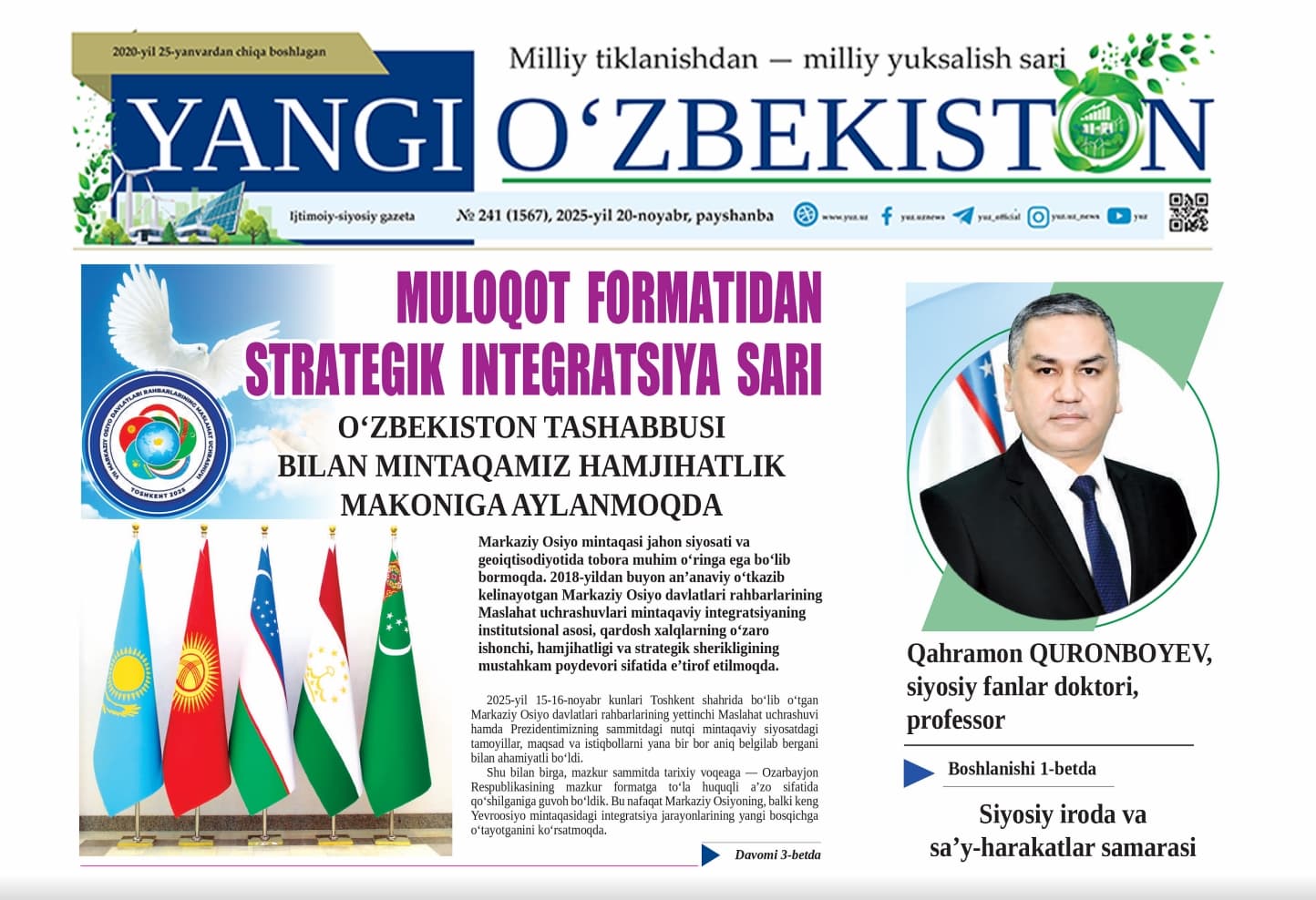
The Central Asian region is increasingly playing an important role in world politics and geo-economy. The Consultative Meetings of the Heads of Central Asian States, which have been traditionally held since 2018, are recognized as the institutional basis of regional integration, a solid foundation for mutual trust, solidarity and strategic partnership between fraternal peoples.
The Seventh Consultative Meeting of the Heads of Central Asian States, held in Tashkent on November 15-16, 2025, and the speech of President Shavkat Mirziyoyev at the summit were significant in that they once again clearly defined the principles, goals and prospects in regional policy.
At the same time, at this summit we witnessed a historic event - the accession of the Republic of Azerbaijan to this format as a full member. This indicates that the integration processes not only of Central Asia, but also of the wider Eurasian region are entering a new stage.
The fruit of political will and efforts
Let us first look at recent history. On September 20, 2017, President Shavkat Mirziyoyev, speaking at the 72nd session of the UN General Assembly, expressed his direct interest in Uzbekistan's transformation of Central Asia into a region of stability, sustainable development and good neighborliness, and put forward the initiative to organize regular meetings of the Presidents of the region.
Not long after, this proposal was supported, and on March 15, 2018, the first Consultative Meeting of the Heads of State of Central Asia was held in Astana.
At that time, the first President of the Republic of Kazakhstan, Nursultan Nazarbayev, said, “You are doing great things in Uzbekistan, and this is having a positive impact on our entire region. Yesterday I spoke with the Presidents of Tajikistan and today with the Presidents of the Kyrgyz Republic. They also said that your political will and efforts make our peoples happy. Today's Consultative Meeting of the Heads of State of Central Asia was also organized on your initiative. This is just the beginning.”
In general, the main goal of the Consultative Meetings was to strengthen stability, economic development and friendship in Central Asia.
With the joint efforts of the heads of state, a new political environment based on mutual trust and good neighborliness has been formed in our region. Dialogues at all levels have become more active, and important historical steps have been taken to establish practical, mutually beneficial and multifaceted cooperation. Over the past short period of time, this format has achieved many important results, including: the opening of borders, free movement of people, agreements on water and energy, the restoration of transport links, a steady increase in mutual trade, and increased cooperation in the security sector.
As Shavkat Mirziyoyev rightly noted in his article “Central Asia on the Threshold of a New Era,” a new economic reality is being formed in the region through the efforts of the states. Over the past eight years, the gross domestic product of the Central Asian countries has grown by almost two and a half times, reaching $520 billion, and the volume of foreign trade has more than doubled, reaching $253 billion. At the same time, the volume of mutual trade between the countries of the region has increased by 2 times, reaching almost $11 billion, and mutual investments have increased by 5.6 times. If we take our country alone, the volume of Uzbekistan's trade with the countries of the region increased from $2.4 billion in 2016 to $7.2 billion in 2024, and the number of joint ventures exceeded 1,800.
As our President put it, over the past short period of time, our region has fundamentally changed, and effective solutions to pressing problems have been found thanks to open dialogue and active practical cooperation. Today, Central Asia has truly become a place of rapid development and solidarity.
Central Asia and the South Caucasus - a new axis of unification
The relations between the countries of Central Asia and Azerbaijan are of a special nature. These relations are based on a centuries-old common history, spiritual and cultural heritage, brotherhood, friendship and solidarity. In recent years, these relations have not only been preserved, but also elevated to the level of strategic partnership. The fact that the Republic of Azerbaijan was accepted as a full member of the Consultative Meeting of the Heads of State of Central Asia can be cited as a practical confirmation of this.
Shavkat Mirziyoyev explained this principled decision as follows: “This strategic step fully meets the interests of our peoples, who are inextricably linked by common history, brotherly ties, spiritual and cultural closeness.
I firmly believe that the accession of brotherly Azerbaijan will give a strong impetus to our Consultative meetings, expand trade-economic, investment, cultural-humanitarian cooperation, as well as open up new horizons for the development of joint decisions on issues of sustainable development.
In essence, we are building a strong bridge between Central Asia and the South Caucasus, paving the way for the formation of a single space of cooperation. This will undoubtedly strengthen the strategic connection and stability of the two regions. ”
In turn, Ilham Aliyev said: “I would like to thank my colleagues for the decision to join Azerbaijan in the format of cooperation of the Central Asian states. This decision once again confirms the friendly and fraternal spirit of our relations, and serves to develop cooperation in a wide geography,” he said.
It is worth noting that this step is of historical importance in several respects. First, a new axis of geoeconomic integration has been created. Azerbaijan is a leading state in the Caspian region, an economic center in the South Caucasus, and an important link in the Europe-Asia transport corridor. Its accession opens up new prospects for the trans-Caspian corridors, the “Azerbaijan-Central Asia-Europe” trade route, and energy cooperation.
Secondly, it will serve to increase the international prestige of Central Asia. As our President has specifically emphasized, with the accession of Azerbaijan to the Consultative Meeting of the Heads of State of Central Asia, the voice of our region in the world community will undoubtedly become even more important.
Thirdly, structural expansion will make a significant contribution to regional stability. Because the South Caucasus is is a very sensitive geopolitical region, and its rapprochement with Central Asia will serve to strengthen the atmosphere of stability and trust in Eurasia.
In this sense, the words of our head of state that “we are building a strong bridge between Central Asia and the South Caucasus” determine a clear strategic direction for the future of the region.
The changing agenda of the region
Recently, the number and scope of dialogues in the “Central Asia Plus” format have been increasing year by year, that is, today there are about 10 such formats. Most importantly, President Shavkat Mirziyoyev is taking several important initiatives within the framework of the “Central Asia Plus” formats and is trying to increase the strategic significance of dialogues in this format. That is, the main goal pursued is to move from the “dialogue format” to “strategic integration” and effectively use practical cooperation mechanisms.
It should be noted with pleasure that at the Consultative Meetings of the Heads of State of Central Asia A number of proposals put forward by Uzbekistan, such as the development of trade, economic, investment, transport, communication and energy, cultural, humanitarian and other sectors, solving water and environmental problems, and providing the population with food products, are being unanimously supported and are being implemented in life.
In this sense, at the Tashkent summit, Shavkat Mirziyoyev put forward extremely valuable initiatives aimed at defining the prospects for regional integration for the next 10-20 years. Among them, the following can be recognized as the five most important areas.
First, strengthening the institutional foundations of the Consultative Meeting, namely, creating the strategic format of the “Central Asian Community”, establishing a permanent Secretariat, and establishing the Council of Elders. These steps will undoubtedly ensure that the format becomes a formal, stable and effective institutional structure.
Secondly, increasing trade and investment by 1.5-2 times, i.e. A regional economic program until 2035, a declaration on a single investment space, a common platform for e-commerce. Currently, trade between the countries amounts to $10.7 billion. There is a possibility of doubling this figure in the next 5-7 years.
Thirdly, the issue of regional infrastructure and transport corridors. Projects such as the China-Kyrgyzstan-Uzbekistan railway, the Trans-Afghan corridor, and the Trans-Caspian corridor can turn Central Asia into one of the global trade centers.
Fourthly, there are security and stability mechanisms, which, in turn, imply a regional security concept, a catalog of threats, and the integration of Afghanistan into economic projects.
Fifthly, attention to ecology and water resources, the announcement of the “Decade of Rational Water Use in Central Asia”. At the same time, the adoption of a common “green development” concept, the establishment of the Water Management Center in Tashkent opening a center of competences. After all, water scarcity is the biggest concern in the region. Cooperation in this area is the main guarantee of peace and stability.
Another of the far-reaching directions of President Shavkat Mirziyoyev’s speech at the Tashkent summit is the idea of forming a single spiritual and cultural space in Central Asia. It is no coincidence that in today’s unstable geopolitical environment, enlightenment, knowledge and culture are gaining importance as a unifying force. This can be seen in the establishment of the Center for Islamic Civilization and the holding of the first international congress dedicated to the spiritual heritage and ideas of enlightenment in Tashkent.
Based on the above, Uzbekistan proposed the adoption of a Special Resolution of the UN General Assembly dedicated to the contribution of prominent scientists and thinkers of our region to the development of global enlightenment, and the establishment of a Regional Scientific Research Fund. Undoubtedly, these initiatives will serve to restore the great position of Central Asia on the world spiritual map.
These initiatives are aimed at one goal - to revive in modern conditions the vast land of enlightenment, which educated such figures as Abu Rayhan Beruni, Abu Ali ibn Sino, Mirzo Ulugbek, Alisher Navoi, and where science was revered as a primary value. This move will strengthen scientific and cultural ties and strengthen Central Asia's position as an even more influential player in the world's intellectual competition and innovation arena.
Shavkat Mirziyoyev is recognized by world leaders
It is no exaggeration to say that in the coming months, Uzbekistan has become the most active participant in world foreign policy. President Shavkat Mirziyoyev's two trips to the United States, the first visits to our country by the Presidents of Slovakia and Finland, the 43rd session of the UNESCO General Assembly, and many other important international events are vivid proof of our idea.
These prestigious conferences and meetings are the result of Shavkat Mirziyoyev's far-sighted, wise and pragmatic foreign policy. Such initiatives and ideas of the head of our country are highly appreciated by the leaders of leading countries of the world.
The leaders of the Central Asian countries and Azerbaijan, who participated in the Tashkent summit and bilateral official meetings, also noted that Shavkat Mirziyoyev is gaining great prestige in world geopolitics with his active position aimed at international solidarity and sustainable development.
President of Kazakhstan Kassym-Jomart Tokayev, noting that the role of the leader of Uzbekistan in the development of Uzbek-Kazakh relations to an unprecedented level today, as well as the recognition of Central Asia as a region of friendship and cooperation, is incomparable, and congratulated the head of our state on the successful holding of the UNESCO General Conference in Samarkand.
The President of Kazakhstan described Shavkat Mirziyoyev as a leader recognized by the Uzbek people, a great statesman who has great influence in the international arena, and who has built a new Uzbekistan. Thanks to the firm and effective leadership of President Shavkat Mirziyoyev, Uzbekistan has achieved impressive results in many areas and is recognized as a successfully developing country all over the world.
The President of Kazakhstan expressed his support for the proposals made by the head of our state at the summit.
Another noteworthy point. The day before, on November 15, the President of the Republic of Kazakhstan Kassym-Jomart Tokayev, in a statement to the media, stated that in the thirties and forties, all the intellectuals of Kazakhstan studied in Tashkent, and because of this, the phrase “He saw Tashkent” has now been formed in the country. “Mukhtar Avezov and other prominent intellectuals studied here. Since then, there is an expression in the Kazakh language: ‘he saw Tashkent,’” Tokayev said.
In his speech, President of the Kyrgyz Republic Sadir Japarov also congratulated the leader of Uzbekistan on the successful holding of the 43rd session of the UNESCO General Assembly in Samarkand. He noted that the session was held outside Paris for the first time in 41 years, which was a truly historic event confirming the increasing role of Central Asia in international humanitarian processes. Sadir Japarov noted that he always comes to fraternal Uzbekistan with a special feeling, where the atmosphere of true solidarity of Central Asia is felt.
President of Azerbaijan Ilham Aliyev noted that Uzbekistan, under the wise leadership of Shavkat Mirziyoyev, is boldly moving along the path of development and creativity. Great international influence, effective economic reforms, large-scale projects in the fields of industry, transport, and agriculture have brought Uzbekistan to a leading position in the region. It was recognized that thanks to the care of the President, Uzbekistan is among the leading sports countries in the world, as the recent Summer Olympic Games clearly demonstrated.
Ilham Aliyev emphasized that Shavkat Mirziyoyev is not only a wise statesman, but also a person who has made a great contribution to the development of relations between Uzbekistan and Azerbaijan. He expressed his boundless respect for the head of our state in Azerbaijan for his concrete work and good attitude towards this nation.
Strengthening the concept of "New Central Asia"
It is appropriate to recognize the seventh Consultative Meeting held in Tashkent as an important step towards a new political direction in the history of the region. The fact that Azerbaijan joined this format, major strategic projects were put forward, and new mechanisms for security and economic cooperation were proposed - all this is evidence that the concept of "New Central Asia" is rising from a theoretical idea to the level of practical policy.
Thus, Central Asia is emerging as a region that determines its own interests and common future. In this process, it is no exaggeration to say that the statement of President Shavkat Mirziyoyev “Our strength is in unity, our path is in friendship and cooperation” has become the spiritual and political motto of the entire format.
After all, Central Asia is not just an increase in economic potential or the expansion of logistical corridors. It is an expression of common values, a common history and a common responsibility for the future. Practical cooperation, pursued with a strong political will, will naturally make Central Asia a more attractive and strong region in global political and economic processes.
From issue 241 of the “Yangi Uzbekiston” newspaper
Kahramon Kuronbayev,
Doctor of Political Sciences, Professor