
EDUCATION AND UPBRINGING ARE THE FOUNDATION OF A GREAT FUTURE, AND A DEDICATED PEDAGOGUE IS ITS STRONG PILLAR
2026-10-08 20:25:00 / News
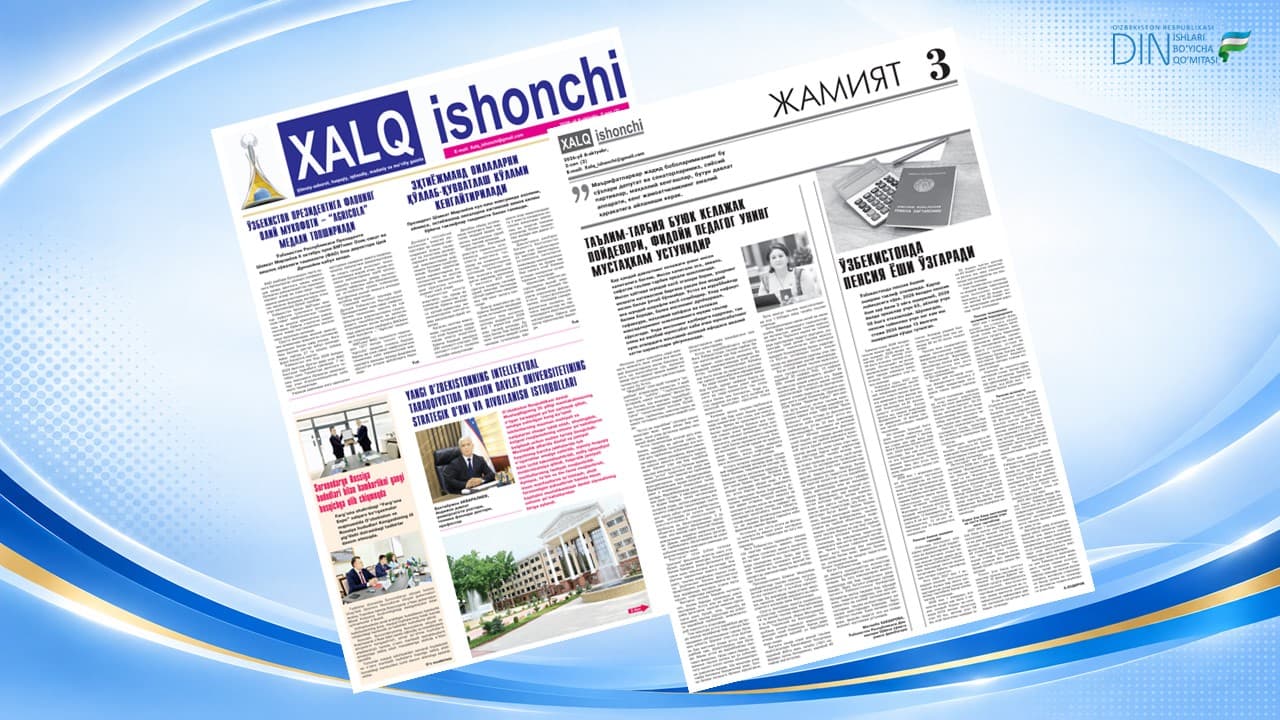
The future of any state depends on human capital. Human capital, in turn, is formed primarily through quality education and upbringing.
In human life, there are representatives of professions whose labor results cannot be measured solely by a single number or material criterion. Teachers and mentors are the owners of such an honorable profession. They not only impart knowledge, but also have a significant impact on the formation of a person's worldview, thinking, spiritual image, and future goals. This harmoniously combines practical actions that reflect a person's internal attitude in the form of spiritual and moral behavior, such as appreciation, recognition, and a positive attitude.
A teacher is a person who highly evaluates a person, their personality, dignity, labor, age, scientific or spiritual qualities, and shapes the intellectual potential of society through words, communication, and actions.
The word "murabbiy" (mentor) is derived from the Arabic term. It is connected with the Arabic verb "rabba" — to educate, nurture, and perfect. In this regard, the etymological content of the concept of "mentor" is broader than the simple concept of "teacher" and covers the ideas of nurturing, educating, shaping, and bringing to perfection.
The concepts of "teacher" and "mentor" are close in meaning, but not identical; there is a certain semantic difference between them. While the concept of a teacher focuses primarily on imparting science, knowledge, experience, and life lessons, the concept of a mentor focuses on educating, developing abilities, shaping, guiding, and bringing a person to perfection. Therefore, every mentor can be a teacher in a certain sense, but the concept of a "teacher" does not always fully reflect the practical and educational functions of mentoring. An important feature of mentoring is that it requires an individual approach. Motivation plays an important role in mentoring: it helps define goals, acknowledges small achievements, explains mistakes as an opportunity for development, encourages independent decision-making, and helps build confidence in the student's own strength. A mentor is a guide and director. They show the direction of movement to their subject, lead them towards the goal, and accompany them in the process of development. Consequently, a mentor is a person who teaches, educates, guides, and purposefully develops a person's abilities.
The word "o‘qituvchi" (teacher) in the Uzbek language is a noun derived from the verb "o‘qitmoq" (to teach) and lexically means a person who imparts knowledge to others and teaches them to read and learn. They are viewed as a specialist who carries out the teaching action, organizes the educational process, directs and develops the student's cognitive activity, and participates in the upbringing process.
A teacher is an educational specialist who imparts knowledge and forms skills; a master teacher (ustoz) is a person who teaches science and life experience, shows a personal example, provides scientific, empirical, and spiritual influence; and a mentor (murabbiy) educates, develops, and brings to perfection.
Of course, in the true sense of a master-mentor, we witness the unification of these tasks in a single person. Therefore, today a teacher is simultaneously a master, a mentor, and a guide. It is masters and mentors who develop the skills of independent thinking, asking correct questions, analyzing problems, and gaining confidence in one's own abilities. In this sense, they are not providers of ready-made knowledge, but rather function as a guiding torch showing the way to seek knowledge.
Respect for teachers and mentors in New Uzbekistan means high respect and honor for every person engaged in education and upbringing. This approach expresses a respectful relationship based on value towards every young person growing up in our country, who will be the creator of the future.
There is an important spiritual aspect here: respect is connected not only with glorifying someone, but also with the idea of recognizing the inviolability and dignity of a person. It embodies the idea of realizing human dignity, showing attention and appropriate attitude towards them.
Every person responsible for the education and upbringing of the future generation must recognize the dignity of another person, not infringe upon it, treat their opinions and rights with attention, be able to listen, communicate politely even when rejecting their opinion, regardless of age or social status, respect the personal space and rights of another person, and base their attitude primarily on human dignity rather than external status.
Respect for the teacher holds a special place in the spiritual values of our people. Valuing their knowledge, experience, and contribution to the upbringing of students is an important manifestation of respect. Respect consists of more than just greeting or addressing someone respectfully. It is manifested primarily in valuing the knowledge given by the teacher, approaching science responsibly, continuing the teacher's work with worthy results, contributing to the development of man and society through honest labor and potential, showing appropriate attitude not only to people but also exercising careful attitude towards nature and the environment, and most importantly, loyalty to the Motherland.
The greatest achievement and service to the Motherland of a teacher are primarily the knowledge, thinking, and noble deeds of their students.
Speaking about the development of New Uzbekistan, first of all, it is appropriate to emphasize the large-scale reforms being implemented in the field of education and upbringing. After all, the future of any society is closely connected with the education system and the opportunities created for the younger generation.
Under the leadership of President Shavkat Mirziyoyev, great attention is paid to radically reforming the education system, in particular the spiritual and educational sphere. In this process, special place is given to the status, labor, professional skills, and responsibility of the pedagogue.
As a result of the reforms implemented in recent years, 14 religious educational institutions and 4 research centers — Imam Bukhari, Imam Maturidi, Imam Termiziy, and Bahauddin Naqshband — operate in the republic. Within a short period, coverage has increased nearly threefold.
Today, nearly 800 students (over 1001 graduates) are studying at the bachelor's level of higher religious educational institutions, along with about 40 master's students; over 1,000 students are studying in secondary specialized educational institutions.
Distribution projects are being developed for graduates to work as imam-khatibs and assistant imams, specialists in organizations within the Muslim Board of Uzbekistan system, pedagogical teachers in religious educational institutions and "Quran and Tajweed" training courses, as well as female graduates of higher religious educational institutions to work based on the staffing needs of regional departments.
Today, nearly 30 of the professors and teachers in higher religious educational institutions hold PhD degrees, 10 hold DSc scientific degrees, as well as academic titles of docent and professor. Similarly, the scientific and pedagogical potential of professors and teachers in secondary specialized religious educational institutions is growing day by day. Also, in 2026, the "Khadichai Kubro" women's secondary specialized Islamic educational institution celebrated its 33rd glorious history. The master mentors of this institution, which began its activities in 1993 under the name "Eshon Boboxon", have worked effectively over the past 33 years on the path of enlightenment, spirituality, and moral perfection, making a worthy contribution to the development of religious and educational training and upbringing in our country. All conditions have been created in this institution for women to receive religious education, and wide opportunities are provided for female students to study in a peace and calm environment, acquire a profession, and fully demonstrate their talent. Thanks to the dedicated work of the master mentors carrying out their pedagogical activities in these educational institutions, the torch of science and enlightenment has been shining in these places for many years. Indeed, any reform can be adopted on paper, but the first person who puts it into practice is the pedagogue. Therefore, today a pedagogue is required not only to impart knowledge, but also to use modern pedagogical technologies, understand the individual abilities of the learner and the object of upbringing, teach through games, and apply an individual approach to each pupil. These goals place a great responsibility on pedagogues. Because improving the quality of education is ensured not only by new buildings or modern equipment, but primarily by knowledgeable, inquisitive, and caring pedagogues.
Today, the reforms implemented in the field of education in Uzbekistan are the most important investment in the future. In realizing these noble goals, the role of each pedagogue is incomparable. After all, in the hands of today's teachers lies the fate of the generation that will be the creator of tomorrow's Uzbekistan. Therefore, respecting the pedagogue, supporting them, and enhancing their professional potential is one of the most important conditions of educational reforms. Quality education is the foundation of a great future, and a dedicated pedagogue is the strong pillar of that foundation.
Matluba KAXXAROVA,
Deputy Chairman of the Committee on Religious Affairs of the Republic of Uzbekistan