
ENLIGHTENMENT AND TOLERANCE — THE SPIRITUAL FOUNDATION OF NEW UZBEKISTAN
2026-09-21 18:10:00 / Statements and speeches of administration
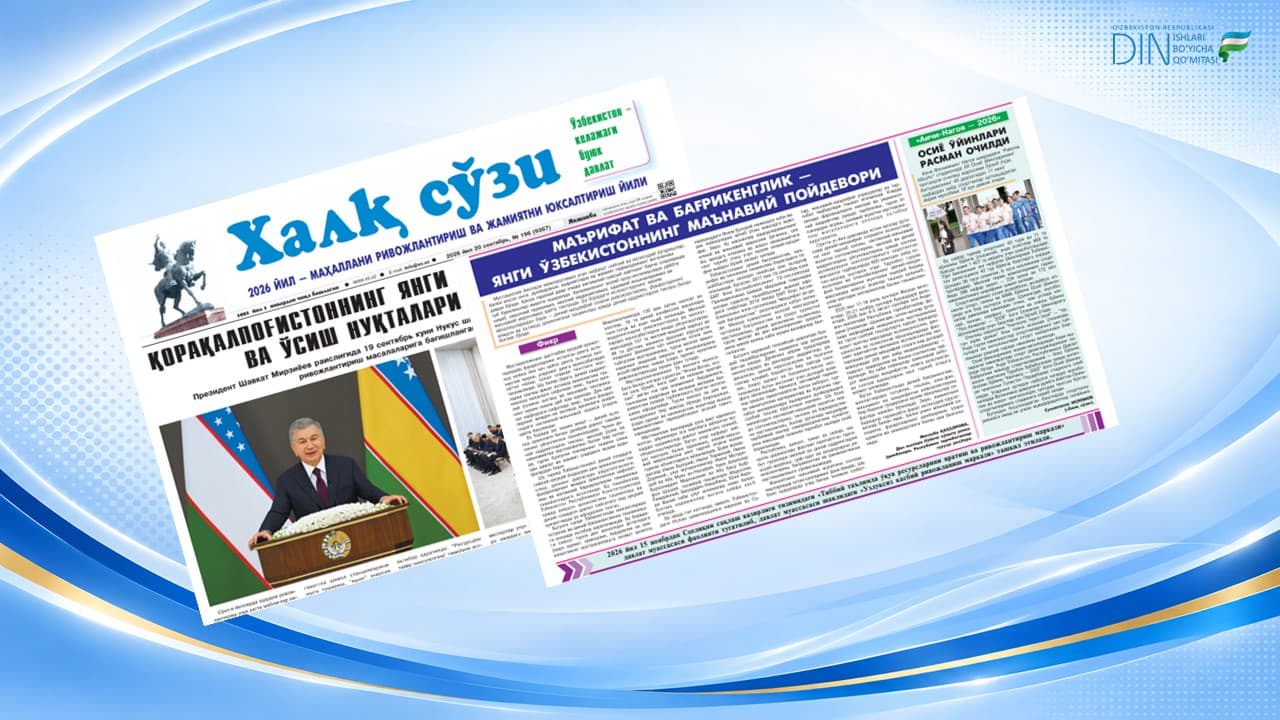
The years of independence have become a period for our country not only of political and economic transformation, but also of renewal in people’s consciousness, worldview, values and social thinking. Within a relatively short historical period, profound changes have taken place across all spheres of socio-political life. The centuries-old aspirations of our people have been realized, while our authentic history, national culture, ancient traditions and spiritual heritage have been revived. One of the important areas of reform has been the development of the religious and educational sphere, the protection of citizens’ freedom of conscience and religion, and the revival of religious values.
From the earliest legal documents adopted during the period of independence, citizens were guaranteed the right to profess any religion or no religion at all, as well as equality before the law regardless of their attitude toward religion. At the same time, the revival of religious values was viewed not only as a matter of ensuring freedom of religion, but also as an important factor in strengthening national identity and spiritual renewal. Religion came to be regarded not as a state ideology, but as a social and spiritual phenomenon within the framework of citizens’ freedom of conscience and religion.
One of the most important aspects in this regard is ensuring harmony between freedom of religious belief and the principles of a secular state. Along with restoring religious values and strengthening national identity and spirituality, preventing the spread of various destructive ideas remains an important responsibility of both the state and society.
Accordingly, Uzbekistan’s political and legal approach to the religious sphere is based on recognition of freedom of religion, the principle of separation of religion from the state, guarantees of citizens’ freedom of conscience and the maintenance of social stability. These principles are reflected in the Constitution of the Republic of Uzbekistan, as well as in legal acts regulating freedom of conscience and state policy in the religious sphere.
Today, Uzbekistan pays particular attention to strengthening interethnic harmony and religious tolerance. Policies pursued in this area contribute to greater mutual respect, cooperation, unity and solidarity among representatives of different religions.
Representatives of more than 130 ethnic groups and 16 religious denominations live together in peace and harmony in our country. In order to promote national cultures and further strengthen interethnic relations, 157 national cultural centers and 46 friendship societies are currently operating. Their activities play an important role in strengthening a sense of belonging to one multinational people, preserving the cultural heritage and traditions of different ethnic groups, and fostering an atmosphere of mutual respect.
The idea “One Homeland, one people — together let us create a new life and future!”, put forward in connection with the 35th anniversary of our independence, also reflects the aspirations of our people for unity, appreciation of peace and the upbringing of future generations in a spirit of tolerance. The ability of representatives of different ethnic groups and religions to unite around a common goal and live in an atmosphere of mutual respect and solidarity is one of the fundamental pillars of our country’s development.
During the years of independence, sacred sites that had long been neglected, some of which had fallen into disrepair, were placed under state protection and extensively improved. Today, they are becoming not only places of pilgrimage but also important tourism destinations that promote our history and scholarly and spiritual heritage. Sites associated with such great scholars as the eminent hadith scholars Imam Bukhari, Imam Termizi and Imam Darimi; renowned theologians Imam Maturidi and Abu Muin an-Nasafi; distinguished jurists Burhaniddin Marginani and Abu Bakr Qaffal Shashi; and leading Sufi figures Abdukholiq Gijduvani, Bahauddin Naqshband and Khoja Ahror Vali are taking on a renewed appearance.
In this regard, particular mention should be made of major projects such as the Center of Islamic Civilization in Uzbekistan and the Imam Bukhari Complex in Samarkand. These institutions are intended to serve as important scholarly and educational platforms for studying the intellectual and spiritual heritage of our ancestors, passing it on to younger generations and presenting it widely to the international community.
Uzbekistan’s initiatives aimed at promoting religious tolerance, enlightenment and peace have also gained recognition internationally. In particular, as a practical expression of the initiative put forward by President Shavkat Mirziyoyev at the 72nd session of the United Nations General Assembly on 19 September 2017, the UN General Assembly adopted the resolution “Enlightenment and Religious Tolerance” at its plenary session in 2018. Among the key objectives of the document are strengthening tolerance and mutual respect, ensuring freedom of religion, and protecting the rights of representatives of different ethnic groups and religions.
In today’s complex geopolitical environment, the significance of such initiatives is greater than ever. At a time when interethnic and interreligious tensions, radicalism, religious intolerance and destructive ideas are intensifying in certain parts of the world, strengthening peace, mutual respect and tolerance has become an urgent task for all humanity. In particular, false information, manipulative materials and destructive propaganda disseminated through social media can adversely affect the worldview of young people. Therefore, systematic educational and outreach activities are being carried out to further improve the social and spiritual environment, strengthen peace and stability, and increase the effectiveness of educational work among young people.
Outreach groups operating at the national, regional, district, city and mahalla levels contribute to preserving national and religious values, developing customs and traditions, and strengthening tolerance and social harmony.
Women play an invaluable role in strengthening the spiritual environment of society. For this reason, regular discussions, spiritual and educational meetings, and outreach activities are organized for women in the regions. Particular attention is paid to raising children in the spirit of national and universal human values, protecting them from alien and harmful ideas, and strengthening a healthy family environment.
Over the past three years, more than 600,000 women have participated in targeted activities aimed at promoting reforms in the religious and educational sphere, improving the social and spiritual environment, harmonizing national and religious values, and fostering a sound worldview. Special training courses are regularly organized to enhance the religious and educational knowledge of outreach group members and otinoyilar — women engaged in traditional religious and educational work — and they are provided with methodological materials.
On 17–18 July 2025, a Republican Forum of Outreach Group Members was held in Jizzakh Region; on 20–21 November, a similar forum took place in Kashkadarya Region; and on 4–5 August 2026, another forum was held in Andijan Region. In addition, more than 200 media projects — including podcasts, videos and other forms of content — have been produced on topical issues in the religious and educational sphere with the participation of qualified specialists in Islamic studies, religious studies and psychology. These projects are aimed at strengthening women’s resilience to harmful influences and promoting informed, knowledge-based and constructive perspectives in the modern information environment.
Today in Uzbekistan, the promotion of religious tolerance and interethnic harmony, alongside the development of education, science, spirituality and enlightenment, constitutes a set of mutually reinforcing priorities. Sustainable development of society is determined not only by economic indicators, but also by its spiritual potential, the worldview of its citizens, mutual respect and social harmony.
Matluba QAHHOROVA,
Deputy Chairperson of the Committee on Religious Affairs