
Agency tasks and functions
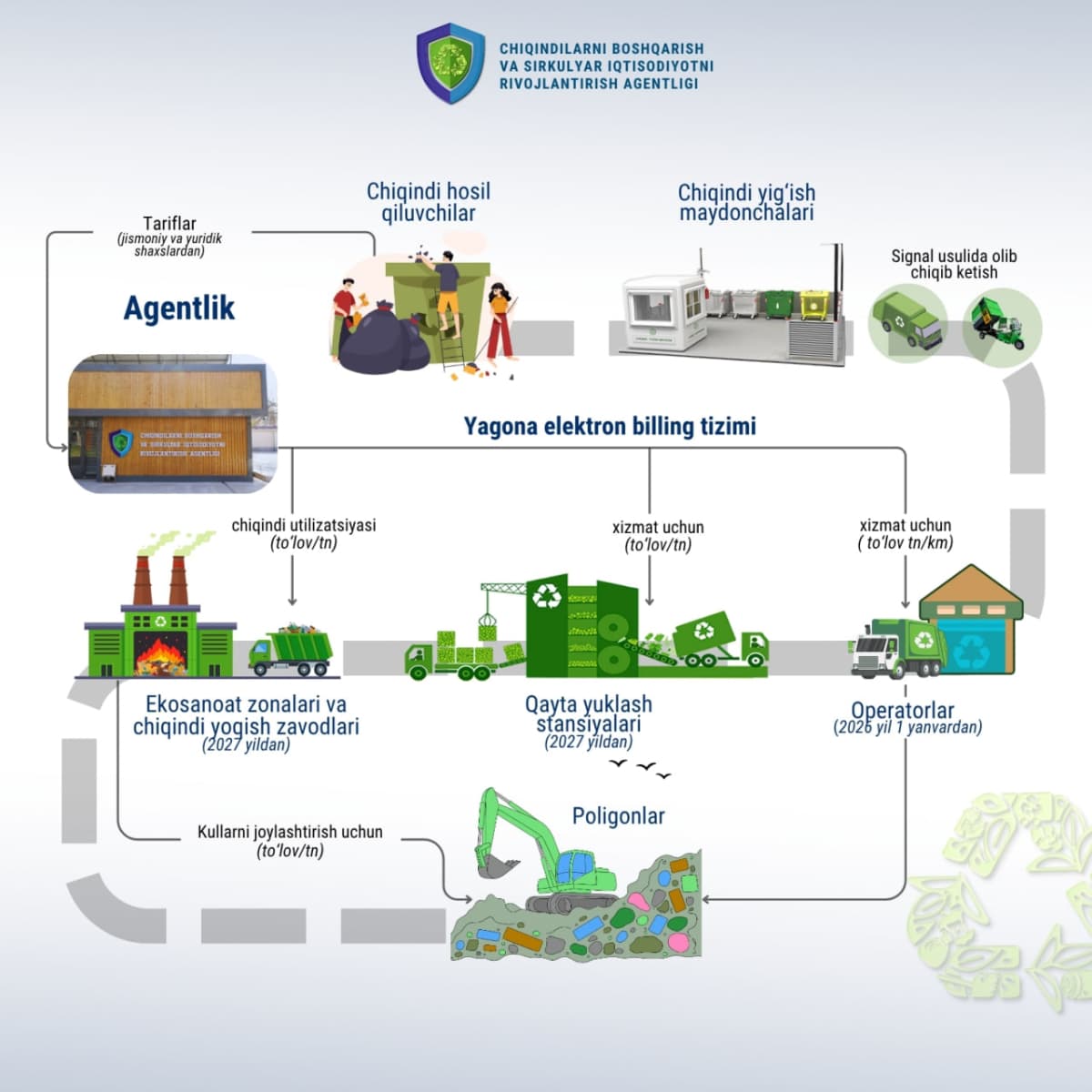
TASKS AND FUNCTIONS OF THE WASTE MANAGEMENT AGENCY
On October 16, 2025, the Cabinet of Ministers adopted a Resolution “On measures to organize the activities of the Waste Management and Circular Economy Development Agency under the Ministry of Ecology, Environmental Protection and Climate Change of the Republic of Uzbekistan.”
The establishment of the Agency was carried out in accordance with Presidential Decree No. 149 of September 26, 2024, “On measures to ensure transparency and further improve the management system in the fields of ecology and environmental protection.”
The document stipulates that, based on the Republican Center for Sanitation Services under the Ministry of Ecology, Environmental Protection and Climate Change, a state institution — the Waste Management and Circular Economy Development Agency — is established while retaining the existing staff units.
The government resolution approves the Charter defining the Agency’s status, main tasks, functions, rights, responsibilities, the functional duties and accountability of its leadership, and the procedure for organizing its activities.
The Agency is the authorized state body responsible for developing, testing and implementing unified norms and standards in the field of waste management, coordinating activities in this area, and managing state property related to waste management.
The abbreviated name of the institution is Waste Management Agency.
The structure of the Agency includes the central office, the Waste Management and Circular Economy Development Agency of the Republic of Karakalpakstan, regional and Tashkent city departments, as well as the following subordinate state institutions:
“Landfill Management Directorate,” “Toza Hudud,” “Makhsustrans,” and “Maroqand Obod.”
The main tasks of the Agency include:
-
developing, testing and implementing unified norms, regulations, and standards in the field of waste management;
-
coordinating activities in the waste management sector;
-
improving waste management legislation and preparing proposals for national and regional programs;
-
participating in establishing waste generation norms and creating waste disposal facilities;
-
ensuring the uninterrupted operation of the unified electronic system for accounting and payment of mandatory fees for waste collection and disposal;
-
improving management of household, construction, liquid, toxic-chemical, medical, and electronic waste, introducing modern recycling methods and the “zero waste” principle;
-
organizing measures to develop the circular economy through recycling waste into energy resources, raw materials, and materials;
-
creating eco-industrial zones at landfills for collection, sorting, neutralization, recycling, incineration, utilization, and destruction of waste;
-
attracting loans and grants from international financial institutions, foreign government financial organizations, and direct investments from local and foreign investors;
-
analyzing the justification of tariffs for waste collection, transportation, sorting, processing, recycling, and disposal;
-
expanding private sector participation and implementing public-private partnership projects;
-
monitoring the activities of sanitation enterprises and business entities, addressing identified issues, and jointly evaluating their efficiency with local authorities;
-
digitalizing the waste management sector and introducing modern information and communication technologies.
The Agency is authorized to:
-
request necessary information from republican and local executive bodies and other organizations;
-
cooperate with international and foreign organizations, implement and coordinate joint programs;
-
engage international and foreign consultants and experts, financed by the Ecology Fund or other legal sources;
-
conclude contracts for services in the field of waste management and circular economy development using funds from the Ecology Fund and off-budget sources in accordance with public procurement legislation;
-
prepare proposals on financing the waste management and circular economy system, attract foreign loans and grants;
-
suspend or annul orders of heads of territorial divisions and subordinate organizations issued in violation of the law;
-
establish unpaid scientific-methodical and public councils consisting of leading scientists, professors, specialists, and representatives of various institutions;
-
hold conferences, seminars, symposia, exhibitions, fairs, and participate in other related events;
-
submit proposals for rewarding leading employees in the field with certificates of honor, medals, and other awards;
-
transfer state real estate between subordinate organizations of the Agency with the approval of the Agency for State Asset Management and the Ministry;
-
study the activities of sanitation enterprises regardless of their legal form, and perform other related functions.
The Agency is headed by a Director, who is appointed and dismissed by the President of the Republic of Uzbekistan.
The Director has one Deputy Director, who is appointed and dismissed by the Cabinet of Ministers in agreement with the President of the Republic of Uzbekistan.