About the Agency
On September 26, 2024, by Presidential Decree No. PF-149 signed by the President of the Republic of Uzbekistan, the Agency for Waste Management and Circular Economy Development was established on the basis of the Republican Center for Sanitary Cleaning Works Organization under the Ministry of Ecology, Environmental Protection and Climate Change. (lex.uz)
In accordance with the Presidential Decree of the Republic of Uzbekistan No. PF-149 dated September 26, 2024, the Waste Management and Circular Economy Development Agency was established on the basis of the Republican Center for Sanitation Services under the Ministry of Ecology, Environmental Protection and Climate Change.
The Waste Management and Circular Economy Development Agency of the Republic of Uzbekistan, in addition to effectively organizing the collection, transportation, and disposal of waste across the country, implemented systemic reforms in the field of waste management.
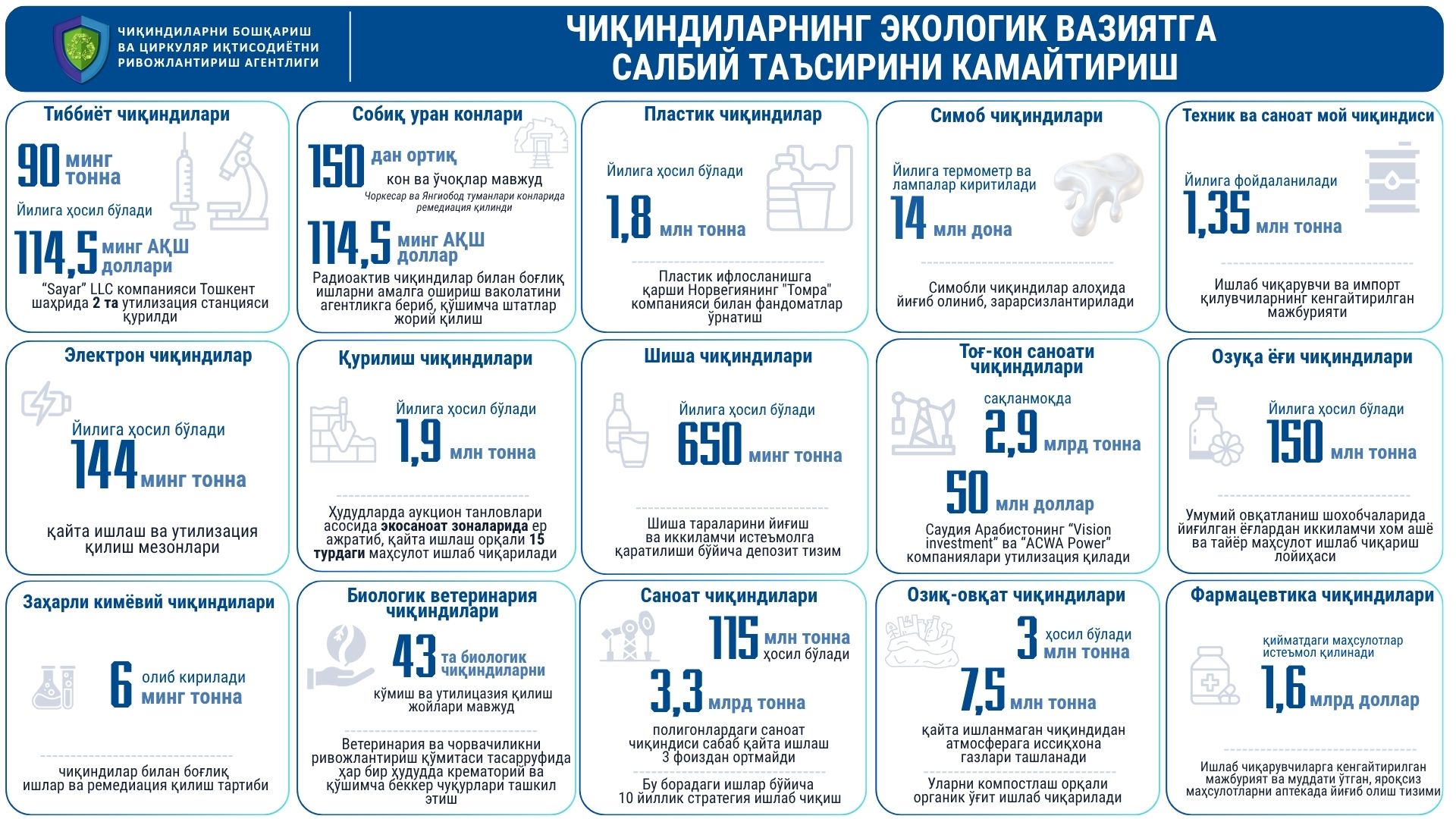
Besides providing waste collection and sanitation services, the Agency also engaged in the recycling and neutralization of fourteen types of waste. This activity played a crucial role in ensuring environmental safety, promoting the rational use of natural resources, and advancing the principles of a circular economy.
To ensure the safe disposal of medical waste, two modern utilization stations were built in Tashkent. Remediation works were carried out to ensure the safety of cold uranium mines and radioactive waste. Cooperation was established with international companies in the field of plastic waste recycling.
Mercury-containing waste was collected and neutralized separately. A system of extended producer responsibility was introduced for the recycling of technical and industrial oil waste. Procedures for the collection, sorting, and recycling of electronic waste were developed. The production of recycled materials from construction waste was launched.
Practical work was carried out to implement a deposit system and glass recycling. International cooperation projects on the utilization of mining industry waste were implemented. Mechanisms for obtaining secondary raw materials from food and fuel waste were introduced.
Procedures for the storage and neutralization of hazardous chemical waste were established. A system for collecting and utilizing biological and veterinary waste was developed. A long-term strategy for industrial waste management was formulated. Valuable products were returned to the economy through the recycling of pharmaceutical waste.
By studying international experience, the Agency achieved significant results in returning waste to the economy as secondary resources, ensuring environmental safety, and promoting the principles of the “green economy.”