
Uzbekistan Launches the Unified ECODATA Platform for Biodiversity Data Management
2026-07-28 18:00:00 / Eco-active employee
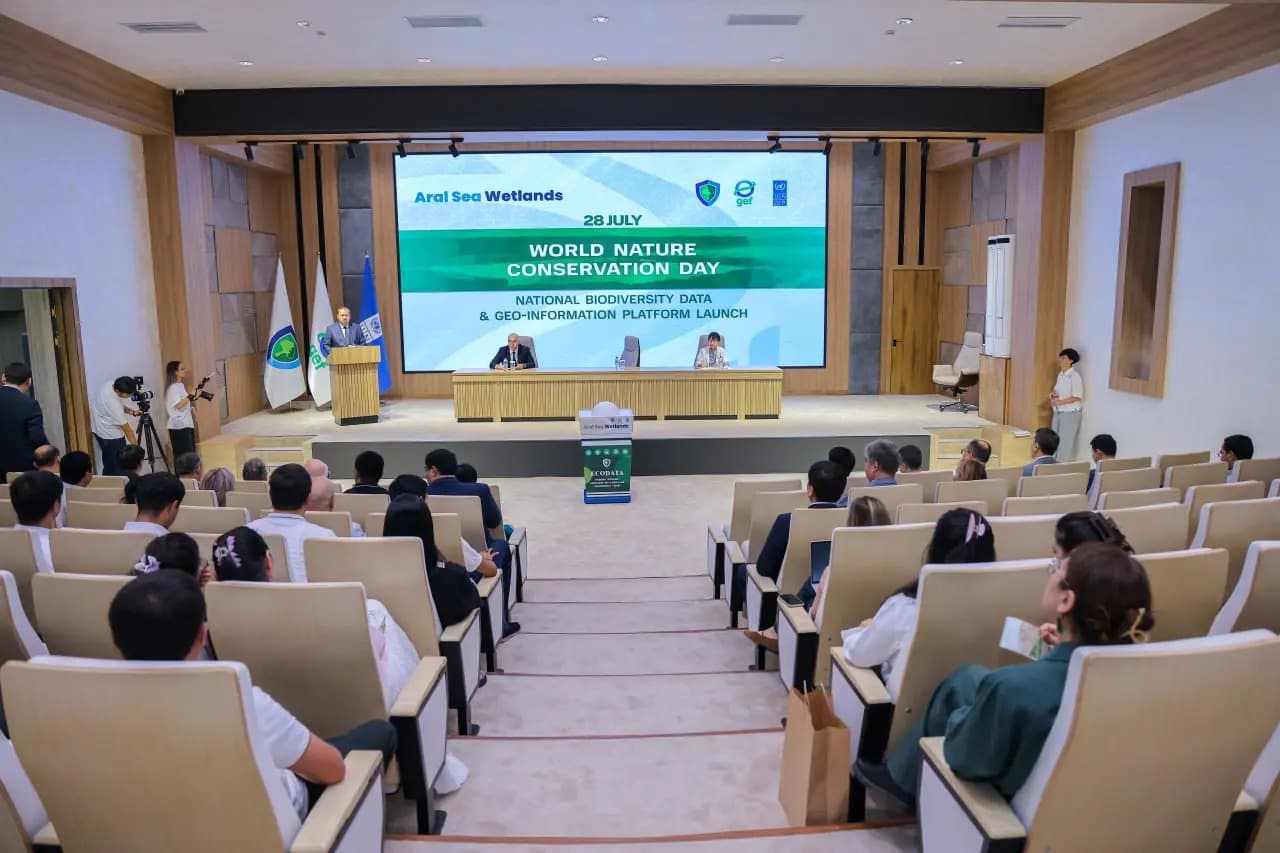
On the occasion of World Nature Conservation Day, observed on 28 July, the official presentation of ECODATA, an updated electronic geospatial database on biodiversity and protected natural areas, was held in Tashkent.
The new digital platform is designed to integrate fragmented environmental data into a single system and provide a modern information base for studying, monitoring, and protecting the country's natural heritage.
The presentation took place at the Central Asian Research Center for Ecology and Environment under Green University. Representatives of the National Committee on Ecology and Climate Change, the United Nations Development Programme (UNDP), Green University, the scientific community, international organizations, development partners, and the media attended the event.
“Launching the ECODATA platform on World Nature Conservation Day carries symbolic significance. It reminds us that environmental protection requires not only ecological responsibility but also modern tools,” said Jusipbek Kazbekov, Deputy Chairman of the Committee on Ecology. “Today, digital technologies make it possible to monitor natural processes much more accurately: where a species occurs, how its population changes, which areas are under the greatest pressure, and where additional conservation measures are needed. ECODATA transforms environmental data into a practical tool for government agencies, scientists, experts, international partners, and society. Effective nature conservation begins with reliable information, and preserving our natural heritage for future generations depends on knowledge-based decision-making.”
The platform is built on the principle of “Data → Analysis → Decision.” It not only stores environmental information but also enables users to monitor changes over time, compare regional indicators, track the status of individual species and protected areas, and support more informed management decisions.
ECODATA was developed by the Committee on Ecology within the framework of the Aral Sea Wetlands project, implemented in cooperation with the United Nations Development Programme (UNDP) and the Global Environment Facility (GEF).
Before the creation of the unified system, environmental data were stored in different formats and across multiple sources, making comparison, monitoring, and analytical work difficult. ECODATA consolidates information on flora and fauna, protected natural areas, forests, water bodies, pastures, the use of natural resources, and environmental monitoring results into a single digital environment.
The platform currently consists of seven modules and more than 60 interconnected tables, covering all regions of Uzbekistan. One of its key functions is the systematization of biodiversity data. It enables the registration and monitoring of animal and plant species, including those listed in the Red Data Book, tracking their population, distribution, and conservation status. It also provides information on state nature reserves, national parks, wildlife sanctuaries, forestry and hunting enterprises, fisheries, and ecotourism areas.
A key feature of ECODATA is its mobile data collection module, which allows specialists to record field observations directly from natural sites using GPS coordinates and photographs. Data can be collected even without an internet connection and are automatically synchronized once connectivity is restored.
The platform also allows citizens to contribute by submitting observations of plants and animals, which are then verified by specialists.
ECODATA is intended not only as an information repository but also as a practical tool for natural resource management. It will support quota calculations based on up-to-date data, enable the electronic provision of selected public services, and establish a unified database for scientific research and long-term environmental monitoring.