
🌳Climate-resilient trees and shrubs to be planted under the "Green Belt" project
2026-07-15 12:00:00 / Eco-active employee
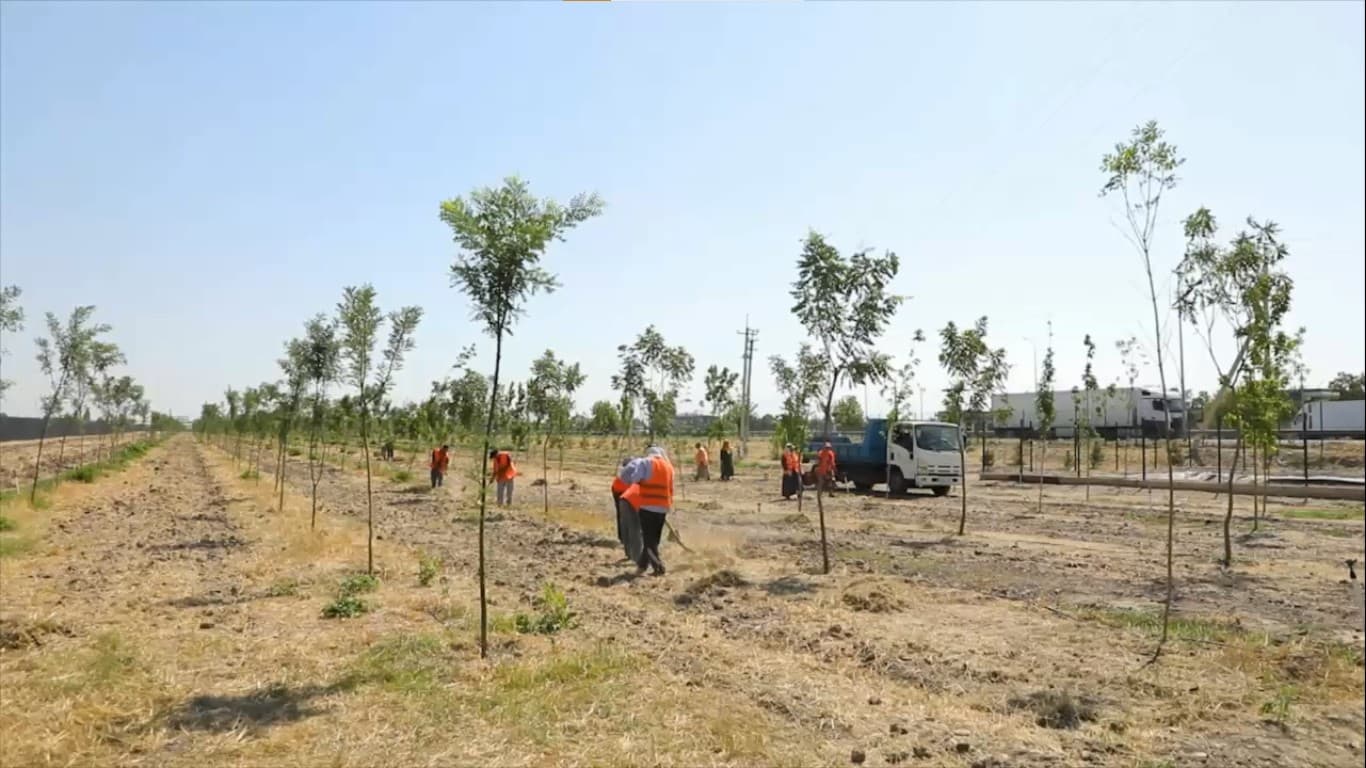
For information: The tasks related to the development of green belts are set out in the Presidential decrees and resolutions. Between 2022 and 2026, more than 1.35 million tree and shrub saplings were planted in the city of Tashkent.
During 2025–2026, the following numbers of trees were planted in the capital and surrounding areas:
- 38,000 in Bektemir District;
- 20,000 in Tashkent District;
- 2,100 in Yangihayot District;
- 100,000 in Qibray District.
In addition, more than 2,000 ornamental trees and shrubs were planted along the 4R–21 highway in the section of Yangihayot District bordering Tashkent Region.
In 2026–2027, additional green belts are planned to be established on:
- 21.21 hectares in Yangihayot District;
- 6.81 hectares in Sergeli District;
- 40.1 hectares in Bektemir District;
- and 100 hectares along the section of the Chirchiq River passing through Mirzo Ulugbek, Yashnobod, and Bektemir districts.
In accordance with Presidential Decree No. 47 of March 25, 2026, a total of 385.3 hectares of land has been allocated for the establishment of botanical and dendrological gardens in Tashkent City and Tashkent Region, including:
- 337.3 hectares in Tashkent City;
- 48 hectares in Tashkent Region.
Furthermore, under Cabinet of Ministers Resolution No. 83, nine new public parks with a total area of 139.6 hectares will be developed in Tashkent.
In addition, under the Green Belt Project, it is planned to establish at least 58,000 hectares of intensive protective forest plantations in Tashkent and its surrounding areas by 2045.
The project also aims to plant at least 50 million climate-adapted, drought-resistant trees and shrubs with high dust-retention capacity, while increasing their survival rate to 85 percent.
International experience shows that green belts are not simply one-time tree-planting campaigns. They are ecological infrastructure with a clearly defined legal status, supported by sustainable financing, maintenance, irrigation, monitoring, and public oversight.
This approach has been successfully implemented in the United Kingdom, South Korea, China, and Kazakhstan.
Accordingly, the work being carried out in Tashkent and surrounding areas goes far beyond tree planting. The primary focus is on strengthening the legal protection of green areas, preventing unjustified land allocation for construction and other purposes, ensuring the survival of planted trees and shrubs, introducing water-efficient irrigation systems, and continuously monitoring air quality and green coverage.
Special attention is also being given to preserving naturally growing tree and shrub seedlings along roadsides.