MODERNIZATION OF DEHQAN MARKETS: OBJECTIVES, CONDITIONS AND PRIVATIZATION PLANS
2026-11-17 09:35:00 / News
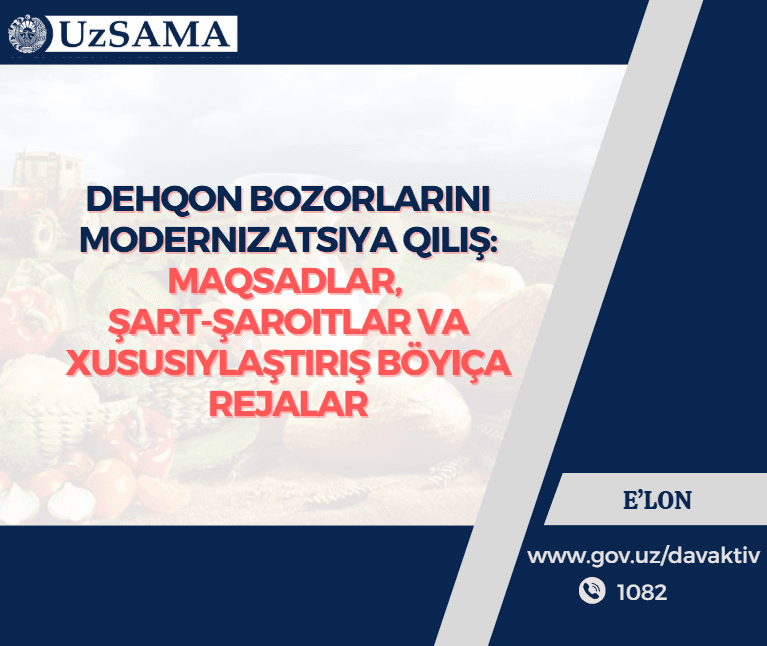
The issue of the further development and modernization of dehqon markets remains relevant to many citizens. In this regard, questions and various assumptions periodically arise on social media concerning their future operations, privatization conditions, and possible changes to the familiar trading infrastructure. In order to ensure transparency and public access to information, the Agency for Management of State Assets provides clarification on the main objectives, principles, and key aspects of the ongoing transformations.
The involvement of the private sector and the gradual reduction of state participation in the management of dehqon markets are primarily aimed at upgrading their infrastructure, improving the quality of services, enhancing sanitary and hygienic conditions, and ensuring modern standards of comfort and safety. One of the key objectives is to create a favorable environment for consumers, as well as for entrepreneurs, farmers, and agricultural producers.
At the same time, preserving the primary purpose of dehqon markets remains a fundamental principle of the reform. There are no plans to close them, change their intended use, or replace them with facilities unrelated to traditional trading activities. The markets familiar to the public will continue operating, retaining their role in supplying citizens with fresh agricultural products and everyday essentials.
On the contrary, attracting private investment is intended to provide additional momentum for the development of these markets. The plans envisage the creation of modern trading spaces with well-maintained premises, convenient conditions for vendors and customers, adequate sanitary facilities, parking areas, security systems, and essential utilities. Modern shopping complexes such as “Eco Bozor” and Food City may serve as examples, demonstrating how traditional trade can be combined with contemporary standards of market organization.
Particular attention is being paid to protecting the interests of the public and entrepreneurs, as well as maintaining the accessibility of trading services. Modernization should not create additional inconvenience for citizens or lead to unjustified restrictions on the ability of producers and traders to sell their products.
The privatization process will be carried out in stages and on an individual basis, taking into account the specific characteristics of each market. This is not a mass sale of state-owned assets. Before any decisions are made, a comprehensive assessment is conducted of each facility's current condition, economic potential, social significance, and prospects for further development, as well as the requirements of legislation governing the protection of the rights and interests of shareholders (participants) and the provisions of the markets' constituent documents.
Another equally important condition is taking public opinion into account. Before each asset is put up for sale, the views of interested parties, including local residents, entrepreneurs, and other market stakeholders, will be studied. This approach will help ensure well-founded decisions that take into consideration both economic feasibility and public interests.
Thus, the privatization of dehqon markets is viewed not merely as a change in ownership, but as a means of attracting investment, improving management efficiency, and comprehensively upgrading market infrastructure. The main objective of these transformations is to preserve the traditional function of dehqon markets while ensuring their modern development, comfortable trading conditions, and compliance with contemporary standards.
Press Service of
the Agency for Management of State Assets