
An exclusive article based on an interview with Behzod Musayev was published in the international publication Euronews.
2025-12-04 15:45:00 / News
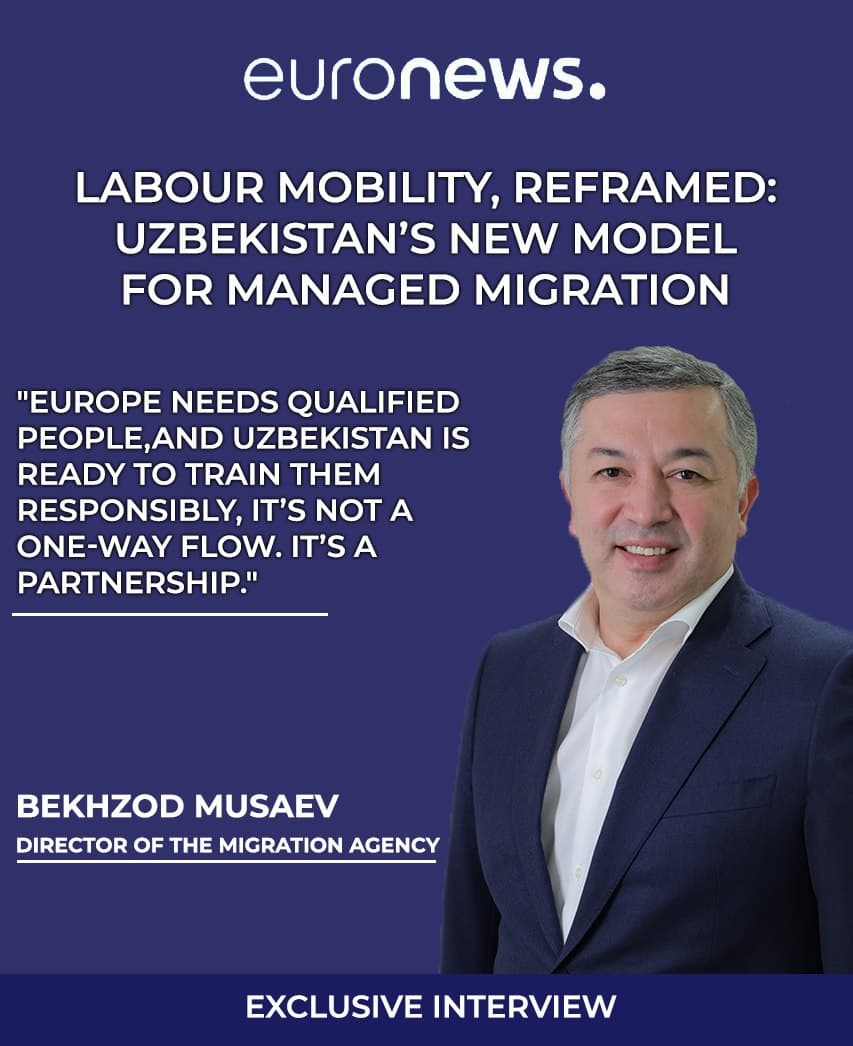
"Europe needs qualified specialists, and Uzbekistan is ready to prepare them responsibly. This is not a one-sided process - it is mutual cooperation," - Behzod Musayev, Director of the Migration Agency
📰 In the article:
▪️Updated model of Uzbekistan on orderly and safe labor migration;
▪️protection of the rights of our compatriots working abroad;
▪️approach to training qualified personnel;
▪️Important points such as the concept of "migration based on cooperation" with European countries have been covered.
With 2 million citizens abroad and €13.9 billion in remittances, Uzbekistan is expanding regulated labour migration, training workers for rising demand in Europe and Asia.
According to the Ministry of Internal Affairs, as of 1 October 2025, about two million Uzbek citizens live abroad, 1.6 million of them employed. The majority still work in Russia (around one million), but the share of workers headed to Europe and Asia for skilled roles is steadily rising.
Created a year ago on the initiative of President Shavkat Mirziyoyev, Uzbekistan’s new Migration Agency has taken on a central role in how the country manages labour mobility. The institution focuses on supporting Uzbek nationals working abroad, protecting their rights, and expanding access to skilled employment across borders.
Through the KOUZON recruitment company, more than 5,000 Uzbeks are joining this year cruise industry in gastronomy, service, medicine, and technical fields, earning between €1,400 and €3,700 per month.
A major agreement with Italy’s Lombardy Region will bring 3,500 nurses to Italian clinics starting in 2026, while in Japan, partnerships with JCAEMCE and Proud Partners aim to prepare 10,000 skilled specialists and professional drivers, supported by training centres in Tashkent, Samarkand, and Namangan.
Other agreements include 2,000 workers for Austria, 200 for Portugal, and 150 for the Netherlands, mainly welders, electricians, and agricultural machinery.
Benefits for both sides
According to the Central Bank of Uzbekistan, citizens working abroad sent home the equivalent of around €13.9 billion in 2024.
For many families, part of these earnings becomes the first capital for launching small businesses, from neighbourhood bakeries to carpentry workshops, helping create jobs and support local enterprise.
At the same time, regulated labour mobility enables European industries to fill shortages in essential sectors such as healthcare, construction, and logistics.
But there is another benefit for the country itself, as described by the Director of the Migration Agency, Behzod Musaev.
“Every successful migrant is an ambassador of Uzbekistan’s new image: Educated, responsible and open to the world,” he told Euronews.
Across Europe, employers are struggling to fill vacancies in healthcare, logistics, and agriculture. EU research, notably from Eurofound, the European Foundation for the Improvement of Living and Working Conditions, a tripartite EU agency that provides evidence and analysis to shape labour and social policy, indicates that skills shortages have become structural, with millions of positions expected to remain unfilled unless recruitment models evolve.
By training and certifying workers before departure, Uzbekistan offers a potential answer: A regulated, skilled workforce able to integrate quickly into European industries.
“The International Organization for Migration works closely with the Migration Agency to advance safe, orderly and dignified migration for Uzbek citizens,” said Andrew Gray, Chief of Mission of the IOM in Uzbekistan. “Since its formation in 2024, the Agency has opened new pathways for labour migration, responded to evolving global demand and promoted safe migration. We expect its efforts will continue to support Uzbekistan’s development and benefit migrants and their families.”
🔗 Source