
Uzbekcosmos Agency determines the actual volume and turbidity percentage of 25 reservoirs for 2023 using space monitoring and bathymetric images
2024-03-12 00:00:00 / News
Uzbekistan is a country with limited water resources geographically. Climate change is further exacerbating drought in the region. Water scarcity for agriculture, industry, and domestic consumption has become the country's greatest threat.
Today, many countries, including Uzbekistan, are faced with the problem of siltation of reservoirs, which occurs as a result of the ingress of sand, clay, and silt into the water, which settle at the bottom of the reservoir and reduce its capacity and efficiency over time.
The lack of reliable information on the actual volume of reservoirs and river flows, especially in dry years, leads to incorrect allocation of water resources and corresponding negative consequences.
One of the conditions for the effective and economical operation of reservoirs is the availability of information on their actual volume, which is constantly decreasing every year due to siltation. In order to take effective measures to reduce water shortages and develop specific solutions, it is necessary to systematically determine the actual volume of water that can be stored in our country's reservoirs.
Currently, there are 71 reservoirs of strategic and economic importance in Uzbekistan, and the fact that 64 of them are naturally filled increases their turbidity.
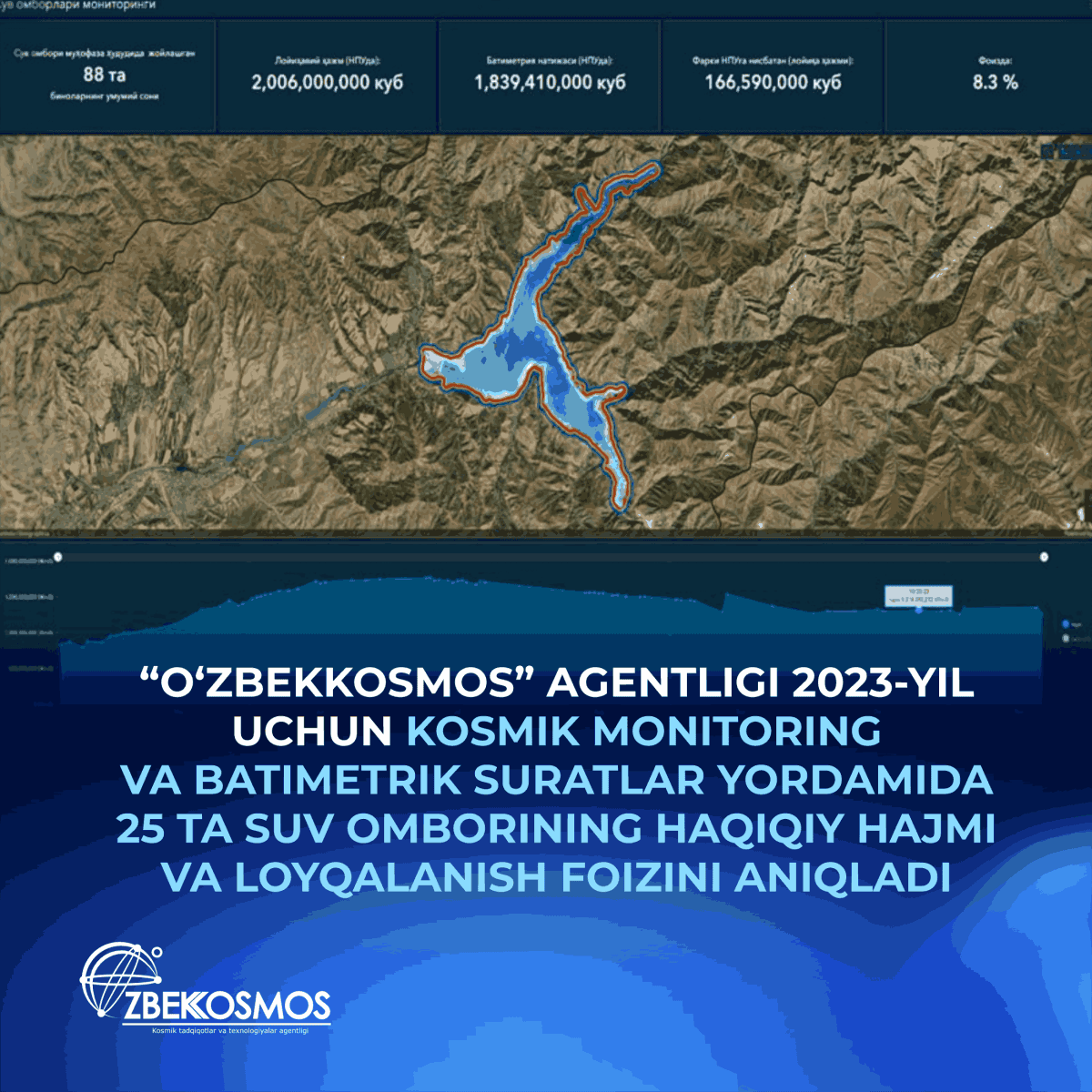
In the case of the Charvak reservoir, the design water volume of the reservoir was about 2 billion cubic meters of water. According to the results of bathymetric surveys, the current capacity was determined to be 1 billion 840 million cubic meters of water, and a three-dimensional digital model of the reservoir basin was created. The difference in volume of 166 million cubic meters indicates that silt accounts for 8.3% of the total volume of the reservoir.
For information: Bathymetric surveys are carried out to measure the depth of water bodies. The data obtained during a bathymetric survey allows you to create a detailed map of the bottom of a reservoir or a bathymetric map that reflects changes in depth.