
Results of space monitoring by the Uzbekcosmos agency regarding water leakage from the Qosh-Tepa canal
2023-12-14 00:00:00 / News

On December 12-13, 2023, information was disseminated on the Internet with reference to experts from the international environmental coalition "Rivers Without Borders" about the first serious "accident" at the Kosh-Tepa irrigation canal under construction in Afghanistan. According to Internet sites, in the first month after Kosh-Tepa began to fill with water from the Amu Darya, the walls of the hydraulic structure could not withstand the pressure of the water flow, and a large volume of water thrown out of the canal spread to the nearby territory.
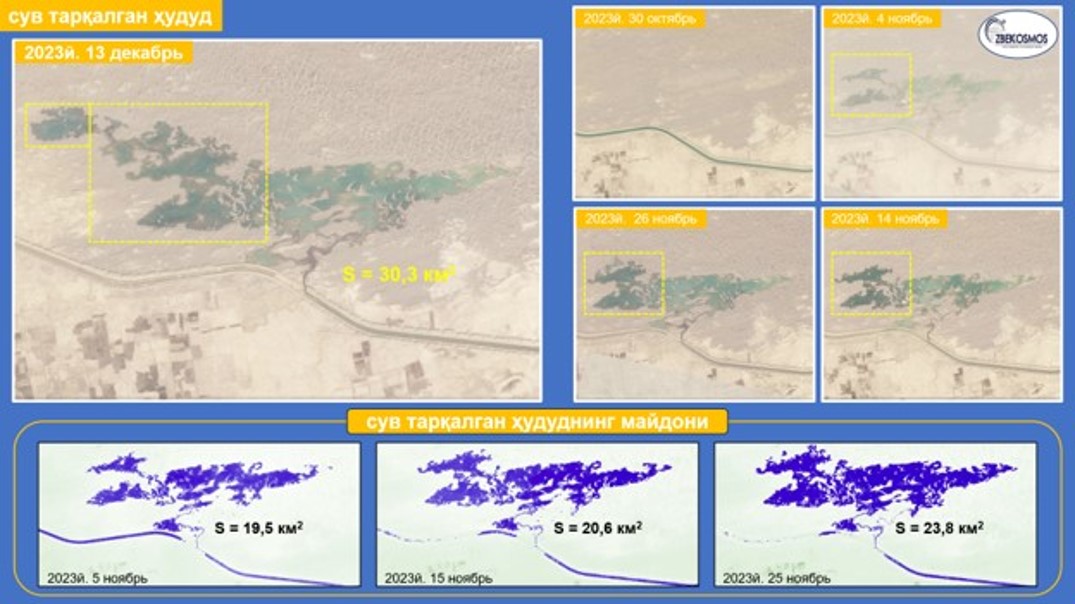
Satellite and photo images of water leakage on the right bank of the Kosh-Tepa canal
Based on a retrospective analysis of multispectral space images of various spatial resolutions, reports of water leaks from the Kosh-Tepa Canal, disseminated by the Uzbekcosmos Agency in online publications, were studied.
As a result of regular monitoring of the dynamics of the Kosh-Tepa Canal construction using space monitoring, the Uzbekcosmos Agency found that an increase in groundwater levels is expected in the areas of excavation work from May 2022.
During construction, artificial barriers were left in four sections of the canal, which were completely dismantled on October 10, 2023, upon completion of the first stage of work, and a watercourse was created.
As a result of space monitoring, on November 4, 2023, a water leak was detected approximately 30 m along the right bank at 75.6 km of the Kosh-Tepa Canal. The area of flooded territory on November 5 was 19.5 km2, on November 25 – 23.8 km2, and as of December 13 – 30.3 km2, while no measures were taken to stop the water.
.
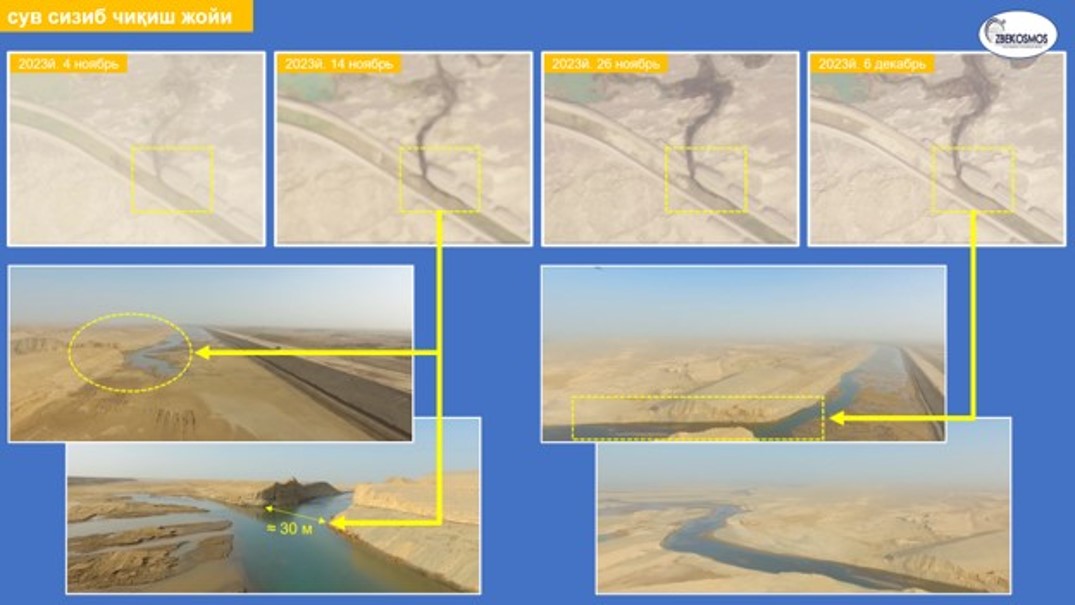
Satellite images of the terrain and distribution of water leakage from the Kosh-Tepa canal
According to experts from the international environmental coalition "Rivers Without Borders", this situation arose because the walls of the canal could not withstand the pressure of the water flow coming from the Amu Darya.
In turn, the Afghan engineers responsible for the construction of the canal emphasize that the water was deliberately diverted to an open area at 75.6 km of the canal in order to control the groundwater level.
Space monitoring of the dynamics of the construction of the Kosh-Tepa canal shows that the excavation work on the section of the structure receiving water from the Amu Darya River has not been completed, and currently there is about 20 m of unexcavated area at the junction with the river.
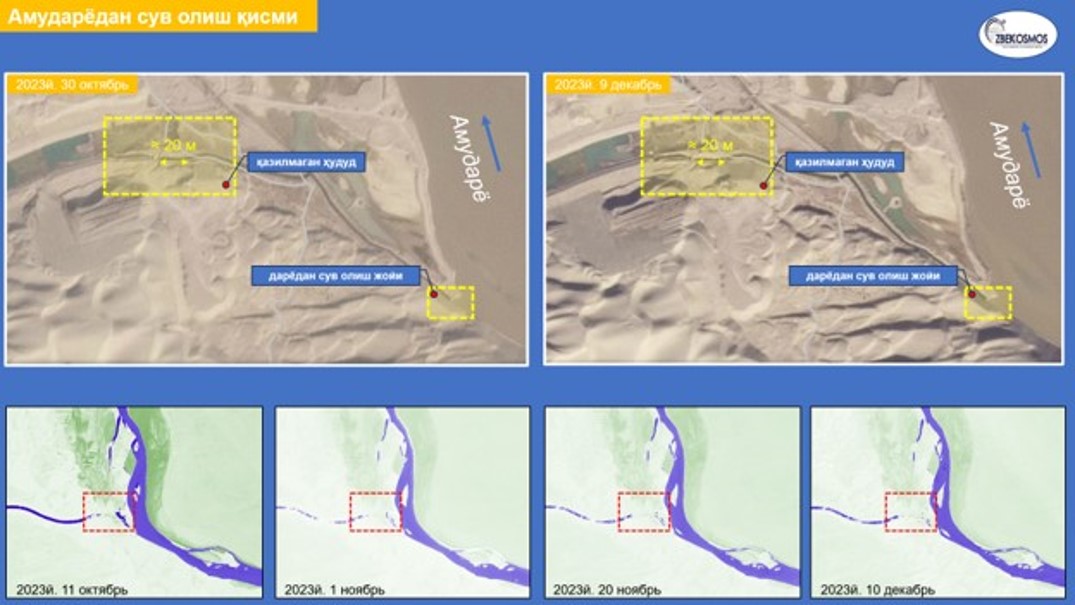
Satellite images of the unexcavated area and the water intake of the river water intake on the Amu Darya section of the Kosh-Tepa canal
At the same time, the analysis of ultra-high-resolution satellite images did not reveal any visual signs of targeted excavation work on the bank of the canal to drain storm water (use of special equipment, presence of excavated soil, etc.).
In addition, the available materials indicate that at present, water seepage around the leak site is decreasing, and the bottom of the canal is gradually drying out.
Thus, the conducted analyses confirm that the information disseminated on the Internet by experts of the international environmental coalition "Rivers without Borders" that the banks of the Kush-Tepa canal were washed away by a stream of water taken from the Amu Darya River is not true, and the seeped water is filtration.
Satellite and photo images of water leakage on the right bank of the Kosh-Tepa
Based on a retrospective analysis of multispectral space images of various spatial resolutions, reports of water leaks from the Kosh-Tepa Canal, disseminated by the Uzbekcosmos Agency in online publications, were studied.
As a result of regular monitoring of the dynamics of the Kosh-Tepa Canal construction using space monitoring, the Uzbekcosmos Agency found that an increase in groundwater levels is expected in the areas of excavation work from May 2022.
During construction, artificial barriers were left in four sections of the canal, which were completely dismantled on October 10, 2023, upon completion of the first stage of work, and a watercourse was created.
As a result of space monitoring on November 4, 2023, a water leak was detected approximately 30 m along the right bank at 75.6 km of the Kosh-Tepa Canal. The area of flooded territory on November 5 was 19.5 km2, on November 25 – 23.8 km2, and as of December 13 – 30.3 km2, while no measures were taken to stop the water.
.
Satellite images of the terrain and distribution of water leakage from the Kosh-Tepa canal
According to experts from the international environmental coalition "Rivers Without Borders", this situation arose because the walls of the canal could not withstand the pressure of the water flow coming from the Amu Darya.
In turn, the Afghan engineers responsible for the construction of the canal emphasize that the water was deliberately diverted to an open area at 75.6 km of the canal in order to control the groundwater level.
Space monitoring of the dynamics of the construction of the Kosh-Tepa canal shows that the excavation work on the section of the structure receiving water from the Amu Darya River has not been completed, and currently there is about 20 m of unexcavated area at the junction with the river.
Satellite images of unexcavated territory and water intake of the river water intake on the Amu Darya section of the Kosh-Tepa canal
At the same time, the analysis of ultra-high-resolution satellite images did not reveal any visual signs of targeted excavation work on the bank of the stormwater drainage canal (use of special equipment, presence of excavated soil, etc.).
In addition, the available materials indicate that water seepage around the leak site is currently decreasing, and the bottom of the canal is gradually drying out.
Thus, the analyses conducted confirm that the information disseminated on the Internet by experts from the international environmental coalition "Rivers Without Borders" that the banks of the Kush-Tepa canal were washed away by a stream of water taken from the Amu Darya River is not true, and the seeped water is filtration.