
A NEW GENERATION OF THINKERS IS THE DRIVING FORCE OF THE COUNTRY
2026-07-17 18:00:00 / News
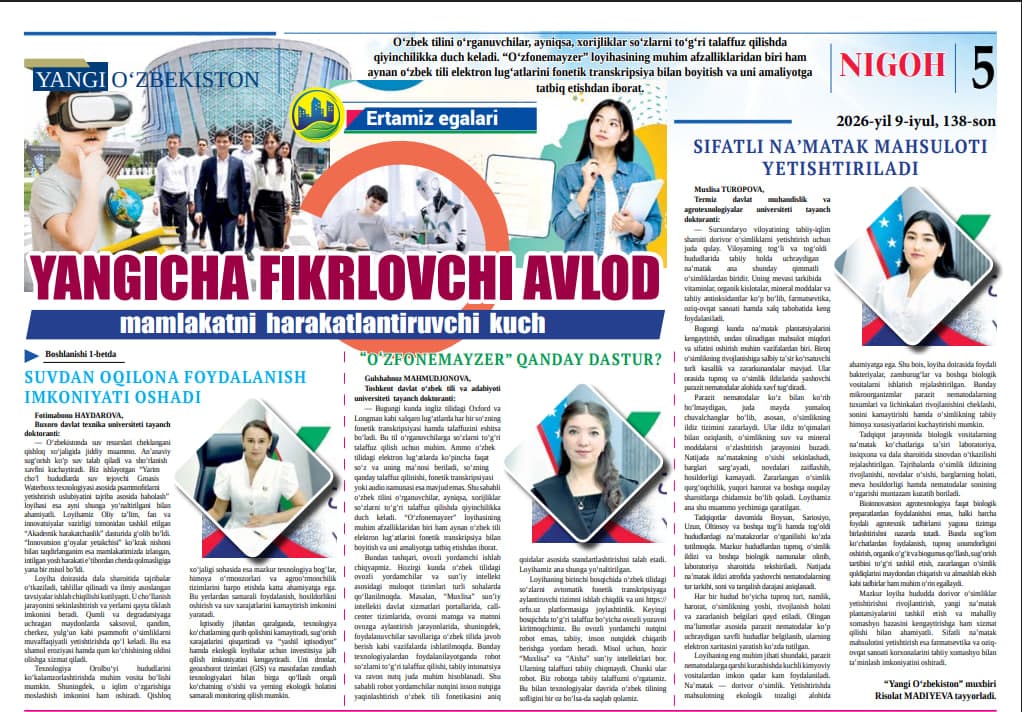
A NEW GENERATION OF THINKERS IS THE DRIVING FORCE OF THE COUNTRY
Recently, a group of young people who have achieved outstanding results in science, education, agriculture, industry, and other fields, and who are contributing to the country's development through their inventions and startup projects, were awarded the "Leader of Innovative Ideas" badge. Most of them are talented youth who have achieved high results in international and national scientific and innovative competitions, olympiads, festivals, and contests, and are distinguished by their innovative initiatives.
Opportunities for Efficient Water Use Will Increase
Fotimabonu HAYDAROVA, PhD Student at Bukhara State Technical University: — The scarcity of water resources in Uzbekistan is a serious problem in agriculture. Traditional irrigation requires a large amount of water and increases the risk of salinization. The project we are working on, titled "Experimental evaluation of methods for cultivating psammophytes based on the water-saving Groasis Waterboxx technology in semi-desert areas," is significant because it directly addresses this issue. Our project won the "Academic Mobility" program organized by the Ministry of Higher Education, Science and Innovations. Being awarded the "Leader of Innovative Ideas" badge is another example showing that the efforts of searching and striving youth in our country do not go unnoticed.
Within the framework of the project, field experiments, analyses, and the development of scientifically grounded recommendations are expected. It will slow down the desertification process and enable land restoration. It will be useful for the successful cultivation of psammophytic plants such as saxaul, kandym, cherkez, and tamarisk in sandy and degraded areas. This, in turn, will serve to prevent wind erosion and sand migration.
The technology can become an important tool for greening the Aral Sea region. It also increases the capacity to adapt to climate change. In the agricultural sector, this technology is of great importance for establishing orchards, protective forest belts, and agroforestry systems. This creates opportunities for efficient land use, increasing productivity, and reducing water costs.
From an economic perspective, the technology reduces the mortality rate of seedlings, cuts irrigation costs, and expands opportunities to attract investments for the "green economy" and environmental projects. By combining it with drones, Geographic Information Systems (GIS), and remote sensing technologies, seedling growth and the ecological status of the land can be effectively monitored.
What Kind of Program is "Ozfonemayzer"?
Gulshahnoz MAHMUDJONOVA, PhD Student at Tashkent State University of Uzbek Language and Literature: — Today, in international dictionaries like Oxford and Longman, one can listen to the phonetic transcription and pronunciation of every English word. This is essential for language learners to pronounce words correctly. However, electronic dictionaries in the Uzbek language often provide only the word and its meaning, while the pronunciation, phonetic transcription, or audio sample is missing. Consequently, learners of the Uzbek language, especially foreigners, face difficulties in correct pronunciation. One of the key advantages of the "Ozfonemayzer" project is precisely enriching Uzbek electronic dictionaries with phonetic transcription and implementing it in practice.
In addition, we are developing a voice assistant. Currently, voice assistants and conversational systems based on artificial intelligence in the Uzbek language are being applied in various fields. For example, the "Muxlisa" AI is used in government service portals, call center systems, speech-to-text and text-to-speech processes, as well as for answering user questions in Uzbek. When using such technologies, correct word pronunciation, natural intonation, and fluent speech by the robot are crucial. Therefore, bringing the speech of robotic assistants closer to human speech requires standardizing Uzbek phonetics based on precise rules. Our project is directed towards this goal.
In the first stage of the project, we developed a system that automatically converts Uzbek words into phonetic transcriptions and uploaded it to the https://orfo.uz platform. In the next stage, we plan to integrate voice recording for correct pronunciation. This will help make the voice assistant's speech sound natural, like human speech, rather than robotic. For example, the artificial intelligences "Muxlisa" and "Aisha" currently exist, but their pronunciation does not sound natural because they are robots. We will teach the robot natural pronunciation. Through this, we will preserve the purity of the Uzbek language to some extent in the era of technology.
Quality Rosehip Products Will Be Cultivated
Muxlisa TUROPOVA, PhD Student at Termiz State University of Engineering and Agrotechnologies: — The natural and climatic conditions of the Surxondaryo region are highly favorable for growing medicinal plants. Rosehip, which grows naturally in the mountainous and sub-mountainous regions of the province, is one of such valuable plants. Its fruit contains many vitamins, organic acids, minerals, and natural antioxidants, and it is widely used in pharmaceuticals, the food industry, and traditional medicine.
Today, expanding rosehip plantations, increasing the quantity, and improving the quality of the harvested product is one of the important tasks. However, there are various diseases and pests that negatively affect the development of the plant. Among them, parasitic nematodes living in the soil and plant roots pose a particular threat.
Parasitic nematodes are microscopic roundworms invisible to the naked eye that primarily damage the root system of the plant. Feeding on root tissues, they disrupt the plant's process of absorbing water and minerals. As a result, the growth of the rosehip slows down, its leaves turn yellow, its branches weaken, and its yield decreases. The infected plant becomes vulnerable to drought, high temperatures, and other unfavorable conditions. Our project is focused on the solution to this problem.
During the research, it is planned to study rosehip groves in Boysun, Sariosiyo, Uzun, Oltinsoy, and other mountainous and sub-mountainous areas. Soil, plant roots, and other biological samples will be collected from these regions and examined under laboratory conditions. As a result, the species composition, number, and distribution level of nematodes living around the rosehip roots will be determined.
For each region, soil type, moisture, temperature, plant age, developmental state, and signs of damage will be recorded. Based on the gathered data, hazardous zones where parasitic nematodes are prevalent will be identified, and the creation of their electronic map is envisioned.
The most important aspect of the project is that strong chemical agents will be used as minimally as possible against parasitic nematodes. Rosehip is a medicinal plant. In its cultivation, the ecological purity of the product is of special importance. Therefore, the project plans to use beneficial bacteria, fungi, and other biological agents. Such microorganisms can limit the development of eggs and larvae of parasitic nematodes, reduce their numbers, and enhance the natural defense characteristics of the plant.
During the research process, the impact of biological agents on rosehip seedlings is planned to be tested in laboratory, greenhouse, and field conditions. In the experiments, root development, branch growth, leaf condition, fruit yield, and changes in the nematode population will be regularly monitored.
Bio-innovative agrotechnology involves not only the use of biological preparations but also the integration of all beneficial agrotechnical measures into a unified system. In this regard, utilizing healthy seedlings, increasing soil fertility, applying organic fertilizers and vermicompost, properly organizing the irrigation regime, removing infected plant residues from the field, and crop rotation also play an important role.
This project is significant as it will also serve to develop the cultivation of medicinal plants in the region, establish new rosehip plantations, and expand the local raw material base. Cultivating quality rosehip products will increase the possibility of providing pharmaceutical and food industry enterprises with natural raw materials.
“Yangi Oʻzbekiston” newspaper, 2026, Issue 138