
Report of the Head of the Fergana District Department for Poverty Reduction and Employment Promotion on the Results of the First Half of 2026
2026-10-19 15:00:00 / News
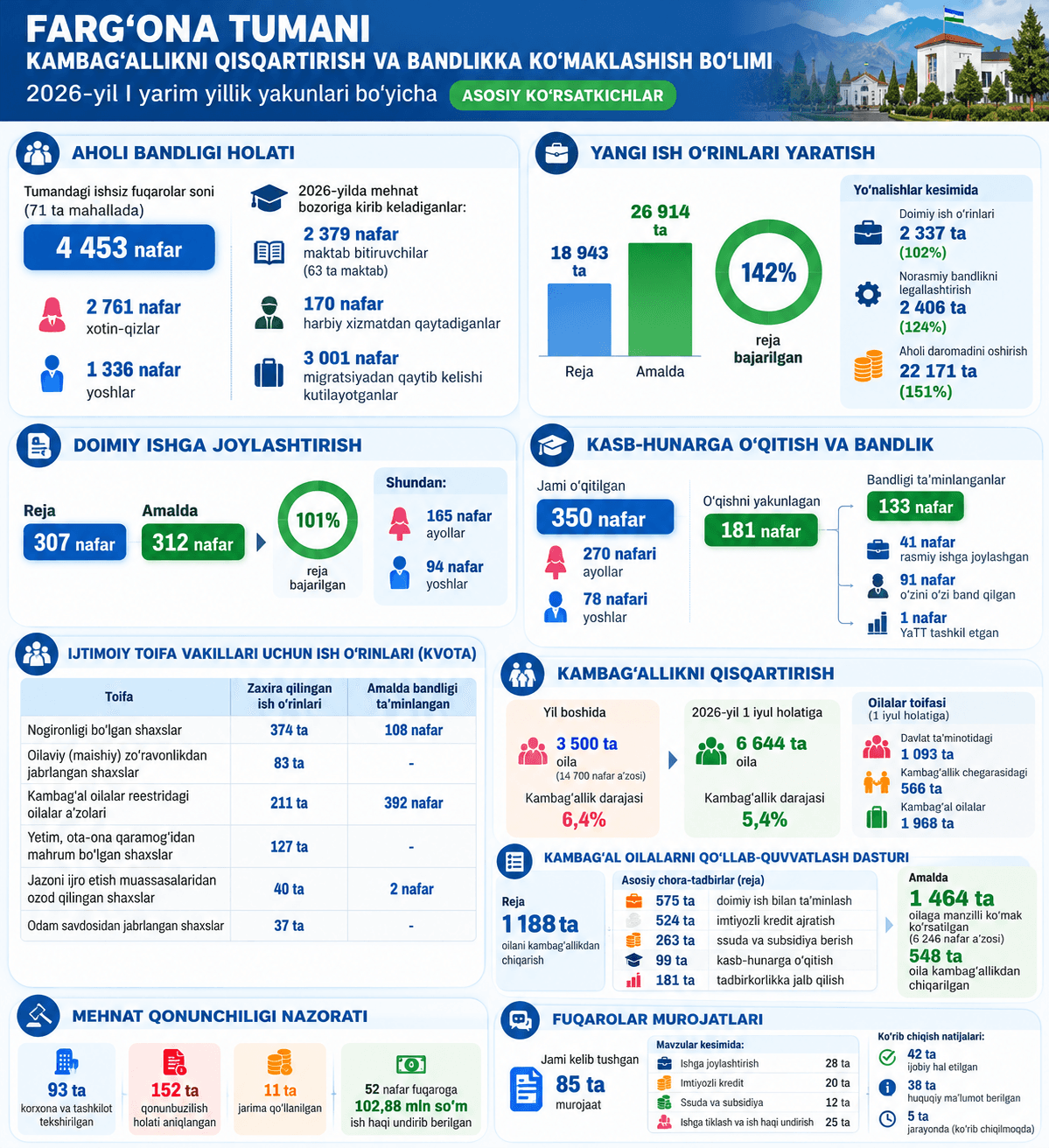
The report of the Head of the Fergana District Department for Poverty Reduction and Employment Promotion (hereinafter referred to as the Department) on the results of the first half of 2026, together with the briefing prepared by the working group established to examine this matter, was reviewed by the standing commission.
It was noted that a number of measures had been implemented in the district to ensure employment, introduce new approaches to engaging people in entrepreneurship and increasing their incomes, organize targeted assistance for vulnerable population groups in mahallas, expand social services, improve the efficient use of available resources, benefits and preferences, create high-income jobs, and reduce poverty.
According to the Department, there are 4,453 unemployed citizens across 71 mahallas in the district, including 2,761 women and 1,336 young people.
In addition, 2,379 students from 63 general education schools are expected to graduate and enter the labour market during the current year. The number of people expected to return from military service is 170, while 3,001 people are expected to return from migration.
The district administration, together with the relevant organizations, has developed separate programmes for each mahalla to provide employment for a total of 37,135 unemployed residents.
Measures are currently being taken to transform six mahallas into areas free from unemployment.
The Department monitors compliance with the requirements of the Labour Code of the Republic of Uzbekistan, particularly adherence to labour legislation by government agencies, enterprises and organizations. This work also takes into account issues raised during outreach meetings, appeals submitted to the regional and district (city) Councils of People's Deputies, and opinions expressed by citizens on social media.
In accordance with the Law of the Republic of Uzbekistan “On Employment of the Population,” the Department planned to employ 307 unemployed people and job seekers during January–June 2026. In practice, 312 citizens were placed in permanent jobs, including 165 women and 94 young people. The plan was fulfilled at 101%.
During the first six months of the year, the District Department for Poverty Reduction and Employment Promotion, together with non-governmental educational institutions, organized vocational training in modern, in-demand occupations for 350 citizens, including 270 women and 78 young people.
Of these, 181 citizens completed their vocational training. Employment was secured for 133 citizens: 41 were employed through the National Labour Management System (YaMMT), 91 became self-employed, and one began working as an individual entrepreneur.
A total of 871 jobs have been reserved under employment quotas at 117 enterprises and organizations in Fergana District for people in need of social protection and those experiencing difficulties finding employment.
The breakdown by category is as follows:
-
People with disabilities: 374 jobs reserved; 108 citizens have been employed.
-
People affected by domestic violence: 83 jobs reserved.
-
Members of families included in the register of low-income households: 211 jobs reserved; 392 citizens have been employed.
-
Orphans and people deprived of parental care who were raised under alternative care arrangements: 127 jobs reserved.
-
People released from correctional institutions: 40 jobs reserved; two citizens have been employed.
-
Victims of human trafficking: 37 jobs reserved.
Implementation of the “From Poverty to Prosperity” Programme
At the beginning of 2026, Fergana District had 3,500 low-income families comprising 14,700 people under the “From Poverty to Prosperity” programme. The poverty rate stood at 6.4%.
As of 1 July 2026, the reported number of low-income families was 6,644. The breakdown provided in the report is as follows:
-
Families receiving state support — 1,093;
-
Families on the poverty threshold — 566;
-
Low-income families — 1,968.
Under the targeted programme approved at the beginning of the year, the district planned to lift 1,188 families, comprising 4,975 people, out of poverty.
The planned measures included:
-
Providing permanent employment for 575 families;
-
Allocating preferential loans to 524 families;
-
Providing loans and subsidies to 263 families;
-
Providing vocational training for 99 family members;
-
Engaging 181 families in entrepreneurship.
As of 1 July 2026, targeted financial assistance had been provided to 1,464 families comprising 6,246 people.
Specifically:
-
593 citizens were placed in permanent employment;
-
Preferential loans and subsidies were allocated to 112 citizens;
-
882 citizens were engaged in entrepreneurship;
-
190 citizens received vocational training.
As a result, 548 families were lifted out of poverty. Compared with the beginning of the year, the district's poverty rate decreased by 1.0 percentage point, falling from 6.4% to 5.4%.
Employment and Income Growth Through New Approaches
On 5 February 2026, the President of the Republic of Uzbekistan adopted Resolution No. PQ-49, “On Measures to Increase Household Incomes, Create Sustainable Jobs and Reduce Poverty by Developing Regions Through New Approaches in 2026.”
Under this resolution, the system is being organized around a fundamentally new project-based approach. The targets include providing permanent employment for 5,344 people, formalizing the employment of 4,277 informal workers, increasing the incomes of 27,514 people, and reducing the unemployment rate to 4.2%.
During January–June, the plan was to create 18,943 jobs. In practice, 26,914 jobs were created, representing 142% of the six-month target.
The results were as follows:
-
Permanent jobs: target — 2,297; actual — 2,337 (102%).
-
Formalization of informal employment: target — 1,933; actual — 2,406 (124%).
-
Increasing household incomes: target — 14,713; actual — 22,171 (151%).
Creation of Permanent Jobs
For January–May, the target was 2,297 permanent jobs, while 2,337 jobs were actually created, achieving 102% of the target.
Breakdown by area:
-
Through the launch of investment projects — target: 267; actual: 245 (92.0%).
-
Through the launch of service-sector projects — target: 805; actual: 735 (91.0%).
-
In agriculture — target: 121; actual: 125 (103.0%).
-
In construction — target: 84; actual: 86 (102.0%).
-
Through vacancies filled via the Employment Department — target: 307; actual: 310 (101.0%).
-
Through financial support provided via the Central Bank — target: 713; actual: 836 jobs (117.0%).
Formalization of Informal Employment
The target for formalizing informal jobs was 1,933, while 2,406 jobs were actually formalized, representing 124% of the target.
Breakdown by responsible organization:
-
Tax Department — target: 633; actual: 912 (144.0%).
-
Social Department — target: 347; actual: 450 (130.0%).
-
Department for Poverty Reduction and Employment Promotion — target: 344; actual: 353 (103.0%).
-
Agriculture Department — target: 260; actual: 264 (102.0%).
-
Transport Administration — target: 117; actual: 159 (136.0%).
-
Construction Administration — target: 184; actual: 195 (106.0%).
-
Tourism Administration — target: 48; actual: 73 jobs (152.0%).
Increasing Household Incomes
Under the project-based approach, the target for activities aimed at increasing household incomes and ensuring employment was 14,713. The actual result reached 22,171, equivalent to 151% of the target.
Breakdown by responsible organization:
-
Department of Economy and Finance — target: 2,689; actual: 6,030 (224.0%).
-
Department for Poverty Reduction and Employment Promotion — target: 2,835; actual: 4,448 (157.0%).
-
Commercial banks — target: 2,027; actual: 3,654 (180.0%).
-
Agriculture Department — target: 6,779; actual: 7,585 (112.0%).
-
Social Protection Department — target: 84; actual: 93 (111.0%).
-
Family and Women's Affairs Department — target: 299; actual: 361 (121.0%).
The relevant responsible officials uploaded the corresponding information to the platform at https://yangiish.mehnat.uz/.
Compliance with Labour Legislation
An officer of the district's State Labour Rights Inspectorate conducted inspections at 93 organizations and enterprises to assess compliance with labour legislation established in the Republic of Uzbekistan. A total of 152 violations were identified.
The results included:
-
Four written instructions issued, two of which concerned women;
-
No formal submissions or representations issued;
-
Eleven fines imposed, amounting to a total of UZS 45,860,000.
Fines totalling UZS 6,180,000 were imposed for three violations involving women.
Wage arrears amounting to UZS 102,880,000 were recovered in favour of 52 citizens.
Handling Appeals Received During the First Six Months of 2026
As of 1 July 2026, 85 appeals had been submitted to the Virtual and People's Reception Offices of the President of the Republic of Uzbekistan. This represented a decrease of 72 appeals compared with the corresponding period of the previous year.
Of the appeals received, 76 had been reviewed. Of these, 42, or 55%, had been resolved positively; legal information had been provided in 38 cases; and five appeals were still under review.
Of the 85 appeals, 42 were received through the Presidential Hotline and 43 through the People's Reception Office.
The main issues raised by residents during the reporting period were:
-
Employment — 28 appeals;
-
Preferential loans — 20 appeals;
-
Loans and subsidies — 12 appeals;
-
Reinstatement at work and recovery of unpaid wages — 25 appeals.