The 8th GEF Assembly will take place in Uzbekistan
2025-06-09 17:05:00 / News
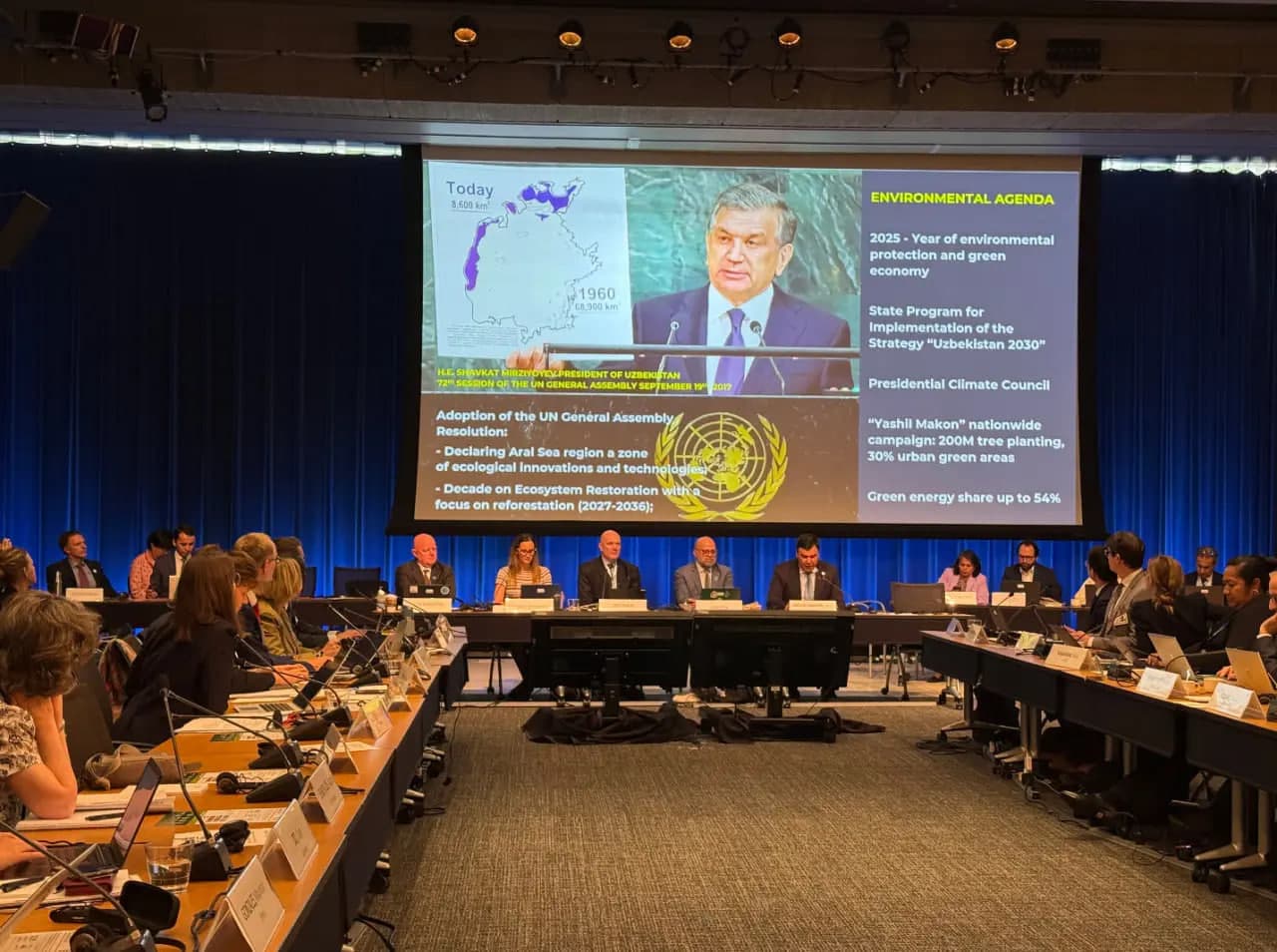
Aziz Abdukhakimov, Minister of Ecology, Environmental Protection, and Climate Change of Uzbekistan, addressed the Council and highlighted a number of major environmental initiatives launched by the President. In particular, he emphasized the large-scale afforestation campaign on the dried-up Aral Sea bed, where 2 million hectares have already been reforested. Within the framework of the national project “Yashil Makon” ("Green Space"), 200 million trees are planted annually, with the goal of increasing green areas to 30% of the country’s territory. Uzbekistan also plans to raise the share of green energy to 54% by 2030 and is actively promoting the transition to renewable energy and zero-emission transport.
The Minister also drew attention to recent legislative reforms aimed at protecting the environment and improving the quality of environmental education in Uzbekistan. The country’s Constitution was amended to include articles on environmental protection, while the Administrative Code and other relevant documents were enhanced to strengthen ecological resilience. Additionally, a number of new institutions were established at the President’s initiative, including the Central Asian University of Environmental and Climate Change Studies (Green University), the Presidential Climate Council, and the National Climate Change Center. The year 2025 has been declared the “Year of Environmental Protection and Green Economy” in Uzbekistan. The country is also advancing a number of UN General Assembly resolutions, including the one on forest and land restoration for the period 2027–2036.
The Council decided that the 8th GEF Assembly and the 71st GEF Council Meeting will be held in Samarkand in 2026. On behalf of the Government, Minister Abdukhakimov expressed deep appreciation to the GEF for its support, which has significantly contributed to the development of the country’s environmental agenda, and voiced hope for continued cooperation.
The event highlighted that Uzbekistan’s environmental initiatives have drawn global attention to the root causes and mitigation of climate change in Central Asia. The upcoming events in Samarkand will bring together leading donor countries to seek joint solutions to the region’s environmental challenges.
“Central Asia remains highly vulnerable to the threats of climate change, water scarcity, and land degradation. The 2026 GEF Assembly will serve as an important platform for mobilizing funding, sharing knowledge, strengthening resilience, and bringing critical attention to these issues. Through the summit and in partnership with other countries, we aim to enhance regional cooperation, improve climate resilience, and prevent biodiversity loss,” said the Minister.
He also noted the symbolic importance of hosting the event in Samarkand, which was recognized by the UN World Tourism Organization as the “World Capital of Cultural Tourism.”
“It is a great honor for us. Samarkand, with its 3,000-year history, sits at the crossroads of ancient civilizations, and its people have always lived in harmony with nature. Today, it is a vibrant city known for its rich history, culture, national cuisine, and unique hospitality. Strategically located in the heart of Central Asia and along the historic Silk Road, Samarkand offers convenient access for delegates from around the world,” the Minister added.
Aziz Abdukhakimov stressed that the 2026 GEF Assembly will be held not only on behalf of Uzbekistan but also as a joint platform representing all of Central Asia. He also noted that citizens from nearly 100 countries can enter Uzbekistan visa-free, while others can obtain a simplified electronic visa within 24 hours—an added convenience for international delegates.
“We have already hosted major events in Samarkand such as the UNWTO General Assembly, the EBRD Annual Meeting, UNCCD CRIC21, CMS COP14, and the recent Samarkand Climate Forum, all attended by participants from across the globe. This year, Uzbekistan will also host significant international events including Eco-Expo Central Asia, the UNESCO General Assembly, and CITES COP20. I warmly invite you to take part in these upcoming events,” said the Minister.
Minister Abdukhakimov also informed the Council that a regional office of the IUCN (a GEF agency) has been established at the Green University:
“The opening of the IUCN office opens up new opportunities and will serve not only Uzbekistan, but all of Central Asia. We promote the motto ‘Nature Knows No Borders’ in the region, as environmental challenges do not respect national boundaries, and transboundary cooperation is of critical importance.”
The GEF Assembly plays a crucial role in mobilizing financial support to strengthen global environmental action and achieve the Sustainable Development Goals. Uzbekistan remains committed to environmental protection and will continue to champion initiatives that improve the ecological situation both in the region and around the world.
For reference: The Global Environment Facility (GEF) is the largest international funding institution for environmental initiatives. It supports countries in addressing global environmental challenges, including climate change, land degradation, biodiversity loss, and water pollution. Hosting the GEF Assembly in Uzbekistan will serve as an important recognition of the country's efforts in environmental protection and sustainable development. It will also provide a unique platform for attracting investment, expanding international cooperation, and promoting national environmental priorities at the global level.
Uzbekistan is steadily strengthening its status as an environmental hub of Central Asia by hosting key international events in the field of environmental protection. In recent years, the country has successfully held major events such as the 21st session of the Committee for the Review of the Implementation of the UN Convention to Combat Desertification (CRIC21), the 14th Meeting of the Conference of the Parties to the Convention on the Conservation of Migratory Species of Wild Animals (CMS COP14), and the first Samarkand Climate Forum. In the coming months, Uzbekistan is preparing to host the international environmental exhibition ECO EXPO Central Asia and the 20th Meeting of the Conference of the Parties to CITES — the Convention on International Trade in Endangered Species of Wild Fauna and Flora. All of this affirms the country’s growing role as a regional center for environmental diplomacy and sustainable development.