Consolidation of the efforts of the neighboring countries of Afghanistan can play a decisive role in establishing a lasting peace in this country
2023-04-13 09:30:57 / Meetings
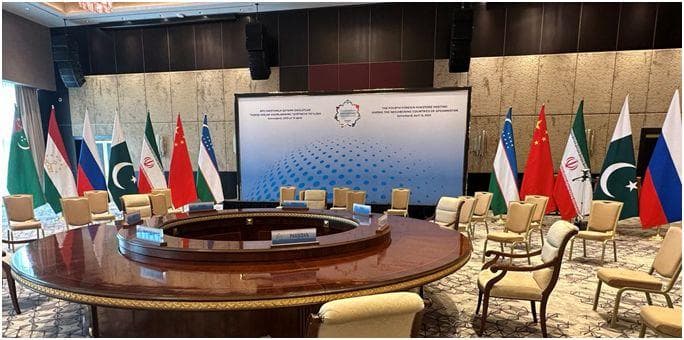
The meeting will be attended by the foreign ministers of Iran, China, Pakistan, Russia, Tajikistan, Turkmenistan and Uzbekistan.
On March 7, Tashkent hosted the first meeting of special representatives of Afghanistan's neighboring countries, at which Uzbekistan's initiative to create a high-level International Negotiating Group under the auspices of the UN to prepare and agree with the Afghan authorities on an algorithm for the phased fulfillment of the obligations of the parties was positively assessed.
The forum will discuss the current situation in Afghanistan, the efforts of the parties to ensure that the new authorities of the country fulfill the key requirements of the world community - the creation of an inclusive government, ensuring access for Afghan women to work and education, and respect for the rights of national minorities.
The strategic importance and relevance of the upcoming forum lies in the fact that in Samarkand all the countries that are the closest neighbors of Afghanistan gather at one site. This format will make it possible to discuss in detail joint measures to provide humanitarian assistance to the Afghan people, as well as to promote the establishment of peace in this country and its economic development.
Uzbekistan invariably stands for the settlement of the situation in Afghanistan exclusively by peaceful, political and diplomatic means, firmly adheres to the need to respect its sovereignty, independence and territorial integrity, support the formation of a neighboring country as a peaceful, indivisible, independent, economically developing state.
The principle of President Shavkat Mirziyoyev regarding the stabilization of Afghanistan - "from instability and destruction to peace and creation" - determines the logic of joint regional cooperation in the Afghan direction.
In 2016, Uzbekistan significantly stepped up its efforts to resolve the Afghan issue. A landmark event was the high-level Tashkent International Conference on Afghanistan “Peace process, security cooperation and regional cooperation” held in 2018 at the initiative of the President of Uzbekistan. The Tashkent Declaration adopted at the end of the conference for the first time consolidated a universal consensus on the need for a political settlement of the situation in Afghanistan, which gave a tangible impetus to the resumption of the peace process and the cessation of the armed conflict.
An important contribution to international efforts to promote peace in Afghanistan was the high-level international conference “Central and South Asia: Regional Connectivity” organized in Uzbekistan on July 15-16, 2021. Challenges and Opportunities”, which once again emphasized the paramount role of peace and stability in Afghanistan for the development of interregional ties.
On July 25-26, 2022, the International Conference "Afghanistan: Security and Economic Development" was also held in Tashkent. It brought together special representatives for Afghanistan from more than 20 states of Central and South Asia, Europe, America, the Middle East, the Asia-Pacific region, directly involved in the Afghan settlement, heads and specialists from a dozen international and regional organizations, including the UN, the European Union, Food and Agriculture Organization of the United Nations (FAO), the Economic Cooperation Organization, the Organization of Islamic Cooperation, the Shanghai Cooperation Organization, as well as the delegation of the Interim Government of Afghanistan.
Domestic experts, heads and specialists of leading analytical centers of Afghanistan's neighboring states, including from all Central Asian countries, Russia, the USA, Iran, Pakistan, India and Belgium were also invited as participants.
This conference has become an integral part of Uzbekistan's systemic efforts to ensure security and stability in Central Asia and turn Afghanistan into a peaceful, prosperous country free from terrorism and wars.
Uzbekistan provides humanitarian assistance to the Afghan people. In particular, from September 2021 to the present, more than 10,000 tons of humanitarian cargo have been sent to Afghanistan. Moreover, our country also performs an important mediating mission, facilitating the delivery of humanitarian aid sent by the international community to this country.
Thus, in 2021, at the initiative of President Shavkat Mirziyoyev, under the auspices of the UN, an international logistics hub in Termez began to operate to receive and deliver aid to Afghanistan. This is the only terminal located near the border with Afghanistan. Its area is 40.7 hectares. In the first half of 2022 alone, the World Food Programme, UNICEF and the Office of the United Nations High Commissioner for Refugees, which opened their offices in Termez, sent more than 35,000 tons of humanitarian aid to Afghanistan.
Uzbekistan also contributes to the training of national personnel for Afghanistan, which is so necessary for the reconstruction of the country's economy. In particular, in 2018, the Educational Center for Afghan citizens was launched in the city of Termez and continues to operate today. This is the only institution in the world that trains Afghans in 17 areas of higher and 16 areas of secondary specialized, vocational education. Currently, 129 Afghans are being trained at the center; they, along with fellow citizens who have already graduated, will undoubtedly contribute to the reconstruction of their country.
Uzbekistan stands for the implementation of large infrastructure projects in Afghanistan. In particular, the construction of the Surkhan-Puli-Khumri transmission line will make it possible to supply 6 billion kWh of electricity to Afghanistan per year, which will cover a third of the country's electricity needs. Through the implementation of this project, 500,000 families, social infrastructure and economic sectors in Afghanistan will have access to electricity.
In turn, the implementation of the project for the construction of the Termez-Mazar-i-Sharif-Kabul-Peshawar railway, which will become a logical continuation of the Hairatan-Mazar-i-Sharif railway, will allow the formation of new and shortest transit corridors with access to Pakistani and Indian railways, as well as to ports of the Arabian Sea (Gwadar, Karachi/Qasim, Mumbai and others, will connect Uzbekistan, Afghanistan and Pakistan.
The implementation of this interregional railway project, which provides for the construction of 785 kilometers of power supply lines, 790 kilometers of communication lines, more than 1 thousand new artificial structures (bridges, tunnels, stations), will contribute to the development of transport and related infrastructure in Afghanistan along the railway.
As a result, it is expected that more than half a million new jobs will be created and new professions will be formed, including those related to the operation of railway transport, up to 15 million residents of the region will become beneficiaries of the project.
The implementation of these large projects can act as a trigger for the economic development of Afghanistan, create alternative sources of income for the population and, as a result, eliminate the social background of the conflict.
Most importantly, the transformation of Afghanistan into a space that unites the countries of the region through infrastructural and economic interconnection projects will increase the interest of the states surrounding Afghanistan in maintaining peace and stability in this country, will return to Afghanistan its lost historical role as a link between Central and South Asia.
President Shavkat Mirziyoyev, within the framework of the IV Summit of the Central Asian countries on July 21, 2022, noted: “Continuing close cooperation in promoting long-term peace in Afghanistan and its socio-economic reconstruction should remain the most important priority of the Central Asian states. We are the closest neighbors, more than anyone else should be interested in stability in this country. It is up to us to a large extent how the international community perceives this problem.”
A consolidated approach can play a decisive role in establishing a lasting peace in Afghanistan and returning this country to the path of peaceful development. Today, the countries of Central Asia stand on the positions of democratic rule of law states, develop on the basis of the principles of secular republics, and stand for strengthening human rights and freedoms.