
IMPORTANT INFORMATION
2026-11-03 19:00:00 / News
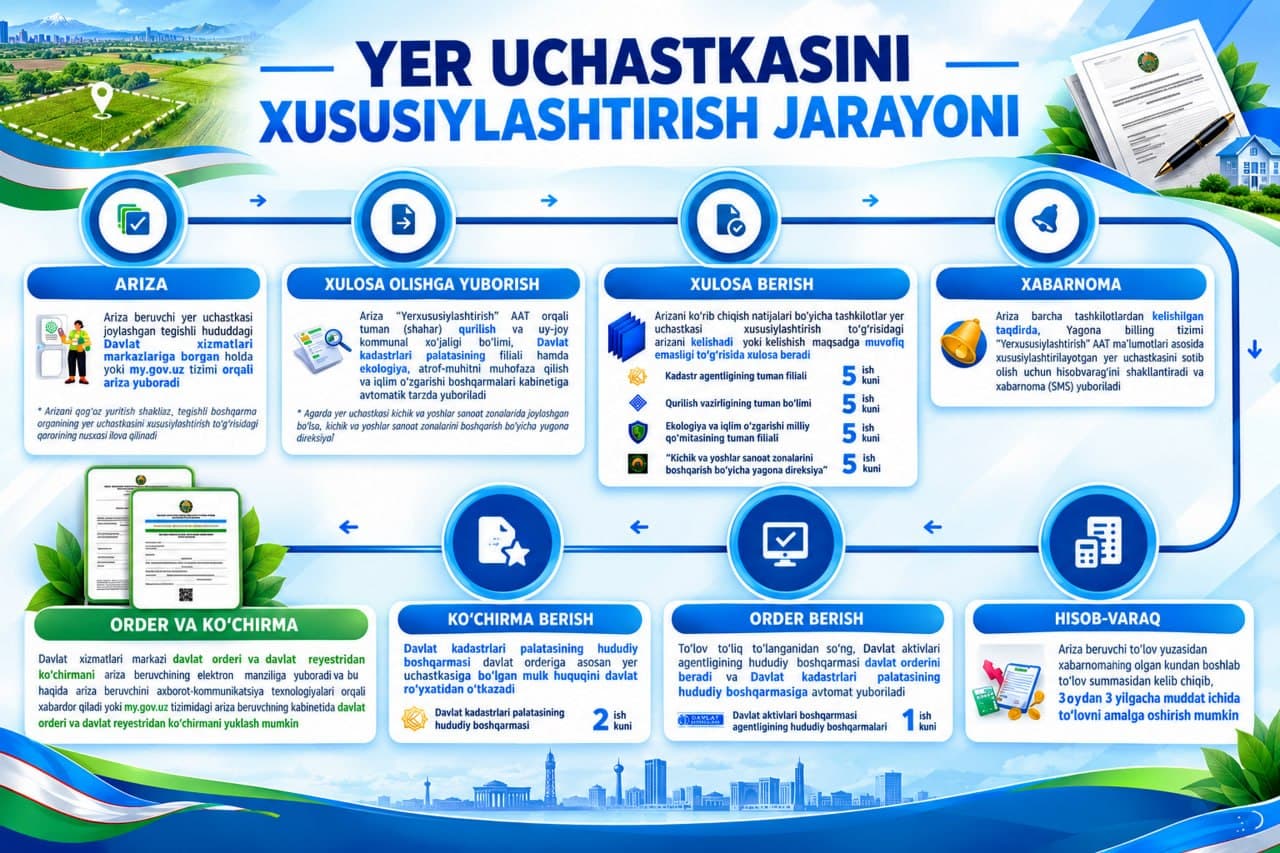
How can citizens privatize the land plots on which their privately owned individual residential houses are located (excluding multi-apartment buildings)?
Until recently, the established practice was to allocate land plots for business activities, that is, to sell them through auctions.
In accordance with Resolution No. 71 of the Cabinet of Ministers dated February 14, 2022, and the Law “On Privatization of Non-Agricultural Land Plots,” three procedures have been developed:
-
The procedure for privatizing land plots belonging to individuals and legal entities;
-
The procedure for putting land plots intended for business activities up for auction;
-
The procedure for acquiring ownership rights to land plots on which individual residential houses are located.
Citizens own individual residential houses, while legal entities own non-residential buildings and structures. They can privatize the land plots on which their real estate is located by completing the relevant cadastral documentation. (If a building has not been registered in the cadastre, the land plot cannot be privatized.)
How Much Does It Cost to Privatize a Land Plot?
We all pay land tax on our land plots. For landowners and land users, the privatization fee has been set at 20 times the amount of land tax assessed for the respective land plot.
For example, if a citizen pays 200,000 Uzbek soums in annual land tax for a residential plot (property tax is not included in this calculation; only the land tax is taken into account), the privatization fee will amount to 2 million soums.
Once this payment has been made, the relevant information is recorded in the billing system, and the authorized state bodies issue a state warrant for the respective land plot. On the basis of this warrant, the cadastral authorities register the ownership right to the land plot in the state register.
Each individual or legal entity may purchase only the land plot that belongs to them. Such land plots are not put up for auction, cannot be purchased by another person, and cannot be transferred to another person through this privatization procedure.
Land plots intended for business activities, on the other hand, are acquired transparently through auction proceedings.
Land Privatization Is Entirely Voluntary. But What Benefits Does It Offer Citizens?
First, you acquire ownership rights to your land.
For example, you may wish to gift part of your residential plot to your son, transfer it to someone else, or sell half of it. Ownership rights allow you to divide your land plot into separate parts and sell them. It is up to the owner to decide how much of the land to sell and to whom, because the land belongs to them.
Second, the state cannot simply take your land away; it can only purchase it.
Legislation provides for the possibility of withdrawing state-owned land or land that is being used by other individuals or entities. Land plots held under five other types of land-use rights, apart from ownership rights, may be subject to withdrawal in accordance with the established procedures.
Once you obtain ownership rights to your land plot through privatization, the state can no longer simply take your land away.
If the state needs your land, it may purchase it from you at market value under a contract. The land will become state property only if it is purchased at a price agreed upon by both parties. In other words, the land cannot simply be taken away without observing the legal guarantees. This is the protection provided by ownership rights.
If the state needs the land, won't it take it anyway, even if I refuse to sell it?
The Land Code does not define land as state property. Instead, land is recognized as the property of the entire nation.
In other countries, if your land plot is worth 100 million Uzbek soums, you may receive an offer at a price that you find acceptable. If you agree, the land is purchased under a contractual agreement.
A similar situation occurred in Türkiye. During the construction of an airport, the government was unable to purchase a plot of land belonging to an elderly man. As a result, the entire project was delayed for several years. There are many similar examples. Ultimately, it is your decision whether or not to sell your land.
Third, you gain the right to freely combine, redistribute, and subdivide your land plot.
Until now, legislation had not provided for the full implementation of mechanisms for combining, subdividing, and redistributing privately owned land plots. These mechanisms are available, but they can only operate when ownership rights to the land plot have been established.
Since this is a relatively new concept in Uzbekistan, its benefits will not become visible within just one or two days. As private ownership of land plots becomes more widespread in certain areas, we will begin to see the effectiveness of these mechanisms.
Here is a simple example: in some foreign countries, there may be 20 land plots within one particular area, with a combined value of 1 million US dollars. Depending on urban planning requirements, the owners of these 20 plots may reach an agreement to redistribute the land. As a result, the total value of the land may increase three or four times, reaching 3–4 million US dollars. Such mechanisms can be particularly beneficial in densely populated areas.
Fourth, you can use your land as collateral.
Once you obtain ownership rights to your land, you can use it as collateral. In particular, you gain the opportunity to pledge your land plot to a bank and obtain a mortgage loan.
Important!
Each individual and legal entity may privatize only the land plot that directly belongs to them. Such a plot is not put up for auction and cannot be purchased by another person or transferred to another person through this procedure.
Individuals and legal entities can apply online to privatize their land plots through the my.gov.uz portal using the following link:
https://my.gov.uz/oz/service/313
JSC “Electronic Online Auctions Organization”
Regional Representative for Andijan Region — J. Isroilov