
"Principles of gender-oriented budgeting, media coverage of the topic of family and women"
2025-09-15 10:05:00 / Statements and speeches of administration
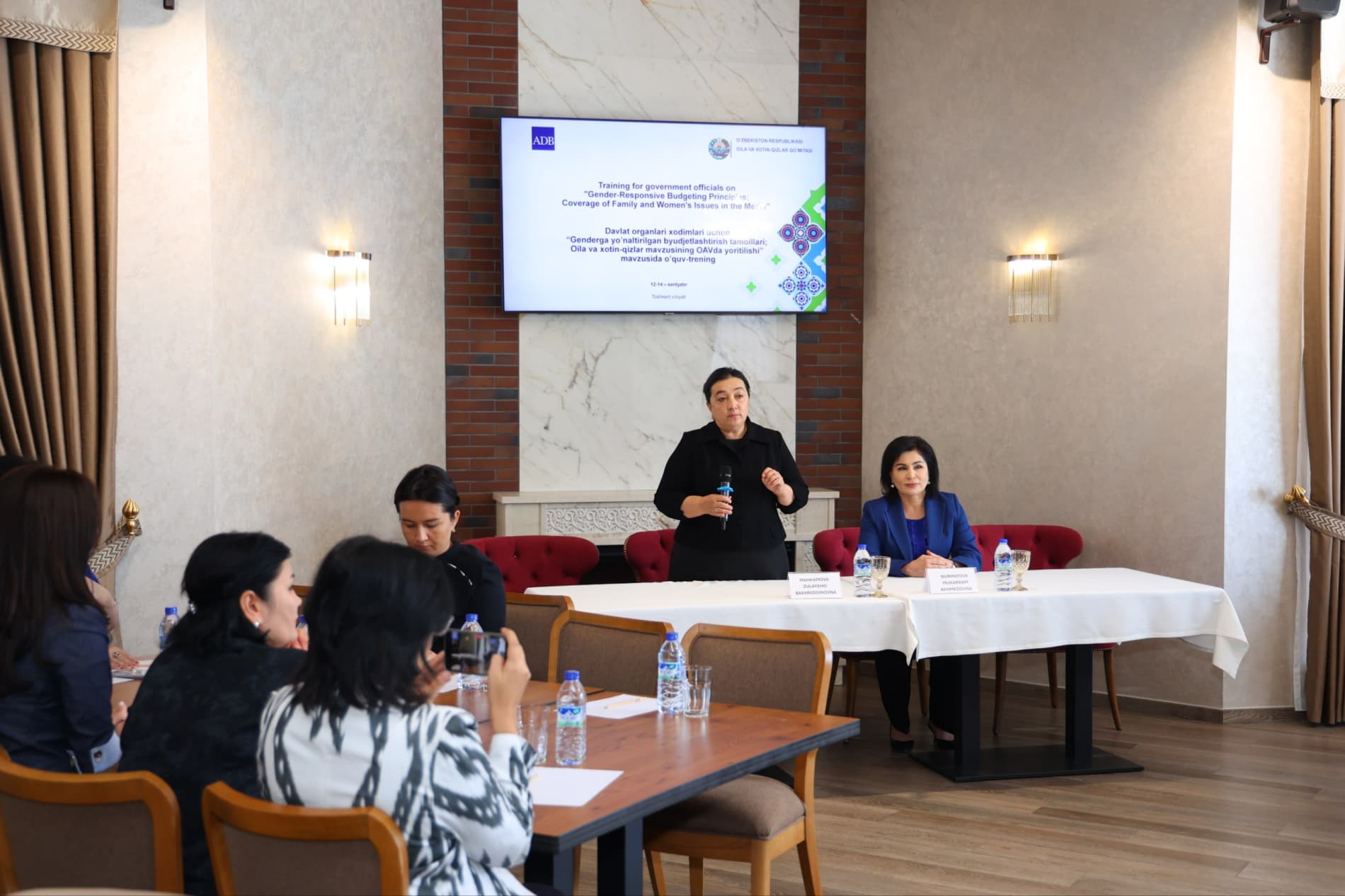
First of all, I would like to express my sincere gratitude to you, Ms. Kanokpan Lao-Araya, and in your person to the staff of the Asian Development Bank's representative office in Uzbekistan for the close cooperation in organizing today's event!
It is well known that under the leadership of the President of Uzbekistan, the esteemed Shavkat Mirziyoyev, powerful steps have been taken and large-scale reforms are being implemented in our country to support families and women, and to ensure gender equality.
In recent years, as a result of legal reforms that improve the status of women in the country, Uzbekistan has become one of the countries that have made progressive changes: for example, criminal liability for domestic violence, the rule of equal pay, and the removal of restrictions on women's employment in certain areas.
Also, in accordance with the Strategy for Achieving Gender Equality in the Republic of Uzbekistan until 2030, it is planned to gradually introduce "Gender-Oriented Budgeting" into budget processes.
Dear seminar participants!
We are well aware that the principle of "Gender-Oriented Budgeting" makes a huge contribution to national development and the further improvement of women's lives.
It should be noted that since 2024, cooperation has been established between the UN Women, the Asian Development Bank, and the Ministry of Economy and Finance on gender-oriented budgeting.
The project "Promoting Gender-Oriented Policy and Budgets: Towards Transparent, Inclusive, and Accountable Governance in Uzbekistan," officially launched by the European Union in May of this year, vividly reflects today's theme of "Gender-Oriented Budgeting." Including:
- execution of the state budget on an equal basis, primarily in accordance with the interests of women and men;
- creation of more effective management that meets the needs of various social groups and leaves no one behind by including gender analysis in the planning and budgeting processes;
- elimination of problems and obstacles, including such indicators as women's ownership of land and property, insufficient representation of women in high-income sectors of the economy;
- helps prevent the spread of violence, increase the level of young marriages, increase the proportion of women living in households using clean fuel, and equalize the proportion of women's seats in national parliaments.
In short, "Gender-Responsive Budgeting" contributes to a more equitable distribution of public resources, ensuring transparent, inclusive, and result-oriented public financing, taking into account the needs of women, girls, and vulnerable groups.
Also, the introduction of a gender-oriented budgeting system in our country plays an important role not only in the fair distribution of state budget funds for men and women, but also in increasing transparency, accountability, and efficiency in public finance management.
For reference
In the parameters of the state budget for 2025, funds allocated for the purposes of state support for women are provided for a total of 14.4 trillion soums.
In particular, 7.4 trillion soums were allocated for benefits for families with children and low-income families, 1.5 trillion soums for expenses related to the health of women and children, 1.4 trillion soums for allocating targeted resources from the state budget to commercial banks for educational loans, and 1 trillion soums for maternity benefits for women working in budget organizations.
Certainly, qualified specialists will provide detailed information to the participants of today's seminar on "Gender-Oriented Budgeting."
I once again thank the organizers and our partners for this relevant seminar on a topic that every civil servant must deeply study and know!
Dear seminar and training participants!
At today's event, we will focus on another priority issue - the coverage of the topic of family and women in the mass media.
It is known that the mass media and social networks contribute to the wide promotion of women's achievements, activities, their place in the family and society, equal rights. Especially in the modern information space, the objective and positive reflection of the image of women, their portrayal as knowledgeable, proactive, and capable individuals influences the public consciousness, encourages them, and inspires them towards new goals.