A Central Asian Research Center for Environmental Protection will be established in Uzbekistan
2025-05-22 08:22:00 / News
A meeting was held at the Ministry of Ecology, Environmental Protection and Climate Change between Minister Aziz Abduhakimov and Vice President of the Academy of Sciences of the People's Republic of China, Professor He Hongping. During the meeting, the parties discussed the main areas of bilateral cooperation in the field of ecology, environmental protection, and sustainable development.
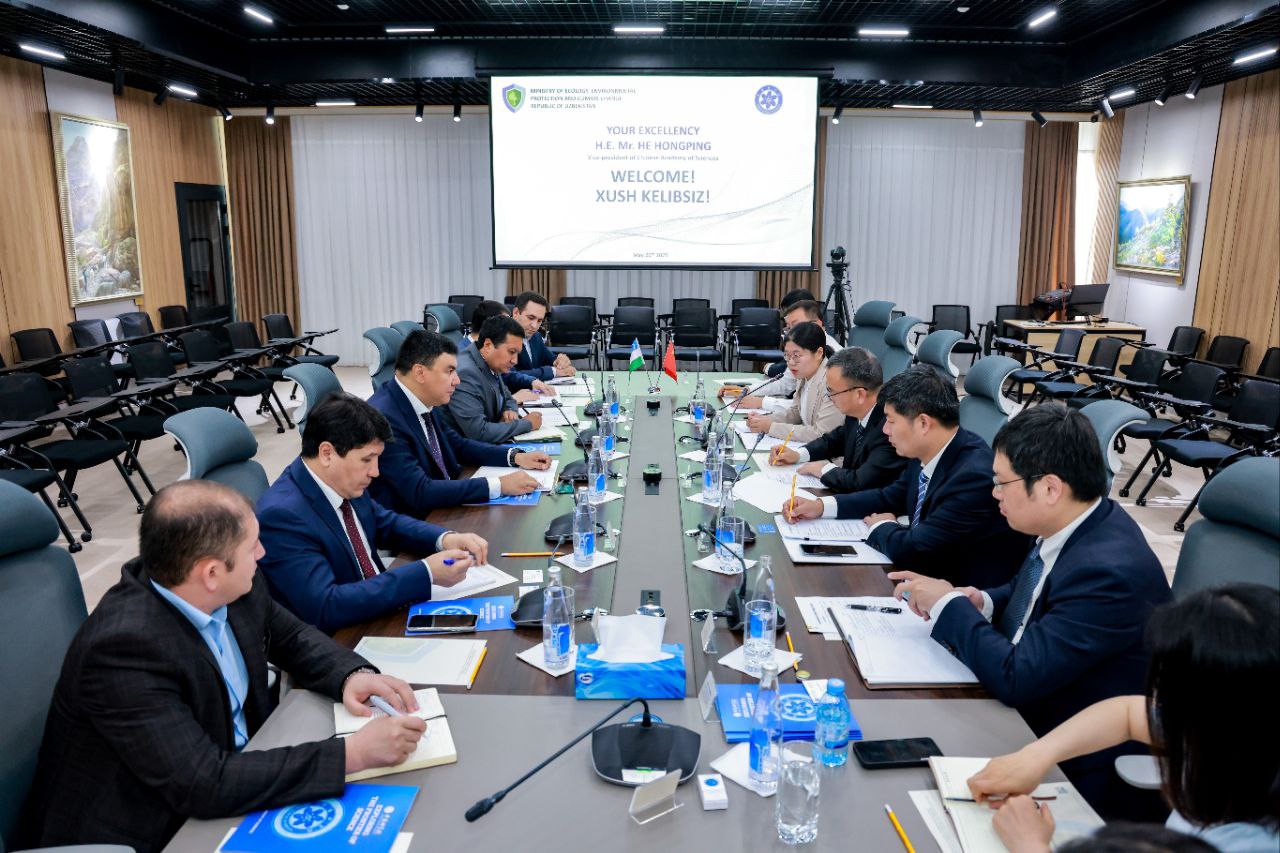 At the event, special attention was paid to the implementation of the agreements reached within the framework of the Intergovernmental Agreement on Environmental Protection, signed in January 2024. The importance of expanding sustainable cooperation and joint scientific and practical initiatives was emphasized. These include the creation of halophyte plantations in the Arnasay, Karmana, Mubarek, Karakul, and Nukus districts, the delivery of 1.4 tons of seeds to the Uzbek Agency of Forestry, the implementation of digital pollution monitoring systems, and the participation of Chinese specialists in the implementation of the nationwide "Green Space" initiative.
Following the negotiations, a Memorandum of Understanding was signed between the Ministry of Ecology, Environmental Protection and Climate Change of the Republic of Uzbekistan and the Xinjiang Institute of Ecology and Geography (SAS XIEG) of the Chinese Academy of Sciences. The document was signed by Aziz Abdukhakimov and the General Director of SAS XIEG, Professor Zhang Yuanming.
According to the memorandum, an agreement was reached on the establishment of the Central Asian Research Center for Ecology and Environmental Studies (Tashkent Headquarter) on the basis of the Central Asian University for the Study of the Environment and Climate Change ("Green University"). The Center will serve as an important platform for conducting scientific research, training specialists, exchanging technologies and experience, as well as promoting "green" and sustainable development in the region.
The document provides for the implementation of broad areas of cooperation: holding scientific conferences and seminars, conducting joint research and preparing publications, equipping laboratories with modern equipment, launching practical projects, and developing personnel potential.