"Keep Thanking the President, Daughter-in-Law!" — How the Public Grievance Redressal System is Delivering Real Results in Nukus
2026-06-19 13:00:00 / News




June 19, 2026
Press Service of the Nukus City Administration
"Keep Thanking the President, Daughter-in-Law!" — How the Public Grievance Redressal System is Delivering Real Results in Nukus
A recent analysis of the past three years of data by the Nukus City Administration reveals a significant and steady decline in the number of public grievances and petitions filed by citizens over the last and current years.
What does this trend signify? Above all, it demonstrates that the fair and equitable system established under the President's directives—focused on listening continuously to the people's voices and delivering prompt, positive solutions—is bearing concrete fruit on the ground.
When Numbers and Facts Speak for Themselves It is particularly noteworthy that by the end of May 2026, the Nukus City Administration outpaced 208 cities and districts across Uzbekistan in its grievance resolution rate. Achieving a 66.26% positive resolution rate (with 1,828 petitions successfully resolved), Nukus secured the number one spot nationwide. Furthermore, at the regional level, Nukus has maintained the top ranking within the Republic of Karakalpakstan for three consecutive months.
Among the tangible achievements of the past three years, one notable milestone stands out: the roofing of 1,690 homes has been fully refurbished with corrugated sheets. It is also a source of pride to highlight that within the framework of targeted resolutions for petitions addressed to the Chairman of the Joqargʻi Kenges of the Republic of Karakalpakstan, A. Orinbayev, the state is currently rebuilding 11 completely new homes for socially vulnerable citizens in the city of Nukus alone. These figures reaffirm that we live in a welfare state where the processes of building a prosperous life are actively in motion.
What Does the Current Landscape of Grievances Look Like? Naturally, a question arises: Why do citizens still submit petitions to the city administration? Today, the remaining incoming requests primarily center around the following matters:
-
Assistance with healthcare and medical recovery;
-
Alimony recovery and enforcement;
-
Land and boundary disputes between neighbors;
-
Social welfare allocations and financial aid.
In this regard, an essential point must be clarified. Many citizens do not yet fully realize that social welfare assistance is now processed through a national digital system that operates without human intervention, thereby eliminating bureaucratic hurdles. The days when personal connections or "having a friend in high places" mattered are entirely over. Your application for financial aid is entered directly into a computerized system, which automatically evaluates eligibility based on strict legal criteria.
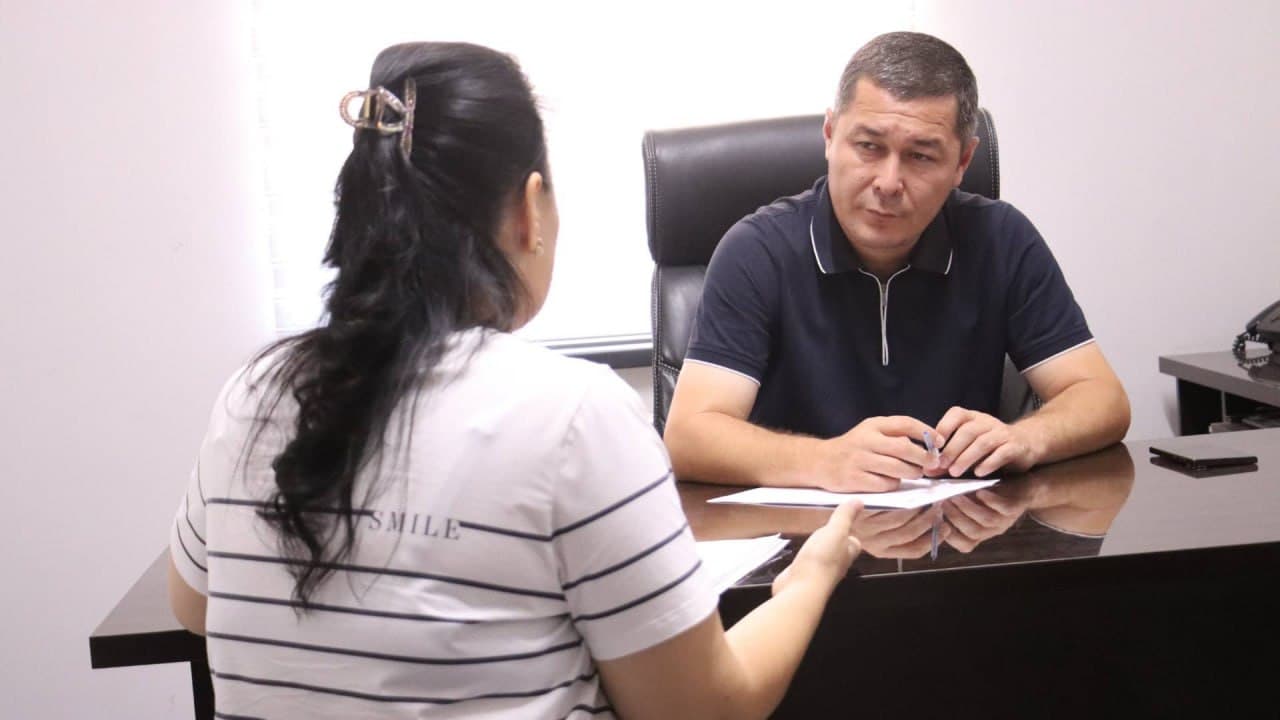
Public Audiences and Addressing Welfare Dependency Today, the Deputy Mayors of Nukus City—M. Kannazarov, Z. Davletnazarova, and G. Davletmuratov—conducted another round of public audiences. During these sessions, issues regarding land registries, housing allocation, and social support were thoroughly reviewed.
On-site, targeted assessments reveal that the vast majority of those requesting housing construction or repairs are young families who have migrated from rural areas to Nukus within the last two to three years.
This brings up a justified question: Is it right to "put on the cloak of poverty" and expect the state to provide everything, even when one is perfectly healthy and able-bodied? Nukus offers ample opportunities for anyone wishing to start a small business or earn an honest living through manual labor. In every neighborhood, neighborhood-level assistants (hokim yordamchilari) stand ready to provide tailored business plans and facilitate access to concessional loans.
A Real-Life Example in Conclusion Just the other day, during a field assessment in the "Nurli Boʻston" neighborhood, a brief interaction caught our attention. While speaking with a citizen, G.D., whose new home is currently being constructed by the state, a worker from the Kegayli district—Murat aka, an ordinary laborer on the construction site—turned to the homeowner and said:
— "Keep thanking the President, daughter-in-law! If it weren’t for that man, where would you ever get a home like this?"
These heartfelt words from an ordinary construction worker, who genuinely understands and appreciates the state's care for its people, carry far more weight than any statistic or raw data. This is the ultimate, living proof that we reside in a truly compassionate, welfare-oriented nation.
Elmira Sagalatdinova.