
Inspection for Control in Mining and Geology Enters New Phase of Anti-Corruption Work: Over 2.5 Billion UZS Recovered and ISO Certification Obtained
2026-08-05 16:05:00 / News
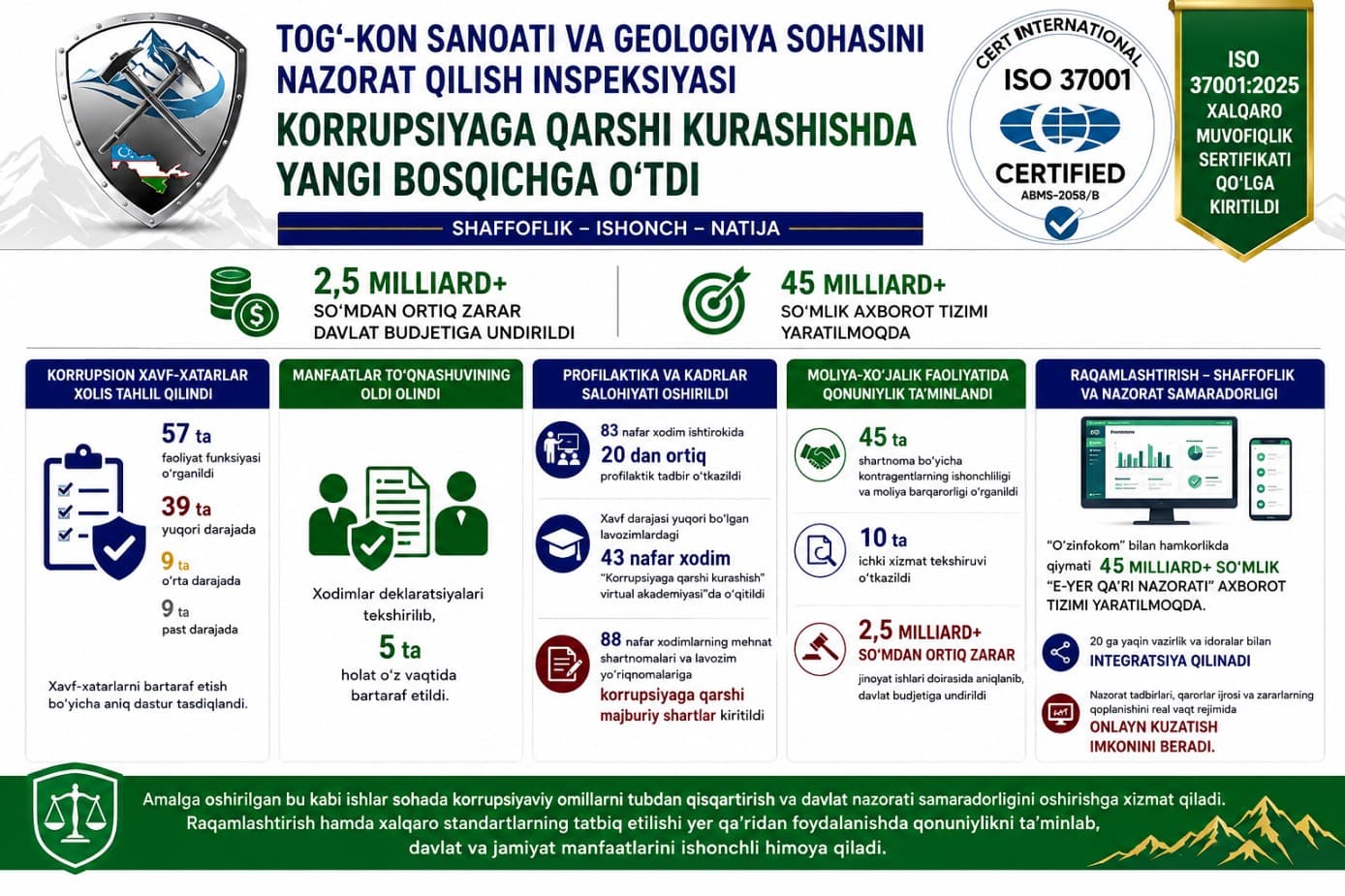
During the first half of 2026, the Inspection for Control in the Field of Mining and Geology executed a comprehensive set of systemic measures aimed at combating corruption and ensuring institutional transparency. In close collaboration with the Anti-Corruption Agency, international standards were introduced and sectoral risks were rigorously analyzed.
During the reporting period, 57 operational functions of the inspection were evaluated, identifying 39 high, 9 medium, and 9 low corruption risks, accompanied by the approval of a targeted action plan. To prevent conflicts of interest, employee declarations were analyzed, allowing 5 potential conflict situations to be identified and resolved in a timely manner.
Significant emphasis was placed on preventive measures and professional development. More than 20 legal awareness and preventive events were held for 83 employees, while 43 specialists holding positions with elevated corruption risks completed training at the Anti-Corruption Virtual Academy. Furthermore, mandatory anti-corruption provisions were incorporated into the labor contracts and job descriptions of 88 personnel members.
To ensure compliance in financial and economic activities, counterparty credibility and financial stability were reviewed across 45 contracts. Following 10 internal investigations and related criminal cases, more than 2.5 billion UZS in identified damages were recovered for the state budget. Marking a major milestone, the inspection obtained the ISO 37001:2025 international compliance certificate.
To minimize the human factor in supervisory processes, the inspection partnered with "Uzinfocom" to develop the "E-yer qa'ri nazorati" information system valued at over 45 billion UZS. Integrated with nearly 20 line ministries and agencies, this platform enables real-time digital tracking of regulatory inspections, decision-making, document workflows, and damage recovery.
These structural reforms fundamentally reduce corruption exposure while enhancing the efficacy of state oversight. The combination of digital technology and international standards guarantees rule of law in subsoil usage, effectively safeguarding public and state interests.