
Digital Revolution in Subsoil Supervision: Artificial Intelligence and "E-YER QARI NAZORATI" System to Be Introduced
2026-07-17 11:30:00 / News
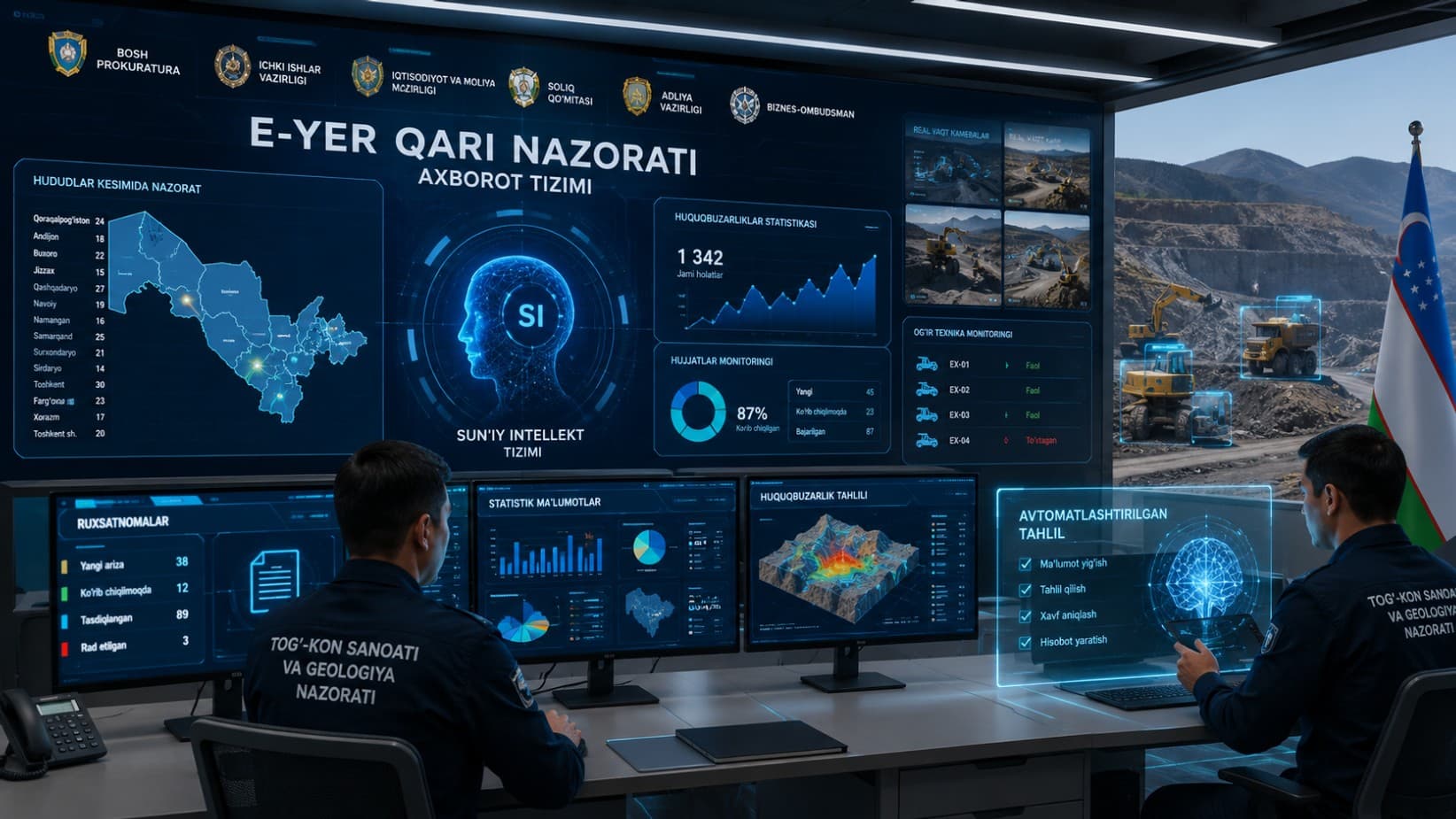
The supervision system in the mining and geology sector of Uzbekistan is undergoing a fundamental reform. A draft resolution of the Cabinet of Ministers "On Complex Measures for Digital Transformation of the Activities of the Inspectorate for Control of Mining Industry and Geology" has been developed. This document is aimed at simplifying the processes of issuing permit-style documents in the sector, reducing the human factor, and ensuring the complete transparency of control activities.
The necessity of preparing this draft resolution arose due to the instructions of the head of state, as well as the inconsistency of existing technologies and personnel potential with the requirements of today's fast-paced era. The new system will elevate the fight against illegal subsoil use to an entirely new level.
New Supervision Tool: "E-YER QARI NAZORATI"
The most crucial link in the reforms is the "E-YER QARI NAZORATI" information system, which will be introduced starting October 1, 2026. This system will carry out online monitoring of the identification of violations of subsoil use requirements, compilation of document packages, and their review.
To ensure the system's effectiveness, it will be integrated with the information systems of several responsible state bodies. These include the General Prosecutor's Office, the Ministry of Internal Affairs, the Ministry of Economy and Finance, the Tax Committee, the Ministry of Justice, and the Business Ombudsman. The integration work is scheduled to be completed by November 1, 2026, and the system is expected to be fully operational by January 1, 2027.
Implementation of Artificial Intelligence Technologies
Within the framework of the new project, the Concept of widespread introduction and development of Artificial Intelligence (AI) technologies in the Inspectorate's activities is being approved. With the help of AI, the following tasks will be accomplished:
-
Starting from November 1, 2026, the design of an automated system for reviewing certain types of permits and applications will begin;
-
An automated system will be created to keep records of offenses and crimes in the field of subsoil use, free from human bias, allowing for deep analysis by regions and types of violations;
-
By January 25, 2027, an AI-based software system for automatic collection and analysis of statistical data will be launched.
In the long term (after 2027), real-time profiling of surveillance camera footage in quarries and AI-powered verification of the authenticity of citizens' photo and video reports will be implemented.
Digital Accounting of Technical Equipment
The supervision of technical equipment used in subsoil operations will also be digitalized. A draft technical regulation for registering devices will be prepared by August 1, 2026.
By February 1, 2027, a specialized AI-based monitoring system will be launched, enabling the verification of the accuracy of tax, electricity, and gas payments made by businesses through automated calculations. Conformity certificates of the technical equipment will be automatically verified through the national "Technical Regulation" information system.
What Conveniences Will Be Created for Businesses?
According to the document, several traditionally conducted state services will be fully digitalized:
-
Approval of a special project for the liquidation and conservation of a mining enterprise or part of it (December 2026);
-
Issuance of a mining allotment act for purposes not related to mining (February 2027);
-
Issuance of a mining allotment act for purposes related to mining (March 2027);
-
Improving the mechanism for approving the mining development plan (September 2027).
The transition of these services into a digital format will eliminate excessive bureaucratic barriers and the practice of requesting additional supporting documents.
Sources of Funding and Expenditures
The implementation of these projects will not impose any additional burden on the state budget. All activities will be financed by the extra-budgetary development fund of the Inspectorate and its own resources. The credit funds of the Fund for Reconstruction and Development, which were planned in the initial draft, were excluded from the project upon the proposal of the Ministry of Economy and Finance.
These digital reforms will make the control mechanisms in the mining sector completely transparent. The introduction of artificial intelligence will minimize the risks of petty corruption and improve the quality of public services.
Establishing inter-agency integration will allow for the early detection of illegal subsoil use through space monitoring and digital analysis, ensure the completeness of tax revenues, and reliably protect the economic interests of the state.
J. Bozorxonov - Chief Legal Advisor