Names of 124 geographical features in Uzbekistan aligned with state language standards
2026-07-10 16:45:00 / News
By Decree No. 376 of the Cabinet of Ministers of the Republic of Uzbekistan dated July 9, 2026, the list of certain mountain ranges, mountains, peaks, gorges, passes, and caves, whose names are to be aligned with the rules and standards of the state language or given new names, has been approved. The document was adopted in accordance with the Laws of the Republic of Uzbekistan "On the State Language" and "On Names of Geographical Features".
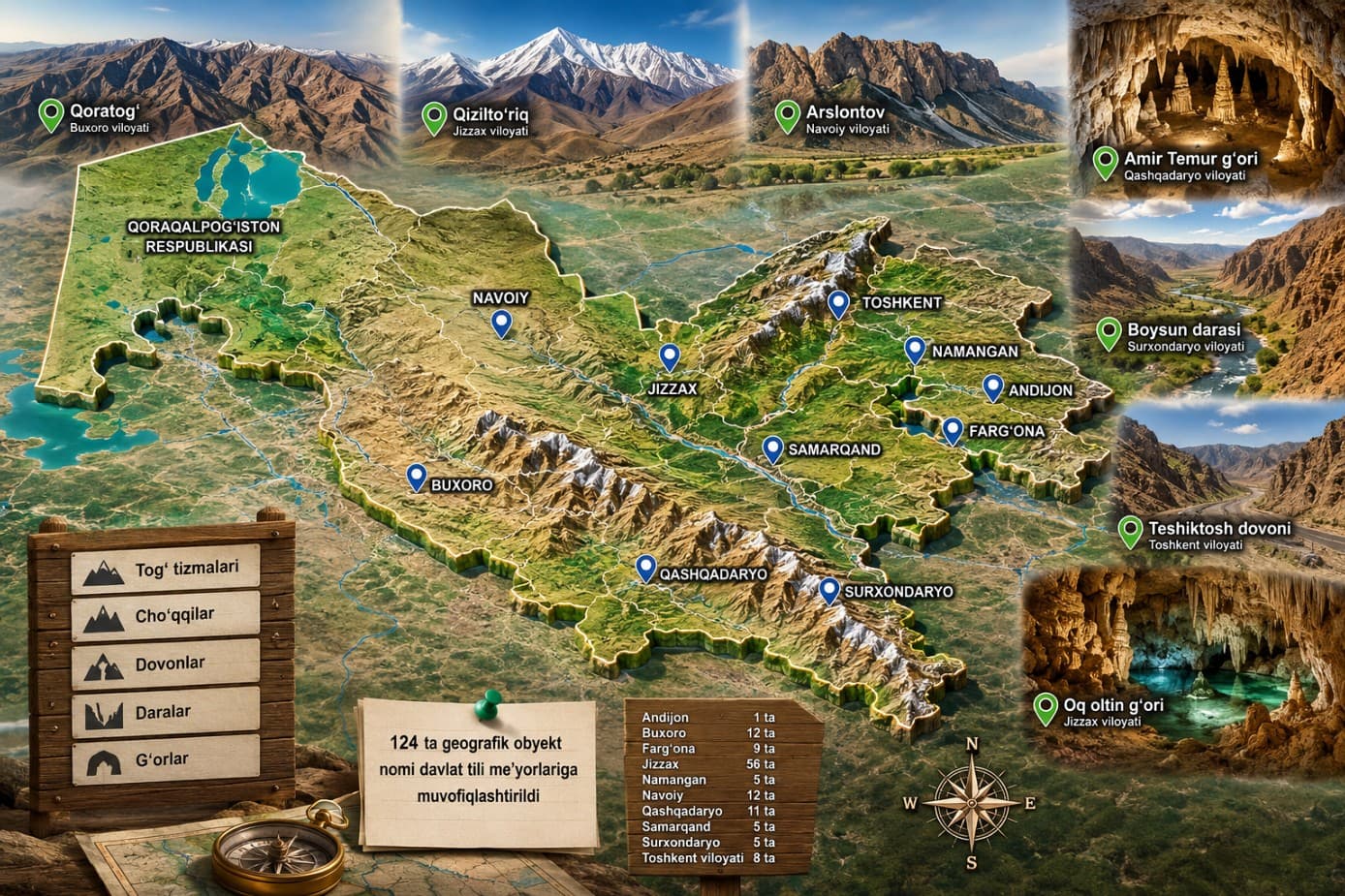
According to the document, the names of a total of 124 geographical features across the republic have been changed or corrected. Among them, 117 features are mountain ranges, mountains, peaks, and passes, while the remaining ones are gorges and caves. Broken down by region, the names of 1 feature in Andijan, 12 in Bukhara, 10 in Fergana, 54 in Jizzakh, 5 in Namangan, 12 in Navoiy, 11 in Kashkadarya, 6 in Samarkand, 4 in Surxondarya, and 8 features in Tashkent region have been harmonized.
As a result of the reforms, names previously misspelled due to the influence of Russian and other languages were brought into conformity with the standards of the Uzbek alphabet based on the Latin script. For instance, "Каратаг" mountain in Bukhara was renamed Qoratog‘, "Кызылтурук" mountain range in Jizzakh became Qizilto‘riq, "Арыстантау" range in Navoiy was changed to Arslontov, and "пещера Тамерлана" cave in Kashkadarya was renamed Amir Temur g‘ori. These names will now be mandatorily used in regulatory legal acts, maps, and official workflows.
The National Committee for Ecology and Climate Change, together with the Cadastre Agency and the Tourism Committee, will introduce amendments to maps and databases within a two-month period. The Council of Ministers of the Republic of Karakalpakstan and regional khokimyats will ensure that signboards and information indicators on the ground are written in the Uzbek language.
Aligning geographical names with the standards of the state language represents a significant step toward national identity reinforcement and ensuring the rule of law. Regulating territorial names supports the expansion of tourism potential, accurate maintenance of the cadastre system, and enhancement of operational efficiency within state authorities.