Wheat diseases
2025-04-09 20:00:00 / News
More than 10 types of diseases damage grain crops in our republic. These are brown rust, yellow rust, powdery mildew, yellow spot, septoria, ear fusarium, powdery mildew, hard black spot, root rot, and snow mold.
Brown rust. If 40-80% of wheat is infected with brown rust during the flowering period, 25-30% of the yield is lost, and if it falls during the ear formation period, 40-50% of the yield is lost. Brown rust disease begins to develop in the body of the wheat plant starting from the air temperature of +2ºС. The most favorable conditions for the development of the disease are considered to be the air temperature of 15-23ºС and the relative humidity of 65-70%. Symptoms of the disease appear as round, yellowish-brown, dusty pads on the leaves of weeds and grain crops such as wild oats, wheat, ryegrass. The spores that develop in these pads are transferred to other leaves and plants by wind, machinery, etc., and if the weather is favorable, they spread widely to other leaves and plants, and fields.
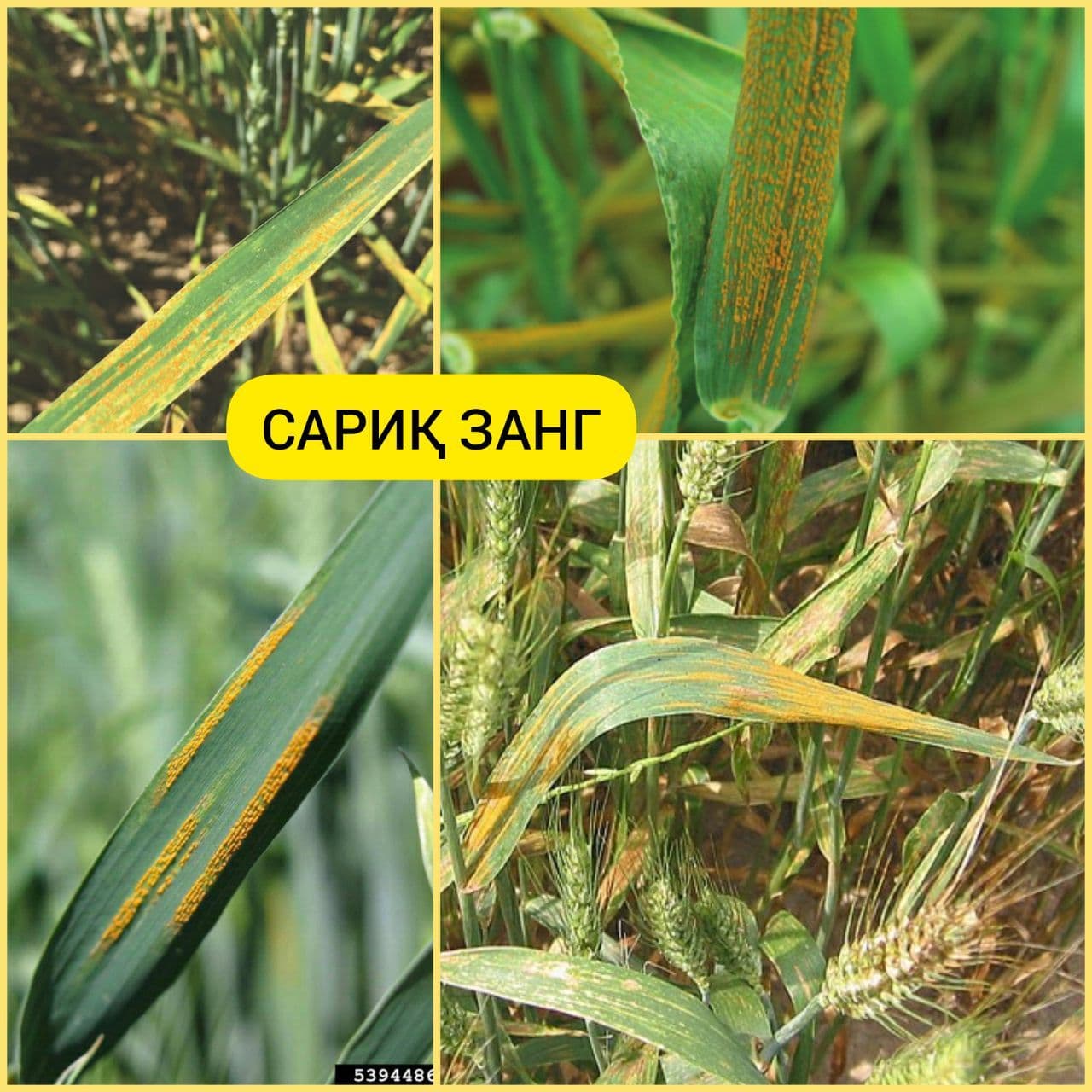
Yellow rust. If the disease occurs during the grain filling period, it destroys the crop from 5-10 to 30-35 percent. If wheat is damaged by yellow rust by 50-60% during the period of flag leaf formation (before ear formation), the grain yield is lost by 45-50%. Spores of yellow rust disease begin to develop in the plant body when the air temperature reaches 0ºС, and the most favorable temperature for its rapid growth is
12-23ºС. Symptoms of the disease first appear on the leaves of sedge weeds and sedge crops in the form of long, clearly visible yellow pads located in rows. Gradually, rust disease covers the entire surface of the leaf. Metabolism in the leaf is disrupted, nutrient formation decreases sharply, and the grain in the ear is not full.
Flour dew - the first signs of this disease appear on the leaves of grasses in the form of white powder, which later forms a cotton-like layer. When there is a lot of precipitation, the relative humidity of the air is 90-99%, and the air temperature is 15-20ºС, the disease develops and spreads very quickly. The fungal layer on the diseased leaves thickens, forming gray or yellowish-gray bumps. Depending on the degree of spread of powdery mildew, the yield can be
from 2-3% to 20-25%.
Yellow spotting. On wheat leaves, it first develops and spreads in the form of small, round, yellowish-brown, then large spots. When the relative humidity in the air is 100% and the temperature is 20-25ºС, favorable conditions are created for the rapid development and spread of fungi, causing severe damage to the crops. When the disease spreads early, the yield is reduced by 20-40%.
Control measures. Treatment with chemical preparations containing the active ingredient Propiconazole + Tebuconazole (TITUL Duo k.e. k. (200 g/l+200 g/l) 0.2 l/ha, DIKONAZOL 40% k.e. k. 0.2-0.25 l/ha, etc.), Propiconazole + cyproconazole (ALTO SUPER 33% em. k. -0.3 l/ha, SUPER KONAZOL 33% em. k. -0.3-0.35 l/ha) gives a good effect.
Plant Quarantine and Protection Department
Chortoq District Department State
Phytosanitary Inspector B.Ibragimov